Finally Overcoming Experiential Avoidance: A Different Approach
A close look at experiential avoidance, why it works in the short term and costs so much over time, and what research suggests as a more workable alternative.
| Wholeness, Resilience, Growth Mindset, Self-Authorship, Intentional Living, Meaning-Making, Anxiety & Stress | 10 min read
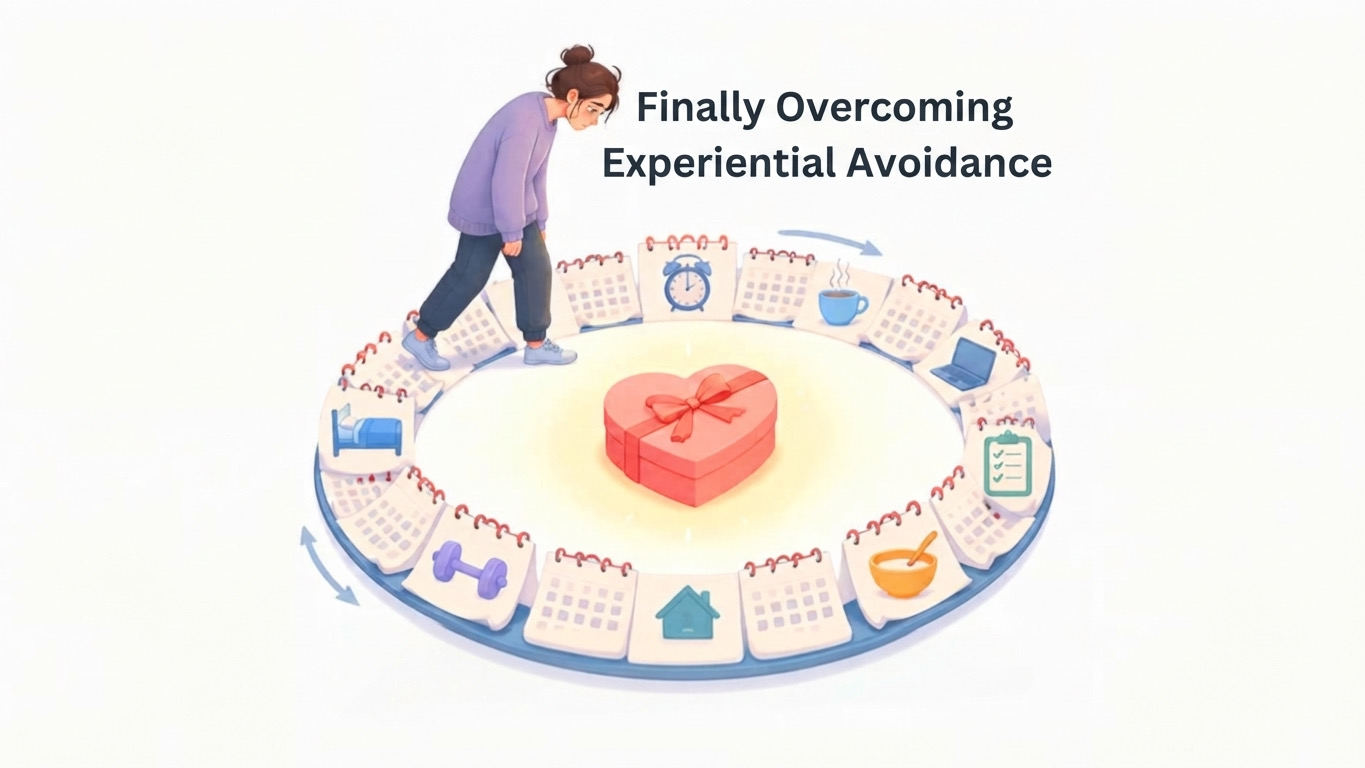
There's a particular kind of exhaustion that comes from spending years arranging your life around what you refuse to feel. You take the job that keeps you too busy to sit with the grief. You end the conversation before it reaches the part that scares you. You scroll, you plan, you clean the kitchen at midnight, anything to keep a certain feeling at arm's length. From the outside, this can look like productivity, or even like resilience. From the inside, it often feels like running a low-grade fever that never breaks, because the thing you're avoiding never actually goes anywhere. It just waits.
Psychologists have a name for this pattern: experiential avoidance. The term comes largely from the work of Steven Hayes and his colleagues in the development of Acceptance and Commitment Therapy, or ACT (Hayes, Strosahl, & Wilson, 1999), and it refers to the attempt to avoid, suppress, or alter unwanted internal experiences, thoughts, feelings, sensations, memories, even when doing so causes more harm than the experience itself would have. It's a strange kind of trade. You give up flexibility, presence, and sometimes entire relationships or opportunities, in exchange for a temporary sense of control over something that was never fully controllable to begin with.
This article isn't about willpower, and it isn't about forcing yourself to feel things you're not ready to feel. It's about understanding why avoidance works so well in the short term and so poorly in the long term, and what the research suggests as an alternative that doesn't require you to become a different person, only a more spacious one.
What experiential avoidance actually looks like
The clinical definition is useful, but it can also sound abstract until you see it in its ordinary clothing. Experiential avoidance rarely announces itself. It doesn't feel like avoidance from the inside; it feels like being reasonable, or busy, or tired, or simply not in the mood. Hayes and his colleagues have described it as functioning across nearly every domain of life: emotional, cognitive, behavioral, and even physiological.
Consider the person who over-schedules every evening of the week, not because they love every commitment, but because an empty evening means an empty mind, and an empty mind has room for thoughts they'd rather not have. Consider the person who changes the subject the moment a conversation drifts toward loss, or who has developed an almost reflexive humor that deflects anything approaching real vulnerability. Consider, too, the more visible forms: substance use, compulsive checking, restrictive eating, all of which can function, at least in part, as strategies to manage an internal experience that feels intolerable.
What unites these behaviors isn't their surface appearance, which varies enormously, but their function. Each one exists to reduce contact with an unwanted internal state. And here's the complication worth sitting with: many of these strategies aren't inherently unhealthy. Structure can be genuinely useful. Humor can be genuinely connecting. The issue isn't the behavior itself; it's the rigidity of the pattern and the narrowing of options that avoidance tends to produce over time.
Why the strategy backfires, even though it works
Here's what makes experiential avoidance so persistent: it's genuinely effective, at least in the moment. If you distract yourself from anxiety, the anxiety recedes, temporarily. If you avoid the conversation that might bring up shame, you don't feel shame, temporarily. This immediate relief is what behavioral psychologists call negative reinforcement, and it's one of the most powerful learning mechanisms we have. The brain doesn't distinguish between a strategy that solves a problem and a strategy that merely postpones it. It only registers that the discomfort went down. Consequently, the behavior gets repeated.
The trouble is what happens over a longer time horizon. Research by Chawla and Ostafin (2007) found that experiential avoidance is associated with a wide range of difficulties, including generalized anxiety, depression, and substance-related struggles. This isn't because avoidance causes these things outright, but because avoidance tends to constrict a person's behavioral repertoire. If enough of your energy goes toward not feeling something, there's less available for the actual business of living, forming relationships, tolerating uncertainty, pursuing things that matter even when they're frightening.
There's also a somewhat counterintuitive finding from the literature on thought suppression. Daniel Wegner's classic research on what's sometimes called the “white bear problem” demonstrated that actively trying not to think about something tends to increase its frequency and intensity once you stop suppressing it (Wegner, 1994). In other words, the very act of pushing an experience away can give it more staying power, not less. This doesn't mean every attempt to manage difficult feelings is doomed. It means that avoidance, specifically, tends to have this paradoxical rebound quality, which is part of why it can feel like the unwanted feeling keeps returning stronger, no matter how hard you push.
The difference between avoidance and genuine rest
It's worth pausing here, because this is where the conversation can get oversimplified into something like “never distract yourself, always feel everything immediately, ” which isn't accurate and isn't sustainable. Rest is not avoidance. Taking a walk instead of ruminating is not avoidance. Choosing not to process a difficult event at two in the morning, alone, exhausted, is often wisdom, not weakness.
The distinction worth making is between choice and compulsion. Genuine rest is available to you; you could engage with the difficult material if you decided to, but you're choosing not to right now, for reasons you could articulate. Avoidance, by contrast, tends to feel less like a choice and more like a reflex, something that happens to you rather than something you decide. If you notice a rising sense of urgency or panic at the mere prospect of sitting with a feeling, that's a different signal than simple tiredness. Similarly, avoidance tends to expand its territory over time. What starts as avoiding one conversation becomes avoiding an entire category of closeness. What starts as skipping one hard task becomes an entire identity built around staying busy.
What the research suggests instead: psychological flexibility
ACT doesn't propose the elimination of avoidance as a strategy altogether; it proposes something called psychological flexibility, which Hayes has described as the capacity to contact the present moment fully, as a conscious human being, and to change or persist in behavior when doing so serves one's values (Hayes et al., 2006). This is a considerably more sophisticated goal than “feel your feelings, ” because it accounts for the reality that some feelings arrive at inconvenient times, and some avoidance is genuinely adaptive.
The core skill isn't feeling everything immediately; it's widening your capacity to hold discomfort without organizing your entire life around escaping it. Kelly Wilson, one of ACT's co-developers, has used the metaphor of quicksand: the instinct is to struggle against it, but struggling is what causes you to sink faster. The more workable response, paradoxically, is to spread out, to stop fighting the sensation of being stuck, and let yourself float. Applied to emotional experience, this suggests that the struggle against a feeling often costs more than the feeling itself would have.
This is also where mindfulness research intersects meaningfully with the conversation. Jon Kabat-Zinn's work on mindfulness-based approaches has repeatedly demonstrated that observing a sensation without immediately trying to change it can, over time, reduce its grip (Kabat-Zinn, 1990). This isn't a quick reframe; it's a different relationship to experience altogether, one where the feeling is allowed to be present without becoming the sole organizing principle of your behavior.
A framework for practicing this differently
If any of this feels relevant to your own patterns, you might find it useful to have something concrete to work with, not as a formula that guarantees relief, but as a set of practices that researchers and clinicians have found genuinely useful for building psychological flexibility over time.
First, notice the avoidance without judging it. This sounds simple and isn't. The goal here is simply naming: “I'm changing the subject right now” or “I've scheduled myself so I don't have time to think about this.” Naming a pattern doesn't require you to stop it immediately. It only requires that you see it clearly, because you can't work with what you can't see.
Second, get curious about the function. Ask what the avoidance is protecting you from, specifically. Is it a fear of being overwhelmed? A fear of being seen as weak? A memory of a time this feeling led somewhere unbearable? The answer matters less than the act of asking, because curiosity itself creates a small amount of distance between you and the automatic reaction, and that distance is where choice becomes possible again.
Third, practice brief, deliberate contact with discomfort in low-stakes moments. This doesn't mean throwing yourself into your most painful material without support. It means, for instance, sitting with mild boredom instead of reaching for your phone, or letting a wave of sadness move through you for thirty seconds during a quiet moment instead of immediately distracting yourself. Building tolerance for small discomfort creates the capacity for larger discomfort later, the same way a person builds physical capacity gradually rather than all at once.
Fourth, anchor the practice to something you value, not to the absence of discomfort itself. ACT places significant emphasis on values clarification, because the goal isn't simply to feel more; it's to move toward a life that matters to you, even when that movement involves feeling things you'd rather not feel. If you're avoiding a difficult conversation with a parent, the relevant question isn't “how do I stop feeling anxious, ” it's “what kind of relationship do I actually want, and is avoidance moving me toward or away from that.”
Fifth, involve your body, not just your thinking. Polyvagal-informed approaches, drawing on Stephen Porges's research on the autonomic nervous system, suggest that a felt sense of safety, established through breath, grounding, or supportive relationship, often needs to precede any meaningful engagement with difficult material (Porges, 2011). If your body is in a state of high alarm, insight alone won't be sufficient. Slowing your exhale, feeling your feet on the ground, or simply being in the presence of someone who feels safe can shift your physiological state enough to make the emotional work accessible.
Sixth, expect the process to be recursive rather than linear. You will likely notice the same avoidance pattern show up again after you thought you'd worked through it, in a new context, at a new intensity. This isn't failure; it's how psychological change tends to actually happen, in layers, revisited from new angles as your capacity grows.
The role of structural and relational context
It would be incomplete, and frankly inaccurate, to suggest that experiential avoidance is purely an individual habit to be corrected through personal effort. Avoidance often develops for good reason, shaped by environments where certain feelings genuinely weren't safe to express. A child raised in a household where anger led to punishment learns, quite reasonably, to avoid contact with anger altogether. Someone navigating a workplace or community where vulnerability has historically been used against them develops avoidance as a form of protection, not dysfunction.
Additionally, broader social and economic pressures shape how much space a person has to do this kind of internal work at all. Sitting with difficult feelings takes time, safety, and a degree of stability that not everyone has equal access to. If you're working multiple jobs, navigating housing insecurity, or managing caregiving responsibilities that leave little room for stillness, the invitation to “sit with discomfort” can feel, understandably, like a privilege extended from a position you don't currently occupy. This is worth naming honestly rather than glossing over, because the goal here isn't to suggest that psychological flexibility is simply a matter of individual willingness. Context matters, and any approach that ignores this risks becoming another form of subtle blame.
What this means in practice is that the work of loosening avoidance often needs to happen incrementally, and often benefits from support, whether that's a therapist trained in ACT or a related modality, a trusted friend, or simply a community where a wider range of feeling is permitted. You're not required to do this alone, and in fact, the research on emotional processing consistently suggests that co-regulation, the felt experience of being accompanied by another calm nervous system, makes difficult material considerably more workable than facing it in isolation.
What becomes available on the other side
None of this promises a life free of avoidance; that would be both inaccurate and, frankly, an unreasonable standard for a species that evolved specifically to move away from threat. What the research does suggest, however, is that loosening the grip of experiential avoidance tends to expand the range of a person's life. Relationships that were once kept at a careful distance become available for more honesty. Work that once required exhausting levels of self-management starts to feel more sustainable. Grief that had been quietly managed for years sometimes finally moves, not because it was forced, but because room was finally made.
There's a particular kind of relief that comes not from feeling better, necessarily, but from no longer needing to organize your entire life around not feeling. That distinction matters. The goal was never simply comfort. It was room to move.
Continuing from here
If you've recognized some version of your own patterns in this, it's worth asking, gently and without urgency, what you might be protecting yourself from right now, and whether that protection is still serving the life you actually want. You don't have to answer that today. The question itself, held with curiosity rather than judgment, is often where the real movement begins.
Keep reading
- The Zeus in You: Why the Old Gods Still Describe the Mind
- Why I Am Guilty of Having No Shame
- The Unflappable You: How to Stop Letting Others Ruffle Your Feathers
- Don't Assume the Worst; Talk to Me About It First
- Possible vs. Probable: Why the Difference Shapes a Life
- Why Old Advice Suddenly Makes Sense Years After You Heard It
- Accept Belonging & Belong Acceptance
- Marcus Aurelius and Rumi: Two Paths to the Same Peace