The Outer Shell Is Not the Whole Collective: Identity Beyond the Kit
What lies beneath the self we present to the world may hold more layers than we think, each one real, each one worth meeting.
| Wholeness | 16 min read
This article is also available as a narrated, illustrated video, read word for word.
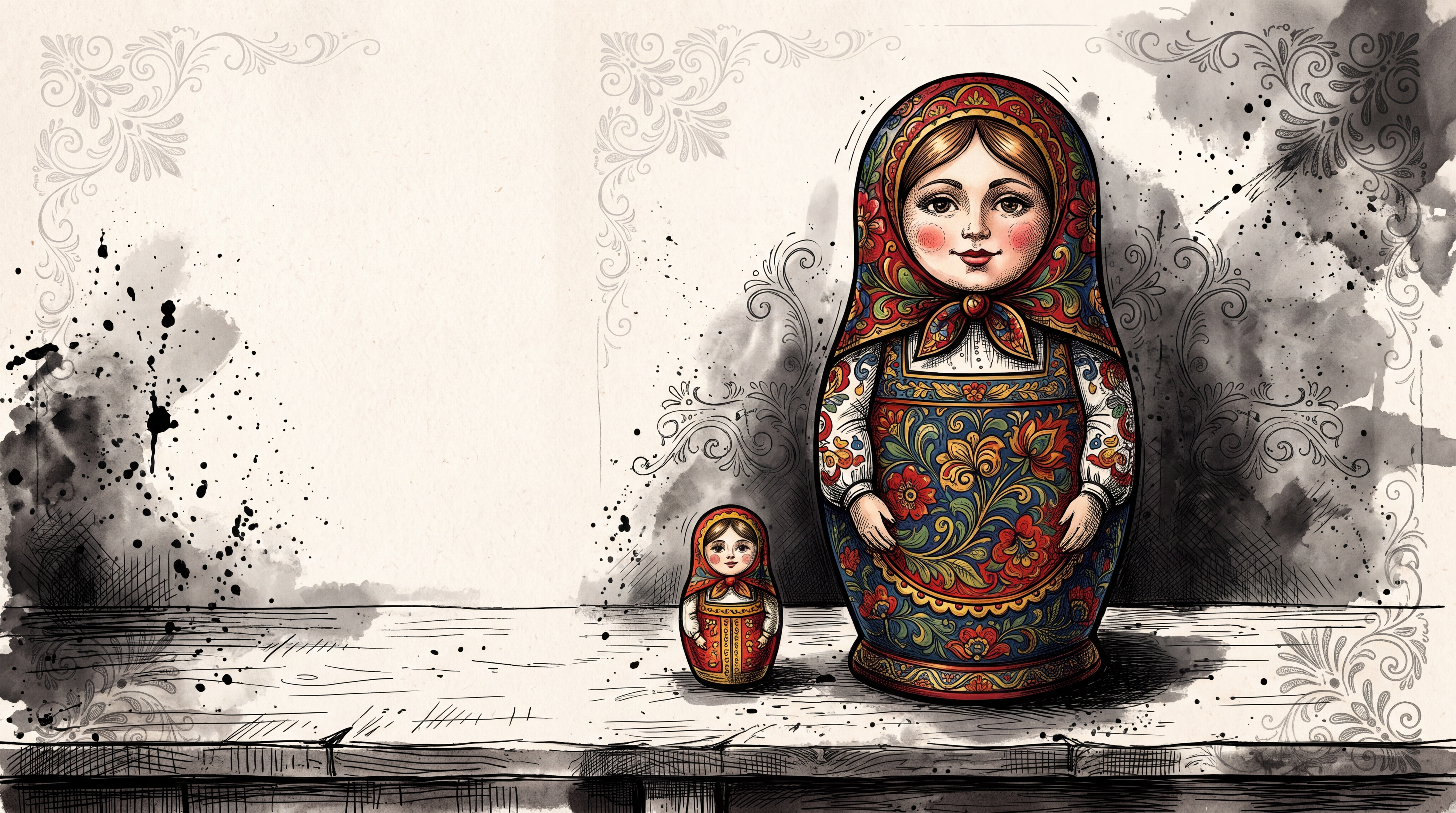
You open a box that has traveled through three closets and two moves, and inside it is a nesting doll you forgot you owned. The outer figure is scuffed, the paint gone soft at the edges, and you almost set it back down. Then your thumbs find the seam. The two halves separate with that particular small sound, and there, inside the shell you were ready to dismiss, is another figure entirely, brighter, waiting. You open that one too. And another. By the time you reach the smallest doll, solid and unopenable, you have six or seven figures lined up on the table, each one real, each one having been inside the others the entire time without disappearing.
Most of us have had some version of this experience with a person rather than a toy. A friend you thought you understood says something at a funeral, or during a layoff, or in a hospital waiting room, that reveals a depth you had no idea was there. You were not wrong about the outer figure. You were only unaware of what it contained. The same thing happens to us, from the inside, more often than we notice: we open some unplanned door in ourselves, under pressure or by accident, and find a version of our own mind we did not know was in there.
This piece looks at what happens when we forget that the first doll is only one of several. It looks at why so many of us spend years polishing a single outer figure, our job title, our role in a family, our carefully kept public self, and mistake that one visible layer for the entire collection. This is an attempt to describe the actual architecture of a self, honestly, and to ask what changes when you remember how many figures are standing inside the one you show the room.
The shell was never built to hold your whole size
A nesting doll's outer shell has one job: survive handling. It gets painted brightly, built a little thicker than the others, and designed to look complete on its own, because for most of its life, on a shelf, in a shop window, that is all anyone will see. Nobody buys the toy expecting to find out it opens. The shell's entire design logic assumes an audience that will never look past it.
Your outer self works the same way, and reason suggests this is not an accident so much as a necessity. The version of you that greets a coworker, negotiates a lease, or introduces itself at a dinner party has to be durable, quick to read, and socially legible. It cannot pause to explain your contradictions. It has to resolve, in about four seconds, into something a stranger can respond to. So it simplifies. It picks a few traits that travel well, a job, a sense of humor, a way of carrying your body, and it leads with those, because leading with the full architecture underneath would overwhelm every ordinary interaction you have.
The trouble starts when the shell stops being a useful simplification and becomes the only inventory you take of yourself. This happens gradually, almost always without a single dramatic decision. You get praised for being reliable, so you lean harder into reliability, until the parts of you that are messy or uncertain or still forming start to feel like liabilities you manage rather than material you are made of. You get hired for a role, and the role becomes the way you answer the question of who you are at parties, in therapy intake forms, in your own head at three in the morning. The shell was supposed to be the entry point. It becomes the entire address.
What makes this especially easy to miss is that the shell genuinely works, for a long time. People respond to it, reward it, remember you by it. A durable outer self is a functional tool that has simply outgrown its original job description, the way a starter apartment can still technically hold your life even after your life has become too large for it. Recognizing this is the beginning of remembering that a shell, by definition, has an inside.
The gap between what you perform and what you are
Matching your outer figure too closely to your actual size brings on its own exhaustion. People describe it as feeling flat, or hollow, or like they are watching their own life from a few feet behind their body. I think what is actually happening, in a lot of these cases, is simpler and more structural than it sounds: the visible layer has been asked to represent the whole collection, and it cannot, because it was never built to scale.
Picture someone whose entire week is organized around being the dependable one at work and the easy one at home. Colleagues bring her problems because she solves them without complaint. Her family calls her the glue. She has built a shell so functional that everyone around her has stopped wondering what else might be in there, and somewhere along the way, she stopped wondering too. Then a small thing goes wrong, a canceled flight, a minor disagreement, and she finds herself crying in a parking lot over something that objectively does not warrant it. The tears are every doll she packed away to keep the outer one presentable, finally making some noise.
This is closer to a pressure problem than a breakdown of character. Every inner figure she set aside, her anger, her grief about something unrelated, her fatigue, her wants that do not fit the dependable role, is still in there, taking up the same volume it always took, pressing against a shell that was never designed to contain that much on its own. The collection it was holding simply grew larger than any single layer was built for.
I notice this gap most clearly in the language people use when they talk about themselves under stress. "I don't even know who I am anymore" rarely means an identity has been lost. More often it means a person has been living entirely inside one doll for so long that they have forgotten the others were ever unpacked, let alone that they are still there, waiting in the dark, intact.
How the kit gets mistaken for the caboodle
The phrase "the whole kit and caboodle" is old enough that most people use it without knowing it is actually two separate ideas stitched together. The kit was your working set of tools, the specific gear suited to a specific job. The caboodle was everything else, the full collection, the whole lot, every object you owned regardless of whether it was currently useful. Somewhere in the phrase's long life, the two words fused into a single idiom for totality. But the distinction they once marked is worth recovering, because it describes exactly what happens when a person collapses their identity down to one setting.
Your kit is whatever role is currently load-bearing in your life. For a long stretch of adulthood, that might be parent, or provider, or the person holding a team together through a hard quarter. The kit is genuinely useful. It is suited to the job in front of you, the way a toolbox is suited to the repair you are doing. The mistake is deciding, somewhere along the way, that the kit is the caboodle, that the tool suited to this particular job is the sum of everything you contain.
I have watched this happen to people after retirement more than almost anywhere else, because retirement is one of the few events that forcibly removes the kit and leaves the person to discover, often with real disorientation, what else was in the box. A man who spent thirty-one years as a surgeon described the first year after retiring as the strangest of his life, because he had never had to answer the question of who he was without that answer on hand. The kit had been so effective, so socially rewarded, so constantly reinforced by every introduction and every form he filled out, that he had stopped checking whether anything else was in there. It was. It took him the better part of a year to find it again.
The caboodle, in this framework, is not a vague gesture at "your whole self" in the abstract. It is the specific, enumerable collection of inner figures that exist whether or not the current kit has any use for them: the curiosity you had before you specialized, the capacity for play you set aside when you became responsible for other people, the griefs you postponed, the convictions you have never had to defend out loud because nobody asked. None of these disappear when the kit takes over. They wait, the way the smaller dolls wait inside the larger ones, fully formed and undiminished by the fact that no one has opened them in years.
What sits inside each layer
If the nesting doll is going to do real work as a structure rather than a decoration, the layers need names, and the names need to correspond to something you can check against your own life rather than a system imposed from outside. I think of the layers as functions, each one answering a different question about how you operate, so that the same person can hold all of them without contradiction.
The outermost layer is the social function, the self calibrated for strangers and institutions. This is the layer that fills out forms, makes small talk with a dentist, and decides how much of your actual opinion to share in a meeting. It is built for distance, the way a formal greeting can be warm without being intimate.
Moving inward, the next layer is the relational function, the self that exists specifically in your closest attachments. You are a different person with your oldest friend than you are with a new acquaintance, because different relationships draw out different real material. This is the layer where your humor gets stranger, your guard drops partway, and people who only know your social layer would likely be surprised by what they found here.
Beneath that sits the working function, the self organized around competence and contribution, the version of you that shows up when a problem needs solving regardless of who is watching. This is often where people locate their entire sense of worth, which is understandable given how much of adult life is structured around work, but it is only one doll among several, however central it feels while you are inside it.
Further in is the private function, the self that exists when no one is checking on you at all: what you think about on a long drive, what you believe about your own life when there is no one to perform that belief for. And at the center, smallest and most solid, is what I would call the continuity function, the thread of preference and conviction that has stayed recognizably yours since childhood, under every other layer that has been added, swapped out, or outgrown. This is the doll that stays closed, because it does not need opening. It is the part of you that was there before the kit existed and will likely still be there after this particular kit is retired.
Why we stop unpacking once the shell gets praised
There is a mechanism from behavioral psychology that explains part of why people stop opening their own nesting dolls, even when the opportunity is right in front of them. Reinforcement makes the rewarded behavior more likely to repeat, and makes the behaviors around it recede from view without requiring a person to consciously decide anything. If your outer shell gets consistent social reward, through praise, through promotion, through being the one people call, that shell will keep getting polished, and the layers beneath it will keep getting less airtime, simply because nothing in your environment asked to see them.
This is a case where research supports something most people already sense about their own lives: B.F. Skinner's work on operant conditioning showed that behavior shaped by consistent reward becomes the default, almost automatic pathway, while unreinforced behavior tends to fade from a person's active repertoire even though the capacity for it never disappears. Applied to identity rather than lever-pressing, this means the parts of you that keep getting responded to will keep showing up, and the parts that go unacknowledged, your curiosity about something unrelated to your career, your appetite for a kind of connection your current relationships do not offer, will recede from your own sense of what you are like, without ever being erased.
This is useful to understand because it removes the moral weight from the situation. You did not fail to stay whole. You responded, reasonably, to an environment that kept asking for one doll and rarely asked for the others. A workplace wants your working function. A first date wants your social function, mostly. Even close friendships, if they settle into a comfortable rhythm, can end up only ever calling on the same two or three layers, simply because those are the ones that already work.
The practical implication is that unpacking the other dolls is not a matter of willpower so much as a matter of exposure. You open the figures that get asked for. If you want access to layers that have gone quiet, the most direct route is finding or creating situations that ask something of them: a context where your private convictions get to be spoken aloud, a relationship that draws out the version of you your current life has no room for, a solitary hour where no one is present to reinforce the usual shell at all.
The false comfort of staying closed
There is a reason people resist opening their own layers even once they suspect the layers are there, and it has less to do with denial than with a kind of practical math. An unopened doll cannot disappoint you. A life organized around the outer shell is smaller, but it is also simpler, legible to other people, and easy to defend when someone asks who you are. The moment you start unpacking, you lose some of that simplicity, and you inherit the much harder work of integrating what you find.
I think of a woman who spent a decade as the organized one in her friend group, the one who planned the trips and remembered the birthdays, and who told me once that she was afraid of what would happen if she stopped. That fear was partly about her friends leaving, but underneath it was a fear of what she would find in the layers beneath the organizing: a tiredness she had been outrunning, a resentment about always being the one who remembers, a wish to be taken care of that her outer shell had no mechanism for expressing. Staying closed protected her from having to feel any of that directly. It also meant she had not felt anything like relief, surprise, or rest, in longer than she could clearly recall.
This is the trade every closed shell makes without naming it as a trade. Safety from the discomfort of the inner layers in exchange for a kind of flatness that, over enough time, starts to feel like its own quiet cost. The acceptance-based approaches within modern therapeutic thought describe something close to this when they distinguish between experiential avoidance, keeping difficult inner material permanently out of view, and willingness, the choice to let that material be present without needing to resolve or eliminate it immediately. You do not have to fix what is inside the next layer to open it. You only have to be willing to let it exist alongside everything else you already show the world.
What tends to surprise people, once they do open a long-closed layer, is how rarely the contents are as dangerous as the avoidance implied. The grief was sized correctly for a person, not for a catastrophe. The anger had a specific, namable cause rather than being some bottomless well. The layers were never monstrous. They were only unfamiliar, and unfamiliarity, left alone long enough, starts to feel like danger even when it is not.
How the layers talk to each other
A nesting doll is a useful image partly because of what it gets right and partly because of where it needs correcting. In the toy, the layers are strictly sequential: you must open the outer one before you reach the one inside it, and each doll is sealed off from the others until the hands opening them decide otherwise. A self does not quite work this way, and the difference matters.
In an actual life, the layers are in constant, quiet conversation, whether you have consciously opened them or not. Your private convictions shape how you behave at work even on days you never consciously consult them. Your relational self occasionally slips into a meeting, in a joke that lands differently than you intended, in a moment of warmth you did not plan to show a client. The continuity function at the center, your oldest and most stable preferences, often determines which jobs you take and which relationships you stay in, long before you consciously credit it with that influence. The dolls are porous, always leaking into one another, usually without your explicit permission.
This cross-talk is the mechanism behind the discomfort people feel when a layer gets violated by another. You feel it when your working function gets pulled into a space meant for your relational function, a boss who wants to be your friend, a colleague who treats a professional disagreement as a personal betrayal. You feel it in reverse too, when your social function intrudes somewhere it has no business being, a public performance of warmth at a funeral where only the private layer should be present. The discomfort is the sensation of one doll trying to occupy a space shaped for another, and the better you understand the architecture, the more clearly you can tell which doll a given moment is asking for.
This is, I think, where the integration people describe as feeling "whole" comes from. Not from flattening every layer into one consistent surface, which would just rebuild the original mistake in a more elaborate form, but from knowing which doll belongs in which room, and trusting that the others are still there, intact, even while they are not the one currently in use. A whole person is not a person who has resolved all seven layers into a single, uncomplicated identity. A whole person is someone who knows the collection exists and has stopped mistaking any single figure in it for the entire set.
What the practice of unpacking looks like
Opening a nesting doll you have not touched in years takes attention and a willingness to stay with whatever is inside before deciding what to do about it. The same is largely true of the inner layers described here. You do not need a system to unpack them. You need to notice where your life has only ever asked for one doll, and then, carefully, create small occasions for the others to speak.
This might look like noticing the specific moments when your outer shell feels thinnest, the ten minutes before you fall asleep, a long drive with no one else in the car, the quiet after a difficult conversation, and treating those moments as information. Whatever surfaces there, a stray wish, an old grief, a conviction you have never said aloud, is a layer making itself briefly available, and the only real skill involved is staying present with it long enough to look, instead of closing the shell back over it out of habit.
It might also look like deliberately placing yourself in situations that ask for a layer your current life rarely calls on. If your working function has been doing all the talking for years, this could mean finding one relationship, one room, one solitary hour a week, where competence is not the currency and nothing needs to be produced or proven. If your private convictions have gone unspoken for so long you have lost track of their exact shape, it might mean writing them down with no audience in mind, just to hear what they sound like outside your own head.
The acceptance and commitment framework within contemporary psychology offers one useful piece of language here: the idea of acting from your values even when the momentary demands of whichever context you are in pull in another direction. Applied to this image, it suggests letting your deepest, most continuous layer, the one that does not open because it does not need to, inform how the outer layers get used, so the outer layers never get to decide, by default, what the rest of the collection is allowed to become. You do not need every layer visible at every moment. You need to remember, reliably, that they are all still yours.
None of this requires drama. Most people do not discover a hidden layer through crisis. They find it on an ordinary afternoon, doing something unrelated, when a doll they forgot they owned simply opens on its own, because the conditions happened to be right. The discipline is staying curious enough, and patient enough, to notice when it happens, instead of sealing the shell back shut out of habit before you have had a chance to see what was inside.
What stays unopened, and what that means
Not every layer gets opened in a given year, or a given decade, and I do not think that is a failure. Some dolls stay closed because the life you are currently living has no room for them yet, not because something is wrong with you for leaving them be. A parent raising young children may have almost no access to the layer that wants solitude and long, uninterrupted thought. That layer waits the way the smaller dolls wait inside the larger ones, undiminished by the years it spends unopened, ready the moment conditions change enough to let it out.
What I would ask you to leave this with is simpler than a plan for opening every layer by some deadline, because that would just be another shell, a new kit mistaken for the whole caboodle. The next time you catch yourself collapsing into a single description of who you are, at a dinner party, in a job interview, in the quiet argument you have with yourself at night about whether you are enough, you might remember the actual shape of the object you are describing. You are not one painted figure standing alone on a shelf. You are the whole set, lined up in a row, each one real, each one yours, whether or not anyone in the room has asked to see them today.
The doll at the center, the one that does not open, was there before any of the others were added, and it will likely still be there long after this year's kit has been replaced by whatever the next one turns out to be. What remains open is only the question of which layer gets to meet the next room you walk into, and whether you will remember, standing in the doorway, that it was never the only one you brought with you.
External Resources
This article belongs to the territory of Legacies of Integration, Volume 7 of the Growing Light Series, now in development.
Keep reading
- You and Everyone Else: Sovereign, Yet Never Separate
- The Zeus in You: Why the Old Gods Still Describe the Mind
- Why I Am Guilty of Having No Shame
- Accept Belonging & Belong Acceptance
- Rainbow Brite, Rainbow Dark, & The Price of Moral Absolutism
- Why Does Faith Ask for Belief Before Understanding?
- The Parts of You Sent Away: What Shadow Work Really Asks
- From Abundance to Impact: When Giving Becomes Natural