The Zeus in You: Why the Old Gods Still Describe the Mind
Psychologists from Jung to Hillman have read the Greek gods as capacities every person carries. If a Zeus or a Hestia lives in you, here's where to find them.
| Integration, Shadow Work, Wholeness, Trust In The Universe, Trust In Inner Wisdom, Metacognition, Perspective, Social Intelligence, Emotional Intelligence, Self-Authorship | 18 min read
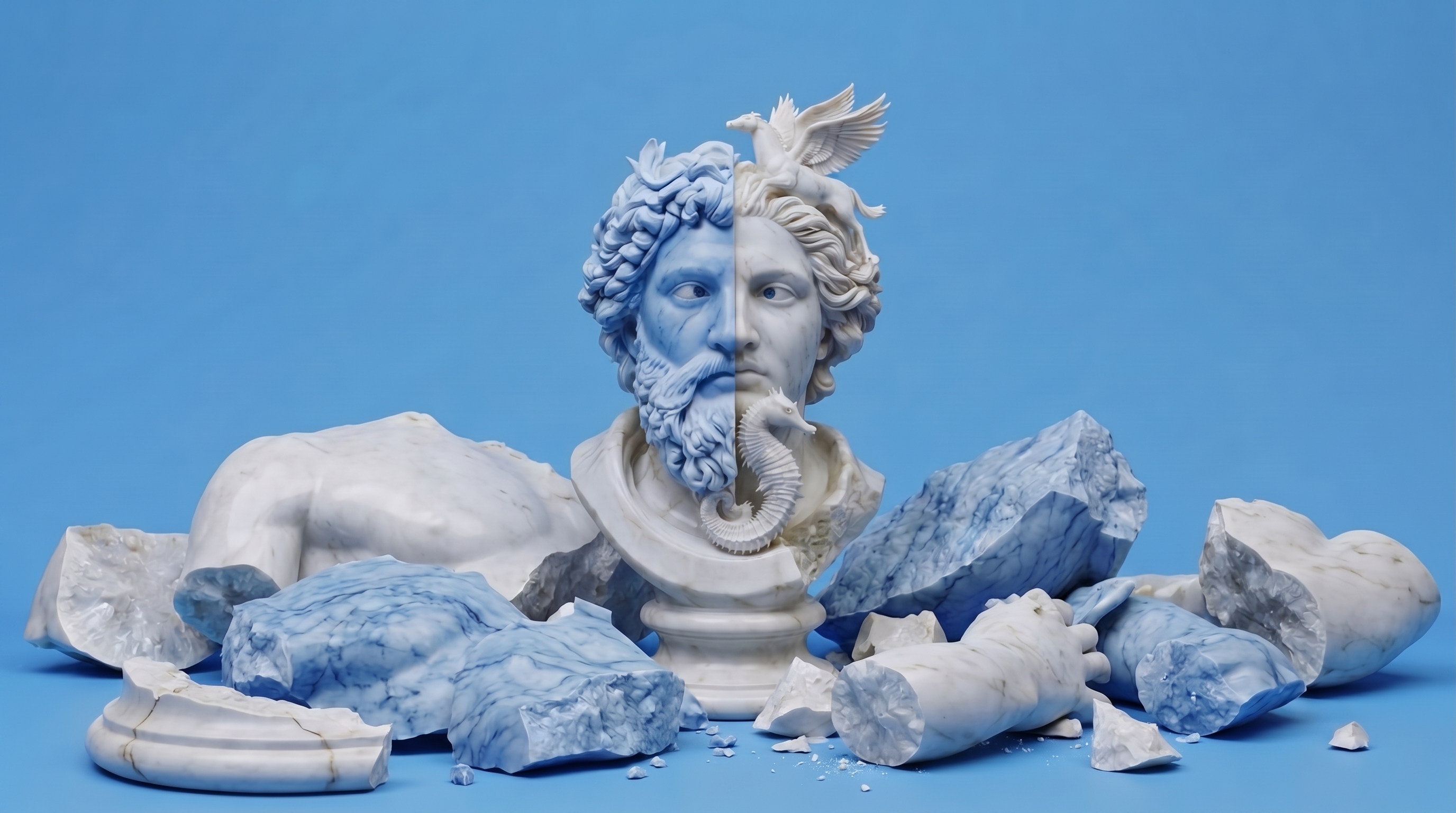
It's past midnight, and you're lying awake with the ceiling for company. One part of you is drafting tomorrow's list, sorting what matters from what can slide, already half inside a meeting that hasn't happened. Another part wants nothing except the lights off and the house gone quiet. A third drifts toward the friend you haven't called in weeks, and a fourth is simply restless, wanting music, wanting a window open, wanting something, anything, to happen.
None of them asked permission to speak. All of them sound like you.
You've probably described moments like this out loud without hearing yourself do it. Part of me wants to take the job. Part of me wants to stay home. Part of me knows better, and another part doesn't care. The phrase is so common that it passes for a figure of speech, yet it reports the experience with real accuracy: something in you wants one thing, something else in you wants another, and neither feels like an intruder. We say it a dozen times a week and almost never ask the obvious question. Who, exactly, is the part?
The ancient Greeks asked. They gave those parts names, faces, appetites, and family trees, and they called them Zeus, Hera, Poseidon, Hades, Demeter, Hestia, and their kin. For some twenty-seven centuries people have kept returning to those figures to understand themselves. Nobody is asking you to believe in a king of the sky who hurls lightning. The invitation is smaller and stranger: to consider that each of these figures describes a capacity you already carry, and that the old stories form a surprisingly exact correspondence with the structure of the inner life.
I came to this correspondence on my own. The figures of Greek myth kept matching what I saw in people, with a precision I couldn't dismiss as coincidence, and I leaned on them for a long time before learning that I was far from the first. Psychiatry had arrived at the same place, and so had family therapy, and so had depth psychology, each by its own road. I was relieved, and more than a little astonished.
The gods you already carry
Eleven figures carry most of the weight in the old stories. Read their names slowly, and notice which ones answer.
Start with Zeus, and start with what he does before the lightning: he orders things. When the cosmos is divided, he draws lots with his brothers for sky, sea, and underworld, and takes the sky, the widest view. In the stories he's also the keeper of oaths and the protector of the stranger who knocks at the door, the god who holds the whole divine household to its word and its hospitality. In a person, Zeus is the capacity that takes responsibility for the whole. It decides, sets priorities, and holds the shape of a day when everything else is coming loose. It's the voice that says someone has to, and then does. Its gift is an authority the other parts can rest beneath, and left to rule alone, it begins to treat every room as its own.
Hera sits beside the king as queen and goddess of marriage, and the capacity she holds is commitment itself. She's the part of you that stays. It treats a bond as something to keep faith with long after the first excitement has settled into ordinary Tuesdays, and it understands that love is mostly made of ordinary Tuesdays. Loyalty, belonging, and the quiet dignity of a promise honored in weeks no one will remember are her territory. Her gift is a steadiness that a family or a friendship can lean on for decades. The risk she carries is mistaking the bond for the whole of a life.
Poseidon rules the sea, and Homer calls him the earth-shaker. He's also the god of horses, a fitting companion for the sea in him: strong, quick, and moving whether or not you've chosen the direction. The capacity he holds is the feeling life, with its swells and calms and its currents that carry you somewhere before you've decided to go. Anyone who has been moved to tears by a song they hadn't thought of in years, or flattened by a mood with no traceable cause, has met him. Moods arrive the way weather fronts do, and you can't reason a front away. You can only notice it, dress for it, and let it cross. His gift is emotional depth and the ability to be moved, and when he takes over the house, a feeling grows large enough that nothing else in you can be heard.
Hades governs the underworld, the realm of everything out of sight, and he rarely leaves it. He owns a helm that makes its wearer unseen, and the Greeks also called him Plouton, the wealthy one, because seed and ore both lie beneath the surface of the earth. In a person, Hades is depth: the private interior, the part that goes quiet and inward, that holds what you haven't looked at yet and what you've set down for now. It's the capacity for solitude, for grief that keeps its own timetable, and for knowing more than you can say. The mind has a Hades because awareness has edges, and what lies past them stays dark the way anything beyond the reach of sight does. At its best this capacity gives a person the sense that there's more behind the face than the face shows. When it dominates, the withdrawal can become more than anyone else can follow.
Demeter is the goddess of grain and harvest, the one who makes things grow and the reason there's bread on the table. The capacity is nurturance: the part of you that feeds, tends, provides, and notices who hasn't eaten. Her best-known story is a mother's search for her missing daughter, during which she lets the fields go barren until the girl is found, and the old tellers understood something true in that. Care this deep can't be switched off by decision. In my experience, people with a strong Demeter give without being asked, and they also feel loss more sharply than most, because so much of themselves is invested in other lives. Her gift is a generosity that can feed a whole table. The risk is a life so given away that the giver is the last to eat.
Hestia keeps the hearth, the fire at the center of the home, and she has almost no stories of her own. Hesiod lists her first among the children of Cronus and Rhea, later writers call her the firstborn, and the Greeks invoked her first at sacrifice, which places the hearth at the very beginning of the family. The quiet is part of the correspondence: the capacity she holds works at the center of a life without announcing itself. She's the part of you that wants warmth, stillness, a lit room, and a day with no performance in it. Hestia is contentment before anyone has asked what to call it. Her gift is a peace that needs no audience, and the risk she carries is a person so devoted to quiet that the world has to knock harder to reach them.
Five more figures complete the family, and you'll likely recognize them too.
Apollo is the bright one, god of light, music, prophecy, and healing, and the oracle at his Delphi carried the injunction to know yourself. He's clarity: the part of you that sees the shape of a situation, composes order out of mess, and makes things lucid and harmonious, the way a few clear notes can organize a noisy room. At its best this capacity produces understanding that heals. Carried too far, it prefers a clean pattern to a living heart.
Artemis ranges the wilderness with her bow, protects the young of every wild creature, and answers to no one. She's independence: the part of you that needs open air, solitude without apology, and ground that belongs to you alone. People with a strong Artemis know the relief of a long walk with no destination and nobody to explain it to. Her gift is self-possession, and the hazard is a distance that hardens into habit.
In Hesiod's telling, Aphrodite rose from the foam of the sea, and the story has the right feel for what she holds: attraction arrives whole, unplanned, and entirely itself. She's desire and delight, the pull toward beauty. The capacity is longing together with the appreciation that accompanies it, the part of you that finds a face, a color, a melody, or an idea irresistible and moves toward it. It's what changes a room when one particular person enters, and what makes a song hard to stop playing. Aphrodite makes connection begin with delight, and followed without the other parts, she can steer a whole life by the next pull.
Hephaestus is the smith, thrown from Olympus and lame, who nevertheless forges the finest works the gods possess, including, in the Iliad, a shield for Achilles worked with cities, harvests, and dances. He's the craftsperson in you, the part that makes, repairs, and refines, whose attention settles into a task until the thing is right. It's the capacity that loses an afternoon at a workbench and comes out restored. His gift is patient skill. The cost, for a person ruled by him, can be a life so absorbed in the work that nobody hears from the maker.
Dionysus is the twice-born god of wine, theater, and the loosening of ordinary limits, and the Greeks called him Lysios, the one who frees. He's release: the part of you that laughs until it hurts, dances badly and doesn't care, sings in the car, and lets a crowd carry it. Greek theater itself grew out of his festivals, perhaps because people sometimes need to become someone else for an evening in order to remember who they are. His gift is a joy that dissolves self-consciousness, and left to himself, he'd make a night that never ends.
Everyone carries all eleven. In my experience, most of us have a favorite or two that run the days, a few that appear only on certain occasions, and some that have been waiting a long while to be asked.
Why a god, and why these gods
Psychology has perfectly good words for these capacities: authority, commitment, emotionality, introversion, nurturance, and so on. The words describe, and the gods do more. A trait is something you have. A god has a will, a history, and a family. Zeus wants things, falls in love, grows tired, and answers to the others in his household, which a word like leadership never does. Once a capacity has a personality, you can put questions to it. What does Hestia want from this weekend? What would Apollo notice about this plan that nobody else has? What has Artemis been asking for all month?
Reason suggests there's a deeper explanation for why this works. In Metaphors We Live By, published in 1980, George Lakoff and Mark Johnson proposed that people understand abstract ideas by mapping them onto concrete, physical experience. The inner life ranks among the most abstract things we ever try to think about, and an idea we can't picture slips through the fingers. A figure with a face stays. A god gives you something solid to hold in a territory that has nothing solid in it.
Reason also suggests why the Greek pantheon in particular has lasted. These gods are strikingly human. They're hungry, restless, tender, vain, and in love, and they're drawn with enough psychological detail that you can predict how each would feel in a situation the myths never describe. Other traditions carry their own maps of the inner life, and each deserves its own telling. This one follows the Greek map because it's the one I know best and the one most of the depth-psychology literature has walked.
A map older than psychology, rediscovered by it
The Greeks were doing something close to psychology. Homer and Hesiod gave these figures their stories roughly twenty-seven centuries ago, and later writers, the tragedians especially, kept returning to them to explore why people feel and choose as they do. When modern psychology began, it spent a long while looking elsewhere. Then, in a series of unconnected places, it started finding the same architecture.
Carl Jung noticed early in the twentieth century that the psyche seems to contain figures that behave like autonomous personalities. His work on complexes held that these clusters of feeling and memory belong to the normal structure of the mind, with a wholeness and relative autonomy of their own, so that, as he put it, we have complexes and they can have us, and he described archetypes, the deep patterns behind them, in language that reached for the divine, writing of their power as something people have always met as godlike. The Jungian vision usually pointed toward a central integrating Self, a single center that holds the many together.
James Hillman, working within the Jungian tradition, pressed the multiplicity much further. Beginning in the early 1970s, he and his colleagues developed what became known as archetypal psychology, and in 1975 he published Re-Visioning Psychology, a book nominated for the Pulitzer Prize. It makes the case for a polytheistic psychology: the psyche as a plurality of centers, each with its own perspective, none entitled to rule the rest. In his reading, the ego is one voice among many, and the Greek gods are the old vocabulary for the others. He was careful to say that he used the gods as reminders and images, with no claim that they literally exist, and he resisted turning the pantheon into a fixed template for measuring people. His school has its critics, including inside the Jungian world, where William Shelburne's 1984 critique of his approach to dreams in the Journal of Analytical Psychology is one example, yet it stands as one of three major schools of post-Jungian thought in the scheme Andrew Samuels laid out.
A decade later the idea reached a wide audience through Jean Shinoda Bolen, whose Goddesses in Everywoman (1984) and Gods in Everyman (1989) held that the whole Greek pantheon lives in every person. She later said a truer title for the pair would have been Gods and Goddesses in Everyone, since the qualities cross every line we draw between people.
Meanwhile clinicians, working without the gods, kept finding the same structure in their offices. The Italian psychiatrist Roberto Assagioli coined the term subpersonalities and traced the roots of the idea to a talk he gave in Bologna in 1911. He held that coordinating the various subpersonalities into a higher unity is possible, and that cooperation between them can mature into an organic synthesis. In the 1980s, the family therapist Richard Schwartz heard clients describe inner parts that interacted the way members of a family do, and he built Internal Family Systems on a principle he states plainly: there are no bad parts, because each one is trying to protect you in the way it knows how. In 1992, the Dutch psychologist Hubert Hermans, with Harry Kempen and Rens van Loon, published the first psychological paper on the dialogical self, picturing the self as a society of I-positions that can speak with one another, an idea drawn from William James and the literary theorist Mikhail Bakhtin.
The traditions don't fully agree on whether this community has a center. Jung pointed toward a Self that gathers the many, and Schwartz describes a calm, curious Self that can lead the parts. Hillman resisted any ruler, and Hermans pictures a society in which no voice holds permanent authority. I suspect the honest answer shifts with the day. Some days a steadier center is plainly visible, and some days the community is simply a community. In the elemental language I use elsewhere, that center would be Quintessence, the point where the capacities meet and integrate, and I hold it as something you grow toward and rarely possess outright.
None of these thinkers proved that Zeus and Hestia are the correct names. What they share is the architecture: a person is a community of capacities, each with its own perspective and its own good intentions. The Greeks supplied the names. Psychology, arriving from several directions at once, supplied the confirmation that the structure is real.
What makes a correspondence isomorphic
Mathematicians and systems thinkers use the word isomorphic for a mapping between two systems that preserves structure: every element in one corresponds to exactly one element in the other, and the relationships among the elements carry across intact. It's the standard I try to hold in my own writing, where I call the larger practice Metaphorical Metaphysics, and it asks more than it first appears to. Resemblance is easy to find. A correspondence has to survive questions.
Hestia shows what passing looks like. She's the goddess of the fire at the center of the home, and she has almost no stories of her own. A capacity for warmth and stillness at the center of a life behaves the same way: it does its work without drama, so it seldom gets noticed until it's missing. The structure matches down to the quietness. Hephaestus passes as well. A smith who was cast out and lame yet forged the finest works on Olympus mirrors a capacity for patient craft that, as far as I can tell, often grows in people who spend long stretches working outside the spotlight.
The relationships between gods can pass the test too, and those may be the most convincing evidence of all. Plutarch reports that at Delphi, the shrine of Apollo, the paean was laid to rest at the beginning of winter and Dionysus was invoked in its place for three months, and he adds that Dionysus has no less to do with Delphi than Apollo himself. The god of clarity yielded a season to the god of release. It's a pairing that fits what many people discover about their own lives: clarity does its best work when it has also had a season of release, and release needs the clarity it occasionally leaves behind.
A pairing fails the moment the god's own story contradicts the capacity. Assign Hades to boundless extroversion, or Dionysus to cautious restraint, and the stories push back at once. A name that sounds right and can't survive its own myth is decoration, and decoration teaches nothing. The same standard explains why Apollo and Hades sit so naturally at the two poles of the elemental framework I use elsewhere: Apollo with Light, which stands for conscious awareness, and Hades with Darkness, which stands for everything beyond its reach. The mapping holds because the structure of each god matches the thing it's set beside.
When one voice takes the whole house
Every capacity has its season, and trouble begins when one stays too long. A person under a long deadline can live for weeks as pure Zeus, deciding and ordering and carrying everything, until the Hestia in them has gone so long without a lit room that she has nearly stopped asking for one. Someone after a loss may spend a winter almost entirely in Hades, and the depth in that is real and has its own work to do. The correspondence passes no judgment on either. It asks which voice hasn't been heard lately.
Naming changes the experience. When you can say that Poseidon is in the house, the flood has weather and duration, and a thing with edges can be waited out, walked around, or met with company. Most of us have lived through a mood so total that it felt like the final truth about our lives. The old stories offer a gentler reading: a god visited, and visitors leave.
Some visits last longer than weather. If a single voice has held the whole house for months and nothing shifts, that's a good reason to bring in someone trained to listen. This map is a way of noticing, and it comes from reading and reflection. An article can offer company and can't offer care, and a good therapist is a worthwhile companion for the harder weather.
Growth runs in both directions
A great deal of inner-work advice points toward the parts of ourselves we find difficult: the habits to unlearn, the reactions to understand, the old hurts to attend. That work matters, and the correspondence holds it. It also holds a second kind of work that gets far less attention, which is the deliberate development of capacities you already admire.
Think of the capacity you've shelved. Perhaps it's Dionysus, who sang loudly in the car at nineteen and hasn't since, though he's waiting in the same ribs and the same lungs for a reason to come out. Perhaps it's Artemis, whose open-air afternoons were traded away one calendar invitation at a time. Maybe your Apollo has been waiting years for the quiet in which to see clearly, or your Hephaestus for a project worth finishing, or your Aphrodite for permission to be moved by something beautiful without a reason. None of these figures is a flaw awaiting correction. Each is a capacity that grows with use, and each grows the way a skill grows: by being asked, practiced, and given a little room.
The thinkers above point the same direction. Assagioli's aim was to bring the subpersonalities into a higher unity. Schwartz's principle that no part is bad turns attention toward what each part has to offer. Abraham Maslow, in Motivation and Personality (1954), described self-actualization as the unfolding of potentials already present in a person, a development from within of what is already there.
If every god is a capacity, growth has two faces: relating more wisely to the ones that cause you trouble, and giving fuller expression to the ones that make you more alive. In my experience the second tends to be neglected. I suspect, and it's only a suspicion, that it may also be the more motivating of the two, because a person looking toward what they could become tends to keep going longer than a person only trying to repair what hurts. The question shifts from what's wrong with me to who in me hasn't been invited, and that second question carries a kind of warmth the first one rarely does.
Using the correspondence on an ordinary day
Imagine a job offer arrives. Before you've named anything, the response is a single undifferentiated unease, a mix of excitement and dread that's hard to read. Once you can name who's speaking, the same decision sounds different. Zeus wants the title and the authority that comes with it. Hestia wants work that leaves enough of you at the end of the day to come home to. Hephaestus is asking whether the work is worth making well. Artemis wants to know how much of your time would still be yours. Demeter is counting everyone who depends on your paycheck. Aphrodite wants to know whether anything about it makes your pulse quicken. Each concern now has a voice and a reasonable claim, and the decision can account for all of them.
Rest works the same way. Most of us believe we know what rest is, then discover that different parts want different things from it. Dionysus rests at a concert or a party. Hestia rests in a lit kitchen with nothing planned. Artemis rests miles from other people, and Hades rests in silence behind a closed door. A weekend built entirely to satisfy one of them can leave the others restless, which may be why a perfectly good vacation sometimes leaves a person unsatisfied in a way they can't explain.
Even grief looks different through this lens, though it's ground to approach gently. Demeter's grief belongs to the one who tended and can no longer. Hades's is the silent kind that goes underground, Poseidon's arrives in waves, and Hestia's asks only for a warm room and someone sitting nearby. Noticing which one is speaking sometimes tells you what kind of company you need.
You might also try an evening roll call. Set aside ten minutes, with a notebook or without one, and read the eleven names slowly. With each, ask a single question: did this one speak today, and did I let it? Some answers will be immediate. Hephaestus may have spent an hour untangling a spreadsheet and come away quietly pleased. Hestia may not have been consulted since Thursday. You may notice that Zeus ran the entire day, and that Dionysus hasn't been heard in a month. Nothing needs scoring or fixing. The aim is acquaintance, and some evenings it leaves you with one name that stays. You might let that name follow you into tomorrow.
The next time you hear yourself say part of me, try finishing the sentence with a name. Notice what changes. Then consider who hasn't spoken yet, and what that quieter one would say if someone asked.
What's still waiting
Back in that dark bedroom after midnight, the voices haven't gone anywhere. The planner is still sorting tomorrow, and the part that wants quiet is still asking for it. With a map in hand, though, the room holds a household of capacities, each with a reasonable claim, and somewhere near the center of it a fire still burns that none of them put out. What remains open, in the old stories and in the psychology that rediscovered them, is how many more of these figures live in you than you've met so far, and which one has been waiting longest for you to ask its name.
Keep reading
- Why I Am Guilty of Having No Shame
- The Unflappable You: How to Stop Letting Others Ruffle Your Feathers
- Don't Assume the Worst; Talk to Me About It First
- Possible vs. Probable: Why the Difference Shapes a Life
- Why Old Advice Suddenly Makes Sense Years After You Heard It
- Accept Belonging & Belong Acceptance
- Marcus Aurelius and Rumi: Two Paths to the Same Peace
- When Someone Won't Consider You: What to Do Next