Rainbow Brite, Rainbow Dark, & The Price of Moral Absolutism
A look at moral absolutism through an invented counterpart to Rainbow Brite, and what gets coerced in the name of universal good. Read and decide for yourself.
| Spiritual Autonomy, Purpose, Self-Actualization, Self-awareness, Cognitive Reframing, Identity, Self-Authorship, Authenticity, Sustainable Inner Peace, Meaning-Making, Wisdom, Perspective, Conflict Resolution, Consideration, Social Intelligence, Connection, Self-Transcendence, Interconnection | 12 min read
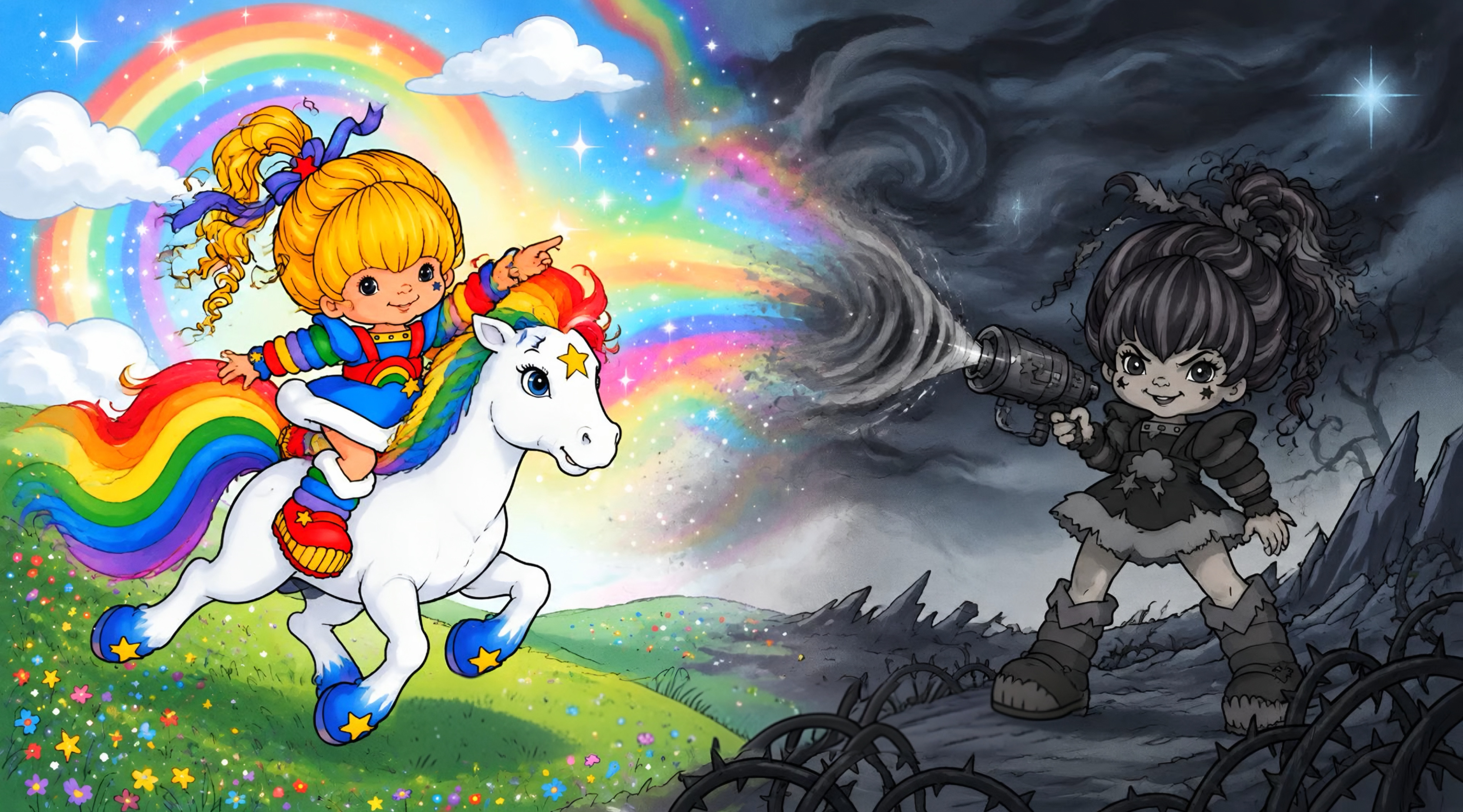
You remember the shape of the story even if you have not thought about it in decades. A girl with primary-colored hair and a horse named Starlite rides out to defeat a figure called Murky, who wants to drain the color from the world and leave everything the same flat gray. Rainbow Brite wins, as she always wins, and the Kingdom of Rainbow Land is restored to its proper palette. You were meant to feel relief at that ending. Most of us did. But if you sit with the shape of the story now, as an adult who has lived through a few seasons of being told what color your life was supposed to be, a different feeling can surface alongside the relief. Something about the completeness of that victory, the total absence of gray left standing anywhere in the kingdom, starts to feel like a warning you were too young to read correctly.
This piece is going to take that children's story seriously enough to misuse it on purpose. I want to invent a counterpart to Rainbow Brite, someone I will call Rainbow Dark, as a dialectical opposite, a figure who exists to ask the questions Rainbow Brite's world has no room for. This essay is about moral absolutism, about what gets lost when a worldview insists that goodness must be total, uncontested, and administered from above by whoever happens to be holding the light. Rainbow Brite is simply the clearest, gentlest-looking version of that worldview I can think of, which is exactly why she is useful here.
What this essay will and will not claim
I am not arguing that kindness is suspicious or that children's shows are secretly sinister. I am arguing something narrower and, I think, more honest: that even benevolent authority carries a cost, and that a world engineered toward total harmony has to do something with whoever refuses to harmonize. This essay will ask what happens to the people, real or imagined, who stand outside whatever version of goodness is currently in charge.
The kingdom that cannot tolerate its own shadow
Picture Rainbow Land as an actual place you might visit, a functioning society with rules, with a ruler, and with an enemy defined entirely by negation. Murky wants gray, which is to say he wants the absence of whatever Rainbow Brite represents. The story needs him to be that empty, because if he wanted something specific and understandable, the conflict would get complicated fast. A villain who wants a particular resource, a particular freedom, a particular form of recognition, is a villain you might have to negotiate with. A villain who wants pure negation is a villain you can simply defeat, and then the story is over.
Now put Rainbow Dark into that same kingdom and ask what she actually wants. Suppose she wants variation that Rainbow Brite's system cannot accommodate: a shade that does not map onto the seven colors already sanctioned by the Color Belt, a mood that is neither bright nor murky but something quieter, something closer to dusk. In my experience, this is what most real dissent actually looks like. It rarely wants the total absence of good. It wants a good that was not on the original list, and it discovers, often too late, that there was never a mechanism in the kingdom for adding to that list. There was only a mechanism for defending it.
This is the first cost of universal harmony that rarely gets named. A system built to produce total goodness needs a stable, closed definition of what goodness is, because an open definition would make total achievement impossible to declare. You cannot throw a victory parade for a goal that keeps revising itself. So the kingdom locks the definition in place, usually around the founding moment, the original rainbow, the first version of the dream. Anyone who shows up afterward wanting a shade that was not in that founding vision is treated as a symptom of the very gray the kingdom was built to prevent. Rainbow Dark does not have to do anything wrong to become a threat. She only has to exist after the definition closed.
The administered good and who gets to administer it
Rainbow Brite does not rule Rainbow Land through force in any way the story would admit to. She rules through what the story frames as earned trust, a kind of moral authority that comes from having the color belt, the sprites, the horse, and the track record. But authority that presents itself as purely benevolent is often the hardest kind to question, precisely because questioning it looks like questioning goodness itself. If Rainbow Dark raises an objection to how color gets distributed in the kingdom, who decides which regions get the Blue sprite's attention first, whose village gets restored before whose, she is received as proof that darkness has returned, which conveniently ends the conversation before it starts.
I think this is the actual coercion hidden inside benevolent authority, and it rarely looks like coercion from the inside. The person holding the light genuinely believes they are distributing good, and they are not lying when they say they want harmony for everyone. The apparatus of total goodness needs an enforcement arm whether or not anyone intends cruelty, and that enforcement arm has to have a category for people who will not be harmonized. In Rainbow Land that category is Murky and his sidekick Lurky, comic enough to defuse the discomfort of what they represent. In a family, a workplace, a church, or a friend group organized the same way, that category has a name too, usually something softer, like difficult, or negative, or not a team player.
Consider an ordinary version of this away from any kingdom at all. A family prides itself on being close, warm, the kind of household that shows up for each other without being asked. One adult child starts needing more distance than the family's model of closeness allows, out of something closer to self-preservation than rejection. The family does not experience this as a reasonable boundary. They experience it as a mysterious darkening of someone who used to be bright, used to be easy, used to be, in the family's own language, like sunshine. The administered good of family closeness had no category for a member who needed something the model had not anticipated, so the model reclassified the person instead of revising itself.
Harmony as a style, not a guarantee of peace
It is worth separating two things that Rainbow Brite's world collapses into one: harmony as an aesthetic, a look, a feeling of everything matching, and harmony as an actual absence of conflict between genuinely different interests. The kingdom achieves the first constantly. Every episode ends with the right colors back in the right places, visually resolved, the palette restored. But the second kind of harmony, the kind where different wants get negotiated into something workable, never really gets tested, because the story never allows a want that falls outside Rainbow Brite's own framework to be legitimate in the first place.
This distinction matters more than it sounds like it should, because a lot of real human communities make the same substitution without noticing. A workplace adopts language about collaboration and positivity, and within a few months the aesthetic of harmony becomes mandatory even where actual disagreement would be more honest and more useful. Meetings end with everyone nodding. The dissenting opinion gets filed as a tone problem rather than a content problem. Reason suggests that a group which cannot tolerate the look of friction will eventually lose the ability to do the quieter, more necessary work that friction makes possible, which is testing an idea against a real counter-argument instead of against a vague feeling that things should stay pleasant.
Rainbow Dark, in my imagined version of her, is not trying to destroy the kingdom’s aesthetic. She might even like a great deal of it. What she wants is for the aesthetic to stop standing in for the harder, slower work of actual negotiation. She wants a Rainbow Land where a color that does not fit the existing belt can still be argued for on its merits rather than immediately treated as proof of the enemy's return. That request alone, reasonable as it sounds, is enough to get her cast as Murky's sympathizer, because in a world organized around harmony as style, any request for renegotiation reads as an attack on the picture itself.
The sprite who never gets to say no
A quieter figure in this imagined kingdom deserves attention: one of the color sprites, the loyal attendants who exist to serve the mission without ever being its author. Picture the Yellow sprite, cheerful by design, whose entire narrative function is enthusiastic compliance. The story never asks what the Yellow sprite would want if given a choice, because the story has no room for a sprite who says, today I would rather not, or I think the belt should include a color you have not considered. Compliance is simply the sprite's nature, built in rather than chosen.
Moral absolutism does some of its quietest damage at the level of everyone positioned as help, rather than at the level of open conflict between Rainbow Brite and her shadow. A kingdom run for universal good tends to produce a great many sprites, people whose job is to support the mission so thoroughly that their own preferences never get asked for, let alone granted. In an actual life, this shows up as the family member who becomes the designated peacemaker, the employee who becomes the designated good sport, the friend who becomes the designated person who is fine with anything. They were simply never given the chance to want something different out loud, because the system around them had already decided what everyone's role in the harmony was supposed to be.
Rainbow Dark, if she has any use at all, might be most useful as the figure who looks at the Yellow sprite and asks an honest question: what would you choose if choosing were available to you. Answering that question only requires admitting that a sprite's cheerful compliance is different from a sprite's consent, and that a system built on universal good has a harder time making that distinction than it likes to admit.
What Murky's defeat costs
Every version of this story ends the same way. Murky's scheme fails, the color returns, and the kingdom spends no screen time on what happens to Murky afterward, simply banishing him again, pushing him back to the edges of the map, available to return next season as the same flattened threat. The story has no interest in whether Murky might have had a legitimate grievance, whether the gray he kept trying to spread had any real complaint buried inside it about a kingdom that never made room for him in the first place. His defeat is total, and because it is total, it is also incurious.
I think this incuriousness is the actual price of universal harmony, more than any specific cruelty. A worldview committed to total goodness cannot really ask what its opponents want, because asking would mean conceding that there might be a legitimate want on the other side, and a legitimate want on the other side would complicate the moral math the whole kingdom runs on. So the opponent has to stay simple. Murky has to keep wanting nothing but gray, forever, so that defeating him keeps feeling clean. The moment he is allowed a real motive, the kingdom would have to reckon with the possibility that its own goodness came at someone's expense.
Extend this past the cartoon and the pattern gets easier to spot in places that matter more. Institutions built around a single, confidently administered vision of the good, a certain kind of church, a certain kind of political movement, a certain kind of wellness culture, tend to produce their own Murkys: people cast as simply opposed to the good, simply broken, simply dark, rather than people who might be pointing at a real gap in the vision. Once someone is cast that way, the institution never has to answer their actual objection. It only has to defeat them, repeatedly, season after season, and call the repetition stability.
Where Rainbow Dark would live if she existed
Suppose, for a moment, that Rainbow Dark is simply allowed to exist inside the kingdom as an ordinary resident with an unusual palette, neither banished nor triumphant. What would that kingdom need to look like for her presence to stop reading as a threat. It would need a color belt that could be revised without the revision counting as defeat. It would need a ruler willing to treat a new shade as information rather than as insurance that the old gray is creeping back. Mostly, it would need the kingdom to separate two things it currently treats as identical: the stability of its values and the fixedness of its list.
This is not a small ask, and I do not think it is naive to notice how rarely real institutions manage it. A community can hold onto honesty, generosity, and care as stable values while still being willing to revise what those values look like in practice as new people and new circumstances show up. The difficulty is that revision feels, from inside the system, indistinguishable from erosion, at least at first. Rainbow Dark's arrival would feel, to a kingdom that has never had to do this work, exactly like the early signs of Murky's gray. The kingdom's task would not be to welcome her uncritically. It would be to develop enough internal steadiness to tell the difference between a threat to its values and a challenge to its list, which are not the same thing even though they often arrive wearing the same unfamiliar colors.
Living with your own Rainbow Dark
You do not need an imaginary kingdom to feel the pull of this. Most of us carry some version of Rainbow Brite inside, a part that wants our own life to resolve into a settled, recognizable palette: the good partner, the good parent, the good employee, the person whose values are visibly, consistently bright. Most of us also carry some version of Rainbow Dark, the part that wants a shade the internal color belt did not anticipate, a want that does not match the self-concept we have spent years defending. The instinct, when that part shows up, is to treat it the way the kingdom treats Murky: banish it, pathologize it, call it a bad mood or a bad week instead of information.
A more workable approach, the kind that shows up across a lot of practical psychological work without needing to be branded as any one method, is to treat the unwanted want as data instead of as an enemy to be defeated. If part of you wants something that does not fit your settled self-image, the useful question is what this shade is pointing toward, and whether your own internal color belt needs revising to make room for it. This is slower and far less satisfying than a clean cartoon ending. It does not produce a parade. But it tends to produce a self that can tolerate its own complexity instead of one that has to keep exiling parts of itself to the edges of the map, season after season, in order to keep feeling whole.
The same applies outward, toward the people in your life who function as your Rainbow Dark, the ones whose objections to your version of good feel, at first pass, indistinguishable from an attack on goodness itself. A partner who questions the shape your relationship has settled into is not automatically trying to drain the color from it. A friend who steps back from the role you had assigned them is not automatically becoming distant or difficult. Reasoning this through carefully, instead of reaching for the nearest available villain story, is slower and less comforting than the kingdom's method, but it is the only version of harmony that was ever going to hold up under real pressure.
What stays unresolved
I do not think there is a clean answer to how much total goodness a person or a community can tolerate before it starts needing a Murky to banish and a Rainbow Dark to misread. Maybe every system that commits to a vision of the good eventually needs an edge, a shadow, a figure it can point to as evidence that the center is holding. The honest question is not whether your own life or your own community has one of these figures. It almost certainly does. The honest question is whether you are willing to look at your particular Rainbow Dark closely enough to ask what she wants, instead of settling for the comfort of already knowing.
External Resources
Keep reading
- The Zeus in You: Why the Old Gods Still Describe the Mind
- Why I Am Guilty of Having No Shame
- The Unflappable You: How to Stop Letting Others Ruffle Your Feathers
- Don't Assume the Worst; Talk to Me About It First
- Possible vs. Probable: Why the Difference Shapes a Life
- Why Old Advice Suddenly Makes Sense Years After You Heard It
- Accept Belonging & Belong Acceptance
- Marcus Aurelius and Rumi: Two Paths to the Same Peace