Love Me, Love Everyone: A Forest Meeting In Wholeness
A close reading of a forest encounter between two men, one demanding personal love, one offering universal love, and what it reveals about wholeness.
| Wholeness, Need, Motivation, Passion, Purpose, Self-Actualization, Beginner's Mind, Ignition, Self-awareness, Integration, Self-Transcendence, Interconnection, Spiritual Autonomy, Prospection, Legacy | 10 min read
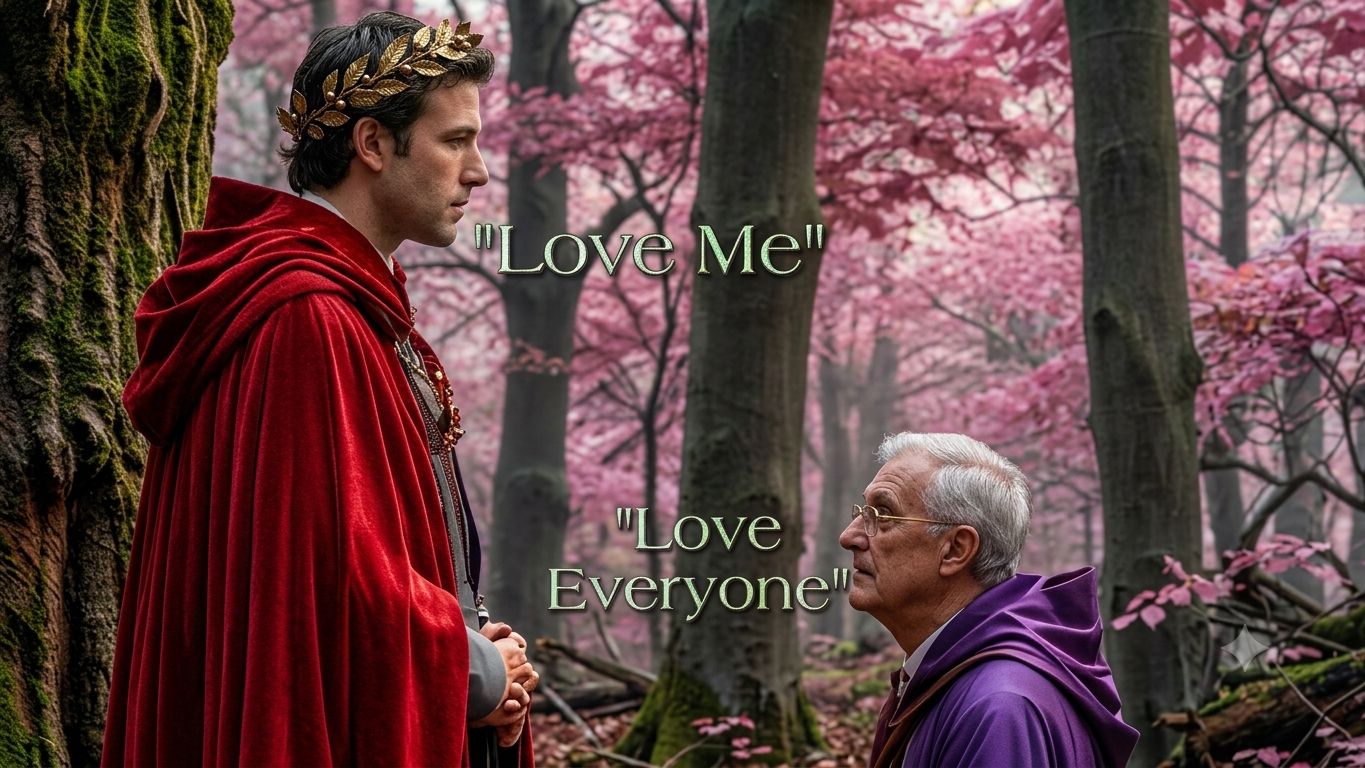
Picture a forest old enough that its oldest trees were seedlings before the concept of your family name existed. Their root systems have moved through centuries the way you move through a Tuesday: unremarkably, persistently, without asking permission from time. Somewhere at the exact center of this forest, where the canopy closes so completely that daylight arrives only as rumor, two men meet. One has just arrived, breathless, dressed head to toe in red, shoes and all, as though he ran the entire way there and wanted everyone, including the trees, to notice. The other has been kneeling in that dim clearing for what may be decades, robed in violet, unhurried, present long before the arrival that is about to interrupt his stillness.
The young man in red speaks first. Two words, delivered loudly, almost like a demand: “Love me.” The elder in violet, still on his knees, finally lifts his face and answers with two words of his own: “Love everyone.” No introductions. No context. And yet something in that exchange lands with a precision that feels less like fiction and more like memory, as if you've heard this conversation before, maybe even had it with yourself in the middle of a sleepless night. This article is an attempt to sit with that image honestly: not to decode it like a puzzle with one correct answer, but to examine why each man said exactly what he needed to say, and why each heard exactly what he needed to hear.
Why the forest matters before the men do
Before either man speaks, the setting is already doing conceptual work. A forest whose trees exceed any single human lifespan is a forest that holds continuity you cannot personally verify. You didn't witness the sapling. You won't witness the eventual fall. Consequently, standing inside that kind of grove produces a specific psychological effect that environmental psychologists have studied under the heading of “awe, ” particularly the subcategory Keltner and Haidt (2003) describe as encounters with vastness that require you to update your existing mental models. Ancient forests are one of the most reliable triggers for this state, not because they are beautiful, though they often are, but because they are old in a way that dwarfs personal timescales.
This matters here because the conversation between the two men isn't happening in a living room or an office. It's happening inside a structure of time that neither man built and neither man will outlast. The forest, in other words, is the only character in this scene indifferent to the urgency of the man in red and the patience of the man in violet alike. It has already absorbed a thousand versions of this exact meeting and will absorb a thousand more. That indifference isn't cruelty. It's scale. And scale is precisely what both men, in their very different ways, have lost access to.
The man in red and the grammar of urgency
He arrives first, and he arrives loud. His clothing, red down to the shoes, isn't incidental. Color psychology research, including work by Elliot and Maier (2014) on the influence of red in achievement and dominance contexts, has repeatedly found associations between red and heightened arousal, urgency, and a kind of demand for attention. He is dressed for visibility because he needs to be seen. His shoes, described as though they arrived before he did, suggest a person who has been running toward something for so long that the running itself has become identity. He hasn't walked into this clearing. He has sprinted into it, propelled by impatience rather than understanding.
And what does he say once he finally stands still? Not “I love you, ” which would be an offering. Not “Do you love me, ” which would be a question holding space for an honest answer, including a difficult one. He says, simply and loudly, “Love me.” It is an imperative. A command aimed outward at another person to solve something that clearly lives inward. This is worth sitting with rather than rushing past, because it names something genuinely common: the experience of wanting love to arrive as a verdict delivered by someone else, rather than as a capacity you develop within yourself.
Psychologists who study attachment, beginning with Bowlby's foundational work and extended significantly by researchers like Mikulincer and Shaver (2007), have documented how early relational experiences shape what they call an internal working model, essentially a template for what you expect love to feel like and how you go about pursuing it. Someone whose early template involved inconsistency or conditional affection may grow into an adult who experiences love primarily as scarcity, something that must be demanded, chased, or won rather than something that can simply be present. The man in red isn't villainous. He's exhausted. His entire posture, from the color of his clothing to the volume of his voice to the two words he chooses, tells the story of someone who has spent considerable energy trying to make love arrive on command because he has never quite trusted that it would arrive otherwise.
There's also something worth noticing in the fact that he speaks first and speaks loudly. Urgency often masquerades as strength, when it frequently signals the opposite: a person moving fast because sitting still has become intolerable. If this feels familiar, you're not alone in it. Many people have moved through periods of their life at a near-constant sprint, mistaking velocity for vitality, when the sprinting was actually a way of outrunning a question they weren't ready to answer.
The man in violet and the discipline of stillness
He was already there. He was already kneeling. And rather than rising to meet the younger man's urgency, he stays low, meeting the demand from a position of humility rather than authority. Violet, historically associated with both mourning and wisdom across a range of cultural traditions, sits at the far end of the visible spectrum from red, the longest visible wavelength meeting the shortest. This isn't decorative symmetry. It's a genuine structural contrast: two men occupying opposite ends of the same continuum, having apparently walked toward each other from entirely different directions for their entire lives, only now arriving at the same clearing.
His answer, “Love everyone, ” initially sounds like deflection. The younger man asked for something specific and personal; the elder offers something universal and diffuse. But philosophical traditions concerned with love have long made a distinction worth sitting with here. The Stoics distinguished between different registers of care and connection, and later Christian and Buddhist thought developed related concepts, agape and metta respectively, describing a form of love not contingent on reciprocity, attraction, or personal benefit. This is love as orientation rather than transaction. It doesn't ask to be earned and it doesn't run out when directed at more than one person.
The elder's answer, then, isn't a refusal to engage with the younger man's need. It's a redirection toward a version of love durable enough to hold that need without being consumed by it. If love is only ever a scarce resource extracted from one specific source, demanded through urgency and won through effort, it will always feel precarious, because it depends entirely on someone else's willingness to keep giving it. If love is instead something you learn to generate and extend, something practiced toward everyone rather than extracted from someone, it stops being a transaction you can lose.
Research on what psychologists call self-compassion, developed extensively by Kristin Neff (2003) and expanded through subsequent decades of study, offers a related insight. Neff's work distinguishes self-compassion from self-esteem, noting that self-esteem often depends on comparison and external validation, while self-compassion involves treating yourself with the same warmth you'd offer someone you cared about, independent of performance or approval. The elder's answer gestures toward a similar logic scaled outward. Loving everyone, in this frame, isn't about spreading affection thin. It's about developing a capacity for care that doesn't depend on any single relationship confirming your worth.
Why each man heard exactly what he needed
Here is where the image becomes genuinely instructive rather than simply symbolic. The man in red needed to hear “love everyone” precisely because he had spent his whole life demanding love from specific sources and finding it insufficient, conditional, or fleeting. Demanding “love me” from one person, one relationship, one validating gaze after another, is an exhausting way to live, because it makes your sense of being loved entirely dependent on someone else's continued cooperation. The elder's answer doesn't deny the younger man love. It relocates the source of it, suggesting that a love broad enough to include everyone might be more stable ground to stand on than a love narrow enough to depend on one person's ongoing decision to give it.
Meanwhile, the elder needed to hear “love me” for a different, quieter reason. A person who has spent decades cultivating a universal, unconditional orientation toward love can occasionally lose track of something equally real: the specific, textured, irreplaceable experience of being loved as a particular individual, not as one node in a diffuse network of everyone. Universal love, taken to its logical extreme without any grounding in particular relationships, risks becoming abstract to the point of hollowness. The younger man's demand, however clumsy, however loud, reintroduces something the elder's stillness may have started to lose: the reminder that love isn't only a philosophical orientation. It's also, sometimes, a person standing in front of you, insisting on being seen.
In this reading, neither man is correct at the other's expense. Each represents an incomplete half of something that only becomes whole when both halves are held simultaneously. This is where the forest setting does its final piece of conceptual work. A single tree, however old, is not a forest. A forest requires many trees existing in relationship, their root systems interlaced underground in ways researchers studying mycorrhizal networks, including Suzanne Simard's long-running forest ecology work, have shown to be far more interconnected and mutually sustaining than early ecological models assumed. Trees, it turns out, share resources through fungal networks, support struggling neighbors, and exist less as isolated individuals than as participants in something continuous. The forest is a fitting location for this meeting because it embodies, structurally, the very synthesis the two men are groping toward conversationally.
The psychological cost of choosing only one register
It would be easy to read this scene as a simple lesson in favor of the elder's position, universal love as mature wisdom, personal demand as immature need. But that reading flattens something genuinely complex. A life organized entirely around loving everyone, with no room for the specific ache of wanting to be loved as yourself, by someone in particular, isn't wholeness. It's a different kind of incompleteness, one that can look like serenity from the outside while concealing a quiet avoidance of intimacy's risks. Attachment researchers have long noted that avoidant attachment styles often present as self-sufficiency and calm, when they can also reflect a learned defense against the vulnerability of needing anyone specifically.
Similarly, a life organized entirely around demanding personal love, with no capacity to extend care beyond the narrow circle of people who might reciprocate, isn't passion. It's a kind of scarcity thinking that treats love as a finite resource to be won in competition with everyone else who might also want it. Neither position, taken alone, constitutes wholeness. Wholeness, if the word means anything psychologically rigorous, seems to require holding both capacities simultaneously: the ability to want to be loved specifically, and the ability to extend love generally, without either one canceling out the other.
This is consistent with what Carl Jung described as the integration of opposites, the idea that psychological maturity doesn't involve eliminating one side of a polarity in favor of the other, but rather holding both in a kind of dynamic tension that Jung called the coincidence of opposites. The red and the violet aren't meant to resolve into a single color. They're meant to remain visibly distinct while occupying the same clearing, the same conversation, the same person's inner life at different moments.
What this means for anyone who has ever needed both things at once
If you've ever noticed yourself wanting, in the same week or even the same hour, both to be loved specifically by someone who sees you clearly and to feel connected to something larger than any single relationship could provide, you're not experiencing contradiction. You're experiencing the two ends of the same spectrum the forest scene stages so precisely. There's no formula for balancing these needs cleanly, and any framework promising a tidy resolution would be oversimplifying something that doesn't resolve so much as it oscillates, depending on the season of your life, the relationships available to you, and the particular griefs or hopes you're carrying at a given moment.
What the image offers instead of a formula is permission: permission to want to be loved as yourself, loudly if necessary, without treating that want as evidence of immaturity. And permission to extend care outward, toward people who will never reciprocate it directly, without treating that extension as a way of avoiding the harder work of being known by someone specific. Both movements are legitimate. Both are, in their own way, forms of the same underlying need, which is to matter, to be woven into something that continues beyond the boundaries of your own attention.
The elder didn't rise to meet the younger man's urgency, and the younger man didn't kneel to meet the elder's stillness. They met exactly as they were, mid-forest, mid-life, mid-sentence, and each one heard in the other's two words something his own life had been quietly asking for. That, perhaps, is the most honest description of what real encounter looks like: not agreement, not correction, but two incomplete truths standing close enough to finally see each other clearly.
Carrying the image forward
You don't need a forest this old, or a meeting this staged, to notice the same tension showing up in your own life. It might appear in the space between wanting a specific person to understand you and finding yourself moved by the struggles of strangers you'll never meet. It might appear in the quiet exhaustion of always needing to be chosen, or in the equally quiet hollowness of having gotten so good at caring for everyone that no one, including you, remembers to ask how you're doing specifically. Both experiences are real. Neither one is the whole story on its own.
Perhaps the more useful question isn't which man was right. It's what would happen if you let both voices speak in the same clearing inside yourself, without rushing to silence either one.
Keep reading
- The Zeus in You: Why the Old Gods Still Describe the Mind
- Why I Am Guilty of Having No Shame
- The Unflappable You: How to Stop Letting Others Ruffle Your Feathers
- Don't Assume the Worst; Talk to Me About It First
- Possible vs. Probable: Why the Difference Shapes a Life
- Why Old Advice Suddenly Makes Sense Years After You Heard It
- Accept Belonging & Belong Acceptance
- Marcus Aurelius and Rumi: Two Paths to the Same Peace