Three Daughters of Themis: What Mythology Teaches About Inner Peace
What can Themis' three daughters, Eunomia, Dike, and Eirene, teach us about building genuine, lasting inner peace through order and justice?
| Sustainable Inner Peace | 12 min read
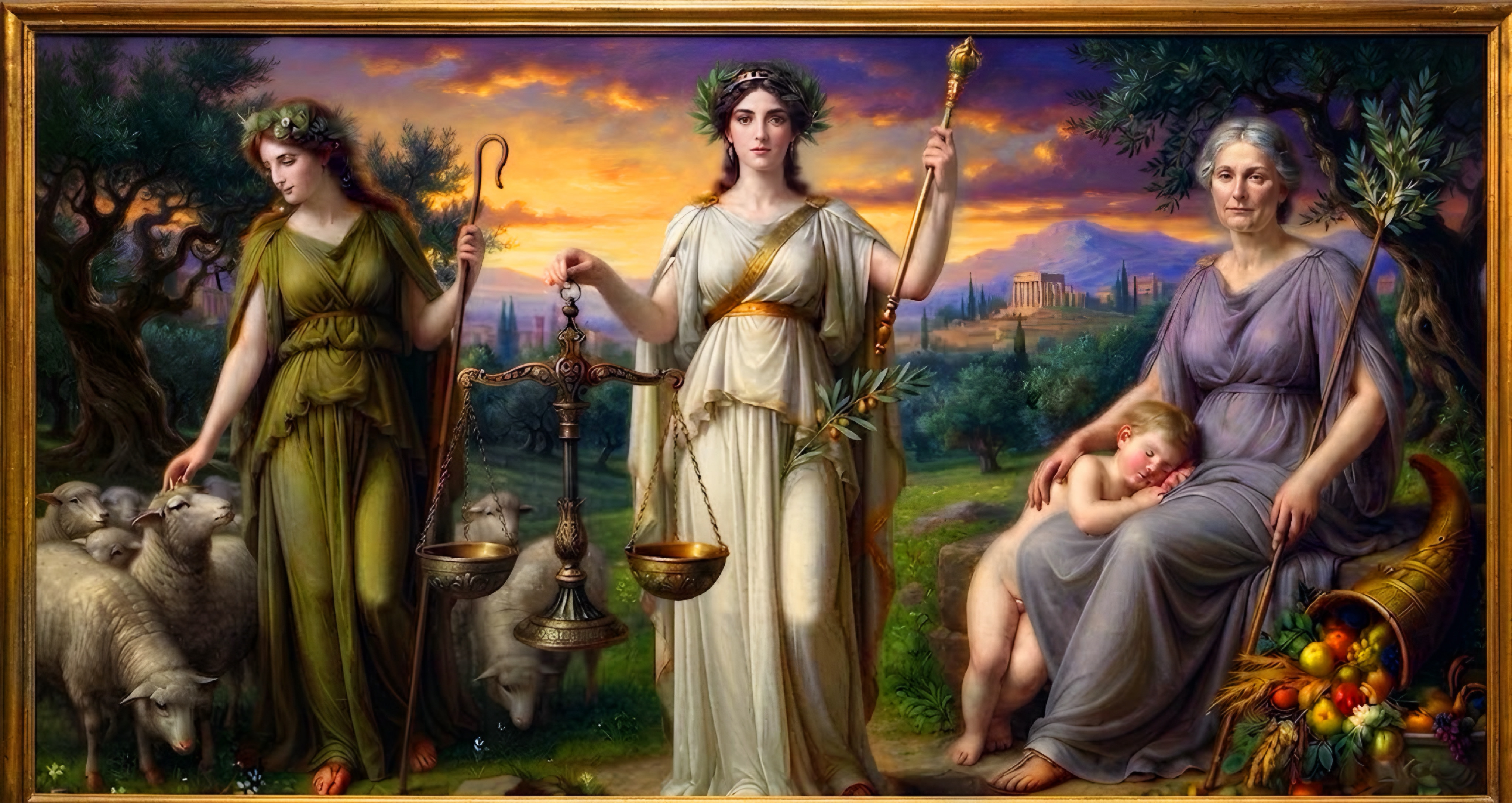
There's a particular kind of exhaustion that comes from trying to hold too many things in balance at once. You know the feeling: the sense that your sense of fairness, your longing for order, and your desire for something like joy keep pulling in different directions, and no matter how you arrange your life, one of them ends up shortchanged. Ancient Greek mythology had a name for the forces you're wrestling with, and it split them into three distinct figures rather than asking one concept to do all the work.
Themis, the Titaness of divine law and natural order, was said to have borne three daughters with Zeus: Eunomia, Dike, and Eirene. Together they were known as the Horae, though that word is often mistranslated simply as "the Seasons." In fact, the Horae governed something closer to the right ordering of human affairs: the conditions under which a life, or a society, could actually flourish. Eunomia represented good order and lawful governance. Dike represented justice, the accurate weighing of what is due. Eirene represented peace, though not the passive absence of conflict so much as the active, cultivated condition that follows when order and justice have done their work.
What makes this triad worth sitting with isn't its antiquity. It's the structural claim embedded in it: that peace is not its own free-standing achievement. It's a consequence. It arrives only after two other conditions have been met, and it tends to depart quickly when either of those conditions erodes. If you've ever noticed that your own attempts at "finding peace" feel hollow or temporary, the myth offers a diagnostic worth considering: perhaps what you're missing isn't more peace-seeking, but more attention to order and justice in how you've structured your actual life.
Eunomia and the architecture of a workable life
Eunomia's name is often rendered as "good order, " but the Greek carries a more specific flavor: it implies lawfulness that has been rightly established, not order imposed from outside but order that fits the nature of the thing being ordered. This distinction matters enormously for anyone trying to build a sustainable inner life, because it separates two very different projects that often get confused with one another.
The first project is control: the attempt to manage every variable, anticipate every disruption, and eliminate uncertainty through sheer vigilance. The second project, the one Eunomia actually represents, is structure: the deliberate arrangement of your days, relationships, and commitments around what you've determined genuinely matters. Structure and control can look similar from the outside. Internally, they feel entirely different. Control is exhausting because it fights against reality's basic unpredictability. Structure works with reality, creating enough stable scaffolding that you can absorb disruption without collapsing.
Research on self-regulation offers a useful parallel here. Baumeister and colleagues' work on ego depletion, though later complicated by replication challenges, pointed toward something researchers still generally accept: willpower functions less like an infinite resource and more like a a finite one that depends heavily on environmental design. In other words, people who build supportive structures around themselves, consistent routines, predictable rhythms, clear boundaries around time and attention, tend to need less raw willpower to stay aligned with their values. They've built Eunomia into their days rather than trying to manufacture good order moment by moment through effort alone.
This has direct implications for how you think about your own life's architecture. If your days feel chaotic, the temptation is often to respond with more discipline: try harder, resist more, white-knuckle your way through disorder. Eunomia suggests a different approach. Rather than asking "how do I resist the chaos, " you might ask "what structure would make this chaos less likely to arise in the first place." That might mean protecting certain hours for deep work or genuine rest. It might mean building in transition rituals between contexts, so your nervous system has a chance to reset rather than carrying the residue of one demand into the next. It might mean being honest about which commitments actually serve your values and which ones you've simply inherited without examination.
None of this promises a frictionless life. Structure doesn't eliminate difficulty; it changes your relationship to difficulty by giving you a stable base from which to meet it. The Stoics understood this well. Epictetus distinguished sharply between what is "up to us" and what is not, arguing that peace of mind depends less on controlling external events than on the internal order we bring to our response. Eunomia, in this reading, isn't about arranging the world so nothing goes wrong. It's about arranging your inner and outer life so that when things go wrong, as they inevitably will, you have somewhere stable to stand.
Dike and the discipline of accurate assessment
If Eunomia concerns structure, Dike concerns accuracy: the capacity to see what is actually true and to give each element of a situation its rightful weight. In Greek thought, Dike was often depicted holding scales, and this image has survived into our modern iconography of justice for good reason. Her domain isn't retribution or punishment. It's calibration. It's the difficult, ongoing work of assessing what something actually deserves, whether that something is a person, a situation, or a piece of yourself.
Consider how often inner turmoil stems not from external circumstance but from miscalibrated assessment. You might carry guilt disproportionate to an actual mistake, or minimize a genuine harm because acknowledging it feels too costly. You might extend endless patience to people who have shown you, repeatedly, that they don't reciprocate care, while withholding the same patience from yourself for infractions far smaller than the ones you forgive in others. This is Dike's territory: the practice of weighing things as they actually are, rather than as fear, guilt, or old conditioning insists they must be.
Cognitive behavioral therapy offers a well-established framework for this kind of recalibration, even though it doesn't use mythological language to describe it. Beck's foundational work on cognitive distortions identified specific patterns, catastrophizing, all-or-nothing thinking, mind reading, personalization, that consistently distort our internal scales. Someone caught in catastrophizing assigns a minor setback the same emotional weight as a genuine crisis. Someone caught in personalization assumes responsibility for outcomes that were never fully within their control. In both cases, the distortion isn't a moral failing; it's a miscalibration, and the corrective work involves returning, patiently and repeatedly, to a more accurate weighing of the actual evidence.
This matters for lasting peace because an inaccurate internal scale generates chronic, low-grade distress even when circumstances are objectively manageable. If you consistently overweight your failures and underweight your efforts, no external success will register as sufficient, because the internal accounting system itself is broken. Conversely, if you consistently underweight harm done to you, whether by others or by your own choices, you accumulate a kind of unaddressed debt that erodes trust in yourself and in your relationships over time.
Acceptance and Commitment Therapy adds a useful companion insight here. Hayes and colleagues' work on cognitive defusion suggests that accurate assessment doesn't require believing every thought that arises, nor does it require suppressing difficult thoughts. Instead, it involves creating enough distance from a thought to examine it: is this an accurate weighing of the situation, or is this an old pattern reasserting itself under new circumstances? That small pause, between the thought arising and the thought being treated as fact, is where Dike's discipline actually lives. It's not glamorous work. It rarely feels dramatic. But it's the quiet, repeated practice of asking "is this true, or does this just feel true" that keeps your internal scales from drifting too far out of alignment.
Structural fairness deserves mention here too, because Dike's domain was never purely personal in the ancient conception. Justice, for the Greeks, operated at the level of the city as much as the individual soul. If you're navigating economic precarity, systemic discrimination, or circumstances genuinely stacked against you, no amount of internal recalibration will manufacture a fairness that doesn't structurally exist. Acknowledging this honestly is itself an act of accurate weighing. Sometimes the correct assessment is that a situation is genuinely unjust, and the appropriate response involves seeking change in the conditions themselves, not simply adjusting your internal relationship to them.
Eirene: peace as consequence, not achievement
This brings the discussion to Eirene, and to the central claim this entire mythological structure seems to be making: peace is downstream. It doesn't arrive because you sought it directly, meditated harder, or optimized your morning routine into some ideal configuration. It arrives, when it arrives, as the natural consequence of a life where order has been rightly established and where things have been weighed accurately.
This reframing has real practical weight. Many people approach peace as though it were a destination reachable through sufficient effort applied directly to the goal of feeling peaceful. They meditate, they practice gratitude, they try to think positive thoughts, and when peace remains elusive, they often conclude they're simply failing at peace, or that peace requires some more intensive practice they haven't yet discovered. The myth of the Horae suggests a different diagnosis. If Eirene is absent, the question worth asking isn't "how do I try harder at peace." It's "what has gone unaddressed in Eunomia's domain, or in Dike's?"
This tracks with what researchers in positive psychology have found regarding the limits of direct pursuit. Studies on hedonic adaptation, going back to Brickman and Campbell's foundational work in the 1970s and developed extensively since, show that emotional states pursued directly and intensely tend to be unstable, subject to rapid adaptation and diminishing returns. Happiness researchers including Sonja Lyubomirsky have found that sustainable wellbeing correlates more strongly with meaningful activity, quality relationships, and values-aligned living than with direct efforts to feel happy. Peace appears to work similarly. It's remarkably resistant to direct pursuit and remarkably responsive to indirect cultivation through the conditions that surround it.
What does this mean practically? It suggests that if you're finding lasting peace elusive despite genuine effort, the more productive question might involve auditing your Eunomia and Dike rather than intensifying your peace-seeking. Is your life structured in a way that supports your actual values, or are you living inside an arrangement you never consciously chose? Are you weighing your circumstances, your relationships, and yourself with anything close to accuracy, or has fear, old conditioning, or unexamined guilt distorted the scales? Peace, in this view, isn't a fourth thing you add to your life alongside order and justice. It's what those two conditions produce when they're functioning well together.
There's also something worth noting about Eirene's particular character in Greek thought. She wasn't imagined as static. Ancient depictions often show her holding a cornucopia or an infant, images of abundance and generativity rather than stillness. This suggests peace, properly understood, isn't the absence of movement or challenge. It's a condition fertile enough to produce new growth. A life ordered by Eunomia and weighed accurately by Dike doesn't become peaceful because nothing happens in it anymore. It becomes peaceful because what happens in it can be met from a place of stability rather than reactivity, and because that stability leaves room for things to actually grow.
Why the three cannot be separated
It's tempting, once you've distinguished these three concepts, to treat them as sequential steps: establish order first, then pursue justice, then arrive at peace. The myth resists this reading, and so does lived experience. The Horae were always depicted together, often dancing in a circle, which suggests something closer to a dynamic equilibrium than a linear checklist. Order without justice becomes rigidity, a structure that serves itself rather than the people living inside it. Justice without order becomes exhausting, endless recalibration with no stable ground from which to operate. And peace pursued without either becomes, as noted, hollow and unstable.
This has real implications for how you might think about your own efforts at building a settled inner life. If you've focused heavily on structure, elaborate routines, careful time management, well-defined boundaries, but you find yourself still restless or dissatisfied, the missing element might not be more structure. It might be Dike's work: an honest reassessment of whether your structure actually reflects accurate weighing of what matters, or whether it has calcified into rigidity for its own sake. Conversely, if you've done extensive inner work around self-compassion and accurate self-assessment but still feel unmoored, the missing piece might be Eunomia: the practical, unglamorous work of actually building supportive structure around the insights you've gained.
Family systems theory offers a related insight, even outside its original clinical context. Bowen's concept of differentiation of self describes the capacity to maintain a clear sense of one's own values and boundaries while remaining meaningfully connected to others, neither fused with their expectations nor reactively cut off from them. This dynamic balance mirrors what the Horae represent: not three separate achievements to check off, but three ongoing conditions that need to be held in relationship with one another, continuously, as circumstances shift.
Because circumstances do shift, this work is never finished. A structure that served you well in one season of life, one job, one relationship configuration, one stage of parenting, may need genuine reassessment when the season changes. An assessment of what's fair or true in a given situation may need updating as new information arrives or as you yourself change. This is simply what it means for growth to be nonlinear rather than a fixed accomplishment: the goal was never to arrive at some permanent configuration of order, justice, and peace and then rest there indefinitely. It's to keep returning to the question of whether these three conditions are currently in right relationship with one another, and to make the adjustments that keeps them there.
Bringing the myth into an actual week
None of this needs to remain abstract. If this framework holds any use, it's likely to show up in fairly ordinary moments: the choice to protect two hours of unscheduled time on a Sunday because you've noticed your nervous system needs it, even though productivity culture insists otherwise. The willingness to sit with a difficult feeling long enough to ask whether it's an accurate response to present circumstances or an old pattern reasserting itself. The recognition that a friendship you've been maintaining out of guilt rather than genuine connection might need honest reassessment rather than continued, exhausted participation.
Consider also how this framework might apply to something as ordinary as how you structure a single difficult conversation. Eunomia shows up as the decision to have the conversation at a time and in a setting where both people have the capacity to engage well, rather than in the heat of an unplanned argument. Dike shows up in the effort to represent the situation accurately, neither minimizing your own contribution to the difficulty nor exaggerating the other person's. Eirene, if it arrives, shows up afterward, not necessarily as agreement or resolution, but as a settled sense that the conversation was conducted with integrity, regardless of outcome.
This is worth emphasizing because peace, properly understood through this lens, was never meant to guarantee comfort or the absence of difficulty. Genuine order sometimes requires saying no to things you want. Accurate justice sometimes requires acknowledging things about yourself or your situation that are painful to see clearly. The peace that follows isn't the peace of a life with no hard edges. It's the peace of a life whose hard edges have been met honestly, rather than avoided, denied, or endlessly deferred.
If any of this feels like it's naming something you've sensed but hadn't quite articulated, that's likely because the underlying pattern predates the myth itself; the Greeks were describing something observably true about human flourishing, not inventing it from nothing. The three daughters of Themis simply gave language to a structure worth returning to whenever peace feels distant: check the order, check the justice, and let peace be whatever naturally follows, rather than the thing you chase directly and never quite catch.
Living with the question rather than the answer
Perhaps the most useful thing this old story offers isn't a formula but a diagnostic habit: when peace feels absent, resist the urge to search harder for it directly, and instead ask what's happening in the domains of order and fairness that might be generating its absence. This question doesn't resolve neatly. It's not meant to. Your structures will keep needing adjustment as your life changes shape. Your internal scales will keep drifting and needing recalibration, because that's simply the nature of trying to see clearly from inside a life rather than from some detached vantage point above it.
What the Horae suggest, in the end, is less a destination than a way of orienting yourself toward the ongoing work of a considered life. There's something quietly freeing in that reframe. You're not failing at peace if you haven't found it yet. You might simply be in a season where order or justice still need your attention, and peace, true to its ancient character, is waiting patiently for those two conditions to catch up.
Keep reading
- The Balance Assessment: Your Compass for Intentional Living
- The Zeus in You: Why the Old Gods Still Describe the Mind
- Why I Am Guilty of Having No Shame
- The Unflappable You: How to Stop Letting Others Ruffle Your Feathers
- Don't Assume the Worst; Talk to Me About It First
- Possible vs. Probable: Why the Difference Shapes a Life
- Why Old Advice Suddenly Makes Sense Years After You Heard It
- Accept Belonging & Belong Acceptance