Marcus Aurelius and Rumi: Two Paths to the Same Peace
Marcus Aurelius wrote to survive his grief. Rumi wrote from the wreckage of loss. Centuries apart, they arrived at something strikingly similar.
| 9 min read
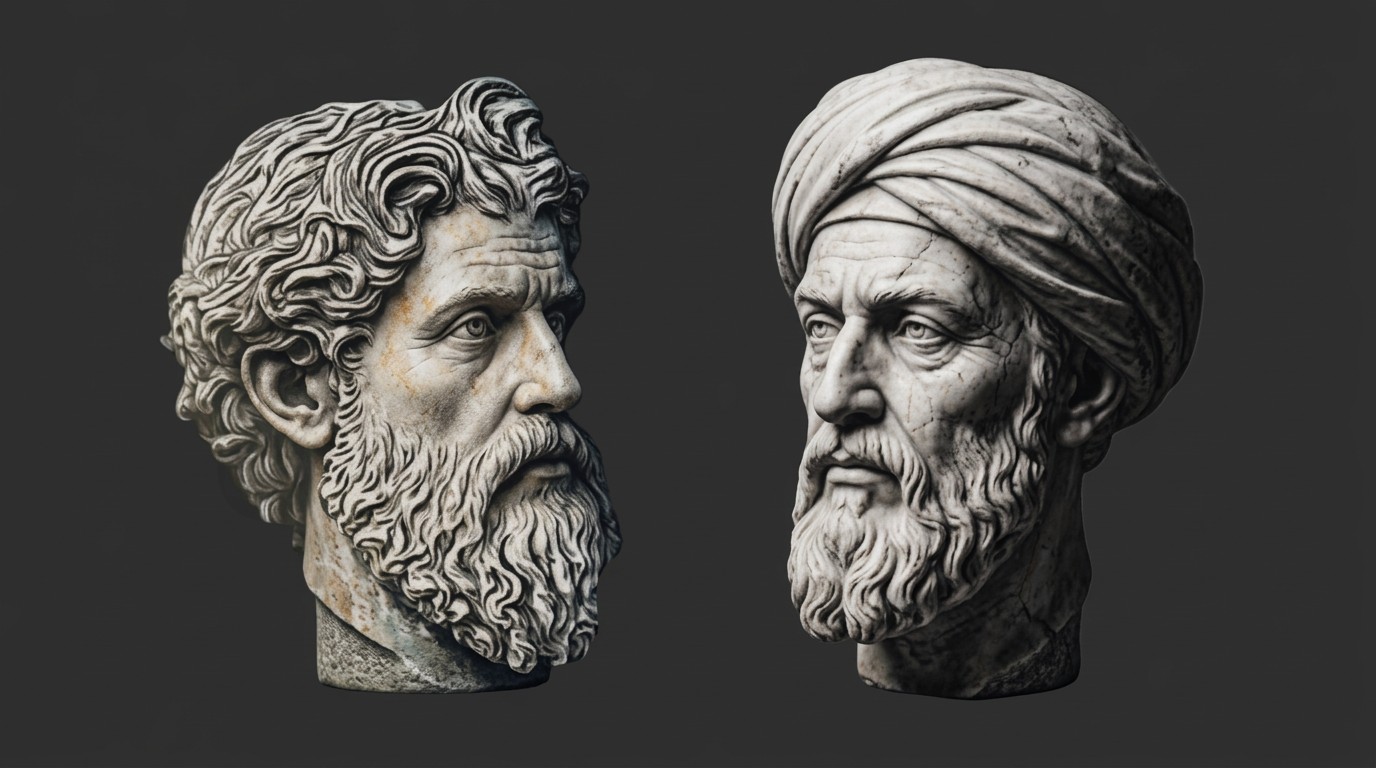
Two men, two worlds, one ache that runs through every human life — the ache for peace, for meaning, for a way to carry loss without being destroyed by it. Marcus Aurelius ruled an empire. Rumi lost everything he thought he knew about God. Neither wrote for us. Yet both still speak to the quiet rooms of modern life — the moment you replay an argument, the grief you haven't let yourself feel, the question of what any of this is for.
Begin with the Roman. Marcus Aurelius was born in the year 121, into a Roman aristocracy that prized duty above comfort. He did not choose philosophy as an escape from power — he inherited power and used philosophy as the discipline that let him bear it. He became emperor in 161, and spent nearly his whole reign at war: against Germanic tribes on the northern frontier, against a plague that may have killed millions, against betrayal from men he trusted. His family life was a catalogue of grief; he outlived at least eight of his children. Picture a man responsible for an empire, writing by candlelight in a military tent on the Danube, grieving children while governing a civilization, using the only tool he had — his own mind — to keep from breaking.
That tent is where the Meditations were written. Not for publication, not for glory. They are private notes, in Greek, called in the original "ta eis heauton" — to himself. He never intended an audience. This is not a philosopher performing wisdom; it is a tired, grieving man talking himself down from panic and fury, sentence by sentence.
His worldview is Stoicism, founded by Zeno of Citium, developed by Chrysippus, carried to Rome through teachers like Epictetus. The Stoic claim at the center of it all: we suffer not because of what happens to us, but because of the judgments we attach to what happens. An insult is only sound in the air until you decide it means something about your worth. Marcus did not believe we control the world. He believed we control the one territory truly ours — our own reasoning, our own will. This produces not denial, but a hard-won serenity: "You have power over your mind, not outside events. Realize this, and you will find strength."
Now cross a thousand years, a different language, a different understanding of the universe entirely.
Rumi — Jalal ad-Din Muhammad Rumi — was born in 1207 in Balkh, in the Persian cultural world, now Afghanistan. His family fled west ahead of the Mongol invasions, a childhood shaped by displacement before he ever wrote a line. He settled in Konya, in present-day Turkey, where his father was a respected scholar. Rumi himself became a serious jurist and theologian — exactly the kind of man you would not expect to become the most read poet in the world eight centuries later.
Then he met Shams of Tabriz. We don't fully know who Shams was — a wandering mystic, unpolished, intense, uninterested in Rumi's credentials. Something in their companionship cracked Rumi open; the scholar of religious law met someone who lived religion as direct, burning experience. Their friendship lasted a few intense years, then Shams disappeared, likely murdered. Rumi's grief became the furnace that produced nearly everything he's remembered for: the vast Masnavi, the ecstatic Divan-e Shams-e Tabrizi named for the friend he lost, and the whirling of the Mevlevi dervishes, said to trace back to Rumi spinning in grief in the marketplace, unable to hold what he felt in stillness.
Where Marcus's defining experience was command under grinding duty, Rumi's was annihilation of the self through love and loss. Marcus writes like a general giving orders to his own mind. Rumi writes like someone drunk on an experience language can barely hold — longing, dissolution, union with what he called the Beloved.
Here we must be careful, because it is tempting, and wrong, to flatten these men into generic ancient wisdom, as if stoic calm and mystic surrender were two brands of the same self-help product. Marcus's cosmology is reason — the Logos, a rational order running through nature, which the wise person aligns with through disciplined judgment. There is no ecstatic union in Stoicism, no romantic surrender; the highest state is clear-eyed equanimity.
Rumi's cosmology is Sufi mysticism, where the aim of life is union with the divine — not closeness, but the dissolving of the separate self into something vast. His image of the reed flute, cut from the reed bed and crying its whole life because it was severed from its source, names a wound Stoicism barely recognizes: the wound of separation itself, prior to any single event, simply the condition of being an individual self. For Rumi, longing is not a problem to manage. Longing is sacred — the very thing pulling you home.
And yet these two men, from opposite ends of the earth, arrive at startlingly similar practical postures. Both insist the present moment is the only real location of a life. Marcus says the past is gone and the future unreal; all we have is this instant of attention and choice. Rumi says it through image rather than argument: "the past and the future veil God from our sight; burn up both with fire." Different vocabulary, the same insistence — stop living in yesterday's ledger and tomorrow's anxiety.
Both treat the ego's demand to be right, honored, in control, as the central obstacle to peace. Marcus attacks it through reason, showing that anger over slights is a judgment you've added, not a fact of the event. Rumi attacks it through love, insisting the self dissolves through surrender to something larger than wounded pride. Marcus disciplines the ego down; Rumi melts it down. Both are obsessed, almost gently, with death as a clarifying device. Marcus's memento mori strips away status anxiety and petty fear. Rumi treats physical death as a second birth, a return to the Beloved — his own epitaph asked not to be mourned. Neither flinches from mortality; both use it to reorganize what matters now.
Now, how does any of this touch an ordinary life today — carefully, as interpretation, never as clinical fact or claim of direct equivalence. Modern psychology did not descend from either man, but thoughtful people have drawn on both traditions for centuries.
Consider attention. Marcus's discipline — notice the judgment, separate it from the raw event, choose your response — loosely resembles what modern approaches call examining automatic thoughts. A practical exercise: at day's end, pick one irritating moment and write two sentences — one the bare fact, no adjectives; one the meaning you added. Most people are startled how much suffering lived only in the second sentence.
Rumi offers something different: not analytical separation but absorption. The Sufi practice of zikr, repeated remembrance, and the whirling, aren't about dissecting thought but filling the present so fully that the grasping mind quiets. Try repeating a short phrase, like "I am here," slowly with your breath for a few minutes when your mind is spinning — not to analyze the spin, but to interrupt it with presence.
Consider emotional response. Marcus's approach to anger is almost procedural: remember the other person acts from their own ignorance of the good, and that an angry response from you adds a second wrongdoing to the first. Try silently asking, "What do they believe that makes this seem reasonable to them?" The asking creates distance, and distance is most of what Stoic equanimity actually is.
Rumi's approach to painful emotion is closer to full acceptance. His image, often rendered as "The Guest House," pictures each feeling — joy, depression, meanness — as a temporary visitor to welcome, because each is clearing you out for some new delight. Try naming a hard feeling as a guest — "grief has arrived again tonight" — and choosing not to fight its presence, trusting it will eventually leave.
Consider grief, since both men were formed by it. Marcus's writing on grief is almost unbearably restrained: nature which gives also reclaims; nothing was ever truly possessed, only lent. There's real comfort here, but also risk — Stoic restraint can tip into suppression if used to avoid feeling grief rather than metabolize it. The healthier reading isn't "don't feel grief," but "don't let the belief that grief shouldn't have happened become a second layer of suffering."
Rumi's grief, after Shams vanished, is the opposite temperature — loud, physical, poured into years of poetry and movement. His implicit teaching: grief fully expressed is a form of love with nowhere left to go, and expressing it is how it transforms rather than calcifies. A grounded practice drawing on both: give grief scheduled, bounded time to be fully felt and expressed — write, speak, move, cry — then outside that window, hold the Stoic reminder that this person was never permanently yours, that you are returning them rather than losing them to injustice. Expression without exile; acceptance without suppression.
Consider relationships and love, where the two men diverge most sharply and perhaps complement each other best. Marcus's view of others is civic and rational — we are made for cooperation, like hands or eyelids, and duty requires patience and justice toward others regardless of how they treat us, because that is what our own integrity requires. Rumi's view of love is the center of his entire cosmology — love is the engine of existence, pulling all things back to their source. "Let yourself be silently drawn by the strange pull of what you really love; it will not lead you astray." Applied carefully, without claiming equivalence: Marcus can steady a difficult relationship by reminding you that fairness is about your own integrity, not their behavior. Rumi can deepen a good relationship by treating intense longing not as excess to downplay, but as sacred data about what matters to you.
Consider meaning. Marcus finds it in function — doing the task in front of you with full attention and integrity, regardless of reward, because meaning lives in right action, not outcome. Rumi finds meaning in longing itself — the reed's cry is not a problem to solve but the very sound of meaning, proof you came from somewhere worth returning to. Most real lives need both: the discipline to keep doing the next right thing, and the willingness to feel the longing that keeps you from going numb.
Consider peace, the word both traditions circle. Marcus's peace is a mind no longer at war with reality — accepting what cannot change, acting fully on what can. Rumi's peace is a drop recognizing the ocean — the dissolving of the separate, anxious self into what was never truly separate. One is the peace of acceptance; the other the peace of belonging. Practice both in the same week: mornings, a few minutes of Marcus's clear-eyed inventory — what is in my control today, what is not; evenings, a few minutes of Rumi's surrender — sitting quietly, letting the edges between your small worries and whatever is larger than you soften.
Here is where these two ancient men meet across the distance. Marcus teaches you to narrow your focus to the ground you actually command — your judgments, your effort, your integrity — and find durable peace there. Rumi teaches you to widen your focus until the walls of the separate self grow porous, until longing and loss become the substance of meaning rather than obstacles to it. One hands you a discipline; the other an invitation. Discipline without invitation calcifies into mere endurance. Invitation without discipline dissolves into feeling with no ground to stand on. Together they offer what neither offers alone: a steadiness that can still feel, and a feeling that still knows how to stand.
A few practices to carry into your week. Each morning, write three columns — what is truly in my control today, what is not, and one honest sentence about where I usually confuse the two. That's Marcus. Each evening, read one line of poetry slowly and notice what your body does before your mind analyzes it. That's Rumi. When grief visits, give it an appointment rather than a lifetime lease — bounded time to feel it fully, then a return to your obligations, carried a little lighter. When anger visits, ask what belief makes the other person's action make sense to them — not to excuse it, but to loosen its grip on you. When longing visits, for a person, a purpose, a sense of home, don't apologize for it; let it tell you something true about what you love, and let that gently change how you spend your days.
Marcus Aurelius never knew Rumi's name. Rumi never read a line of Marcus, writing in a Latin world long gone by the time he was born. And still, across all that distance — different gods, different grammars, different griefs — both arrived at the same quiet insistence: that the mind you bring to your life matters as much as the life itself, that this moment is where you actually live, and that peace, however you reach it, through discipline or surrender, through narrowing the self or dissolving it, is always, somehow, available to you, right where you are standing.
Keep reading
- The Zeus in You: Why the Old Gods Still Describe the Mind
- Why I Am Guilty of Having No Shame
- The Unflappable You: How to Stop Letting Others Ruffle Your Feathers
- Don't Assume the Worst; Talk to Me About It First
- Possible vs. Probable: Why the Difference Shapes a Life
- Why Old Advice Suddenly Makes Sense Years After You Heard It
- Accept Belonging & Belong Acceptance
- When Someone Won't Consider You: What to Do Next