What Gummy Bears Teach Us About Consistency and Change
A jar of gummy bears reveals how consistency actually works: small cues, low thresholds, and quiet identity-building. An invitation to look closer.
| Kaizen, Natural Rhythm Cycles, Lifelong Learning, Resource Allocation, Self-Care, Resilience, Trust In The Universe, Trust In Inner Wisdom | 11 min read
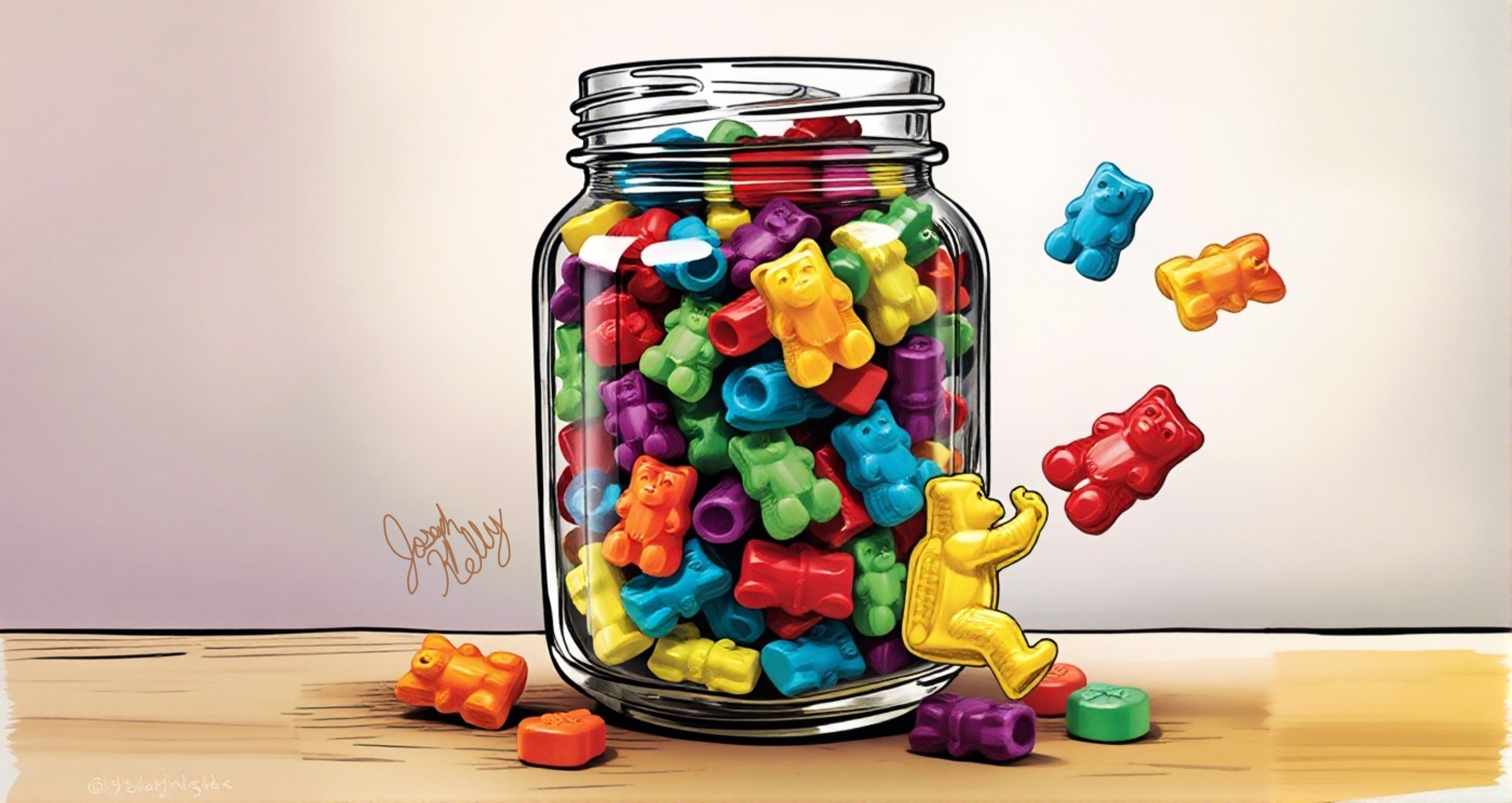
There is a jar on a kitchen counter somewhere, and in it are gummy bears, the kind sold in bulk at hardware stores and health food shops, marketed for no particular reason as a snack you eat one at a time while you work. Someone bought that jar meaning to have one a day. Maybe two. A small, contained pleasure, rationed like a vitamin. By the third week, the jar is a third empty and the person reaching into it has stopped noticing their own hand moving. This is a story about how a behavior, repeated without much thought, becomes a structure the mind builds its days around, and how that same quiet mechanism, pointed somewhere else, is the entire engine behind lasting change.
Gummy bears are an odd teacher, and that is rather the point. They are small enough that no single piece seems to matter, soft enough that the first one costs almost nothing, and abundant enough that the jar never seems to run short until it does. Those three qualities, smallness, low initial cost, and the illusion of abundance, describe almost every habit that has ever quietly taken over a life, good or bad. Understanding why the gummy bear jar works the way it does turns out to be a surprisingly direct route to understanding why your gym bag has been sitting by the door for two months, or why you have, without really deciding to, started reading again.
This piece is about what a jar of small, repeatable things reveals about the architecture of consistency itself, and about a Japanese philosophy of improvement, kaizen, that was built on exactly this kind of smallness long before anyone had a word for habit formation.
What the jar won't tell you
This looks at why small repeated actions accumulate into identity-shaping patterns, using the gummy bear jar as a working model for consistency, without promising a formula for discipline or pretending that insight alone changes behavior. What follows instead is a way of seeing the mechanism clearly enough that you can choose, with more precision, where to point it.
The first one is never the problem
Nobody has ever been undone by a single gummy bear, and nobody has ever been built by a single day at the gym. This is the first thing the jar teaches, and it is almost too obvious to say out loud: the unit of change is never the thing itself. It is the repetition. A single piece of candy carries no caloric weight worth mentioning, and a single missed workout carries no real cost to your body. The mind knows this, correctly, and uses that knowledge to grant itself permission. The trouble is that the mind grants itself that same permission the next day, and the day after, because each individual instance really is negligible when considered alone.
Psychologists who study habit formation, among them Wendy Wood at the University of Southern California, have spent decades documenting a finding that runs against the grain of how most people think about their own behavior: a striking portion of daily action is not decided at all, in the sense of a deliberate weighing of options. It is cued. A location, a time of day, a preceding action, an emotional state, these summon the behavior automatically, the way the sight of the jar on the counter summons the hand before the mind has finished its sentence. Wood's research suggests that willpower, as most people imagine it, a kind of internal muscle flexed in the moment of decision, is doing far less work than we assume. The real work happened earlier, when the cue and the behavior first got wired together.
This reframes the gummy bear jar as something other than a test of character. It is a cue sitting in a high-traffic location, linked to a low-cost reward, encountered dozens of times a day. Of course it works. The question it raises is what have I built, without quite meaning to, that makes this behavior so easy to repeat and so hard to notice. Every consistent pattern in a life, the ones you are proud of and the ones you would rather not examine, got built the same way, through a cue encountered often enough that the behavior stopped requiring a decision at all. The jar is just an honest version of a process that is usually hidden.
Why the first bite costs almost nothing
There is a second feature of the gummy bear that makes it such a useful teacher, and it has less to do with repetition and more to do with threshold. The barrier to eating one gummy bear is about as low as a barrier can be. It requires no preparation, no decision about timing, no change of location, no equipment. The hand is already near the jar. The jar is already open. This low threshold is precisely what kaizen, the Japanese philosophy of continuous, incremental improvement associated with figures like Masaaki Imai, was built around, though kaizen arrived at the insight from the opposite direction, asking how large goals could be made achievable rather than how small pleasures become unavoidable.
Kaizen's central wager is that the size of a first step determines whether a second step ever happens. A goal that requires a dramatic opening move, an hour at the gym, a complete overhaul of a diet, a radical reorganizing of a schedule, carries with it a threshold high enough that most days find a reason not to cross it. A goal that can be started in under a minute, one push-up, one sentence written, one page read, carries almost no threshold at all, and so it gets crossed on the days when motivation is low, which is most days, because most of life is lived on days when motivation is low. The gummy bear jar simply happened to embody the principle perfectly, by accident, in the service of a habit nobody particularly wanted.
What the jar demonstrates, almost cruelly, is that threshold matters more than intention. You can want, quite sincerely, to eat fewer gummy bears and more vegetables, and still lose to the jar every time, because the vegetables are in the refrigerator, in a drawer, requiring washing and cutting, while the gummy bears are on the counter requiring nothing. The structure of the environment is making a decision before you do. Kaizen's insight, translated out of manufacturing and into a life, is that you can use this same structural leverage on purpose. Lower the threshold on the behavior you want and the repetition starts handling itself, the same way it has been handling the jar all along.
Abundance is a feeling, not a fact
The third thing the jar teaches is subtler, and it concerns the sense of abundance that makes the first several weeks of any habit, good or bad, feel costless. A full jar creates a perceptual condition in which no single bear seems to matter, because there are, apparently, so many more where that came from. This is closer to a basic feature of how the mind handles resources that feel plentiful, a pattern economists and psychologists have both described in different vocabularies, sometimes under the banner of hyperbolic discounting, the tendency to weigh a near-term, small cost or reward far more heavily than a long-term, larger one.
The jar is never actually abundant. It has a bottom. But the bottom is far enough away, and the depletion slow enough, that no single day provides evidence of scarcity. This is exactly the condition under which consistency, in either direction, goes unnoticed. A savings account draining by a small amount each month does not feel urgent until a statement arrives showing the total. A friendship fed by nothing more than silence does not feel endangered until a years-long gap has opened between two people who once spoke daily. A body slowly losing its conditioning feels the same day to day, until a flight of stairs that used to be nothing becomes something. The jar's genius, if a snack can be said to have genius, is that it hides its own arithmetic until the arithmetic has already resolved itself.
This cuts the other way too. A habit you are trying to build suffers from the same invisibility, except now the invisibility works against you instead of for the candy. One day of writing does not feel like becoming a writer. One short walk feels, day to day, like nothing much at all, no closer to becoming someone who moves through the world differently. The reward is too distant and too small to register against the immediate, mild friction of doing the thing at all, which is the exact inverse of the gummy bear's problem: there, the cost was invisible and the reward immediate; here, the reward is invisible and the cost, however small, is immediate. Kaizen's answer to this imbalance is to shrink the cost so far that the mismatch stops mattering, rather than to manufacture a bigger reward, which tends to backfire. You are not trying to outrun hyperbolic discounting. You are trying to make the discounted cost so close to zero that even a heavily discounted future reward wins the comparison.
The person the jar is quietly building
There is a fourth layer here, and it concerns identity rather than behavior, which is where consistency stops being a tactic and starts being something closer to a quiet form of self-authorship. Behavior repeated long enough becomes evidence, and the mind is a relentless collector of evidence about who it believes it is dealing with. Someone who reaches into the jar every afternoon for three months is accumulating, bear by bear, a private case file titled, I am someone who does this. The file only requires repetition, which is the quietest and most persuasive kind of argument there is.
This is the mechanism behind what researchers studying self-perception, following an early line of work by Daryl Bem, described decades ago: people often infer their own attitudes and identities from observing their own behavior, in much the same way they would infer another person's character from watching what that person does, rather than from asking them directly. You do not need to believe, in the morning, that you are a person who exercises. You need only to have exercised yesterday, and the day before, and the mind will begin drawing the conclusion on its own, usually without asking your permission. This is not a comforting thought when applied to the jar, because it means the jar is not only draining your candy, it is quietly filing a report that says you are someone who eats like this, built from nothing but the accumulation of small, low-stakes moments you barely noticed making.
But it is an enormously useful thought applied the other way. The identity you are trying to grow into, the version of yourself who writes, who moves their body, who reaches for a book instead of a phone, is being built, bear by bear, by the smallest and least impressive repetitions you can manage, as long as you manage them often enough that the case file starts to fill. James Clear's writing on habits captures this directly when he frames small actions as votes cast for a particular identity, a single vote counting for almost nothing and an accumulating pattern of votes eventually counting for everything. The jar never knew it was running an identity campaign. Most of us are running one too, by default, with no idea what the final tally will say about us.
Building your own jar, on purpose
None of this works as a lecture, because lectures assume the problem lives in insight, and the jar has already shown you that insight was never the missing piece. You already know, in some sense, that the small thing adds up. What the jar teaches that a lecture cannot is where to apply pressure, and the honest answer is almost never at the moment of decision, but earlier, in the design of the surroundings that make the decision in advance.
Consider what it would mean to treat a habit you want the way the jar treats a habit you didn't choose. The jar is visible, so the book you want to read more of might live on the arm of the chair instead of a shelf across the room. The jar requires no preparation, so the walk you want to take more consistently might start by simply putting shoes by the door the night before, removing the one small friction that currently stands between intention and motion. The jar rewards instantly, with sweetness, a sensation available the moment the hand reaches in, so the harder habit might need its own small, immediate marker of progress, a mark in a notebook, a specific and noticeable feeling you let yourself register, rather than waiting for a distant outcome to arrive and validate the whole enterprise.
This requires a redesign of the terrain discipline is being asked to cross, rather than more discipline than you currently have. You might notice, in the coming weeks, which jars already exist in your life without your having built them on purpose, which behaviors have become so low-threshold and so cued by your environment that you no longer experience them as choices at all. Some of those jars are serving you quietly and well. Others are costing you something you have not yet totaled up. The useful question is which identity each habit is filing evidence for, one small, forgettable repetition at a time.
Kaizen, in its original industrial context, was about reducing waste and friction in tiny increments, trusting that the sum of many small corrections would eventually outperform any single large one. Applied to a life rather than a factory floor, the principle holds up remarkably well, maybe because a life, like a factory, is mostly made of repeated, unglamorous motions rather than singular dramatic events. The jar on the counter is a demonstration, running in your kitchen, of exactly how consistency gets built, whether or not you are the one doing the building.
What the jar can't tell you
The gummy bear jar is a good teacher because it is honest about mechanism and silent about meaning. It will show you, with total clarity, how small and low-cost a repeated action needs to be before it becomes automatic, and how long it takes before a pattern of behavior quietly rewrites your sense of who you are. What it cannot tell you is which patterns are worth building, because that question belongs to you, and it changes as you change, season to season, year to year. The jar will keep being a jar regardless of what you decide. It has no stake in the outcome.
Somewhere in your life there is probably already a jar you did not choose, sitting in plain sight, quietly filing its evidence. There is probably also an empty space where a different jar could go, one you would choose on purpose, if you let yourself believe that something this small could really be the whole mechanism. It usually is. The open question is which jar you are willing to fill, one unremarkable bear at a time, and what it might feel like, a year from now, to notice the case file it has built without your having to force a single dramatic day.
Keep reading
- The Zeus in You: Why the Old Gods Still Describe the Mind
- Why I Am Guilty of Having No Shame
- The Unflappable You: How to Stop Letting Others Ruffle Your Feathers
- Don't Assume the Worst; Talk to Me About It First
- Possible vs. Probable: Why the Difference Shapes a Life
- Why Old Advice Suddenly Makes Sense Years After You Heard It
- Accept Belonging & Belong Acceptance
- Marcus Aurelius and Rumi: Two Paths to the Same Peace