Personal Growth Resources for Psychology Students (2026)
Discover the best personal growth resources for psychology students—tools for self-care, research, reflection, and career development. Start building.
| listicle | 32 min read
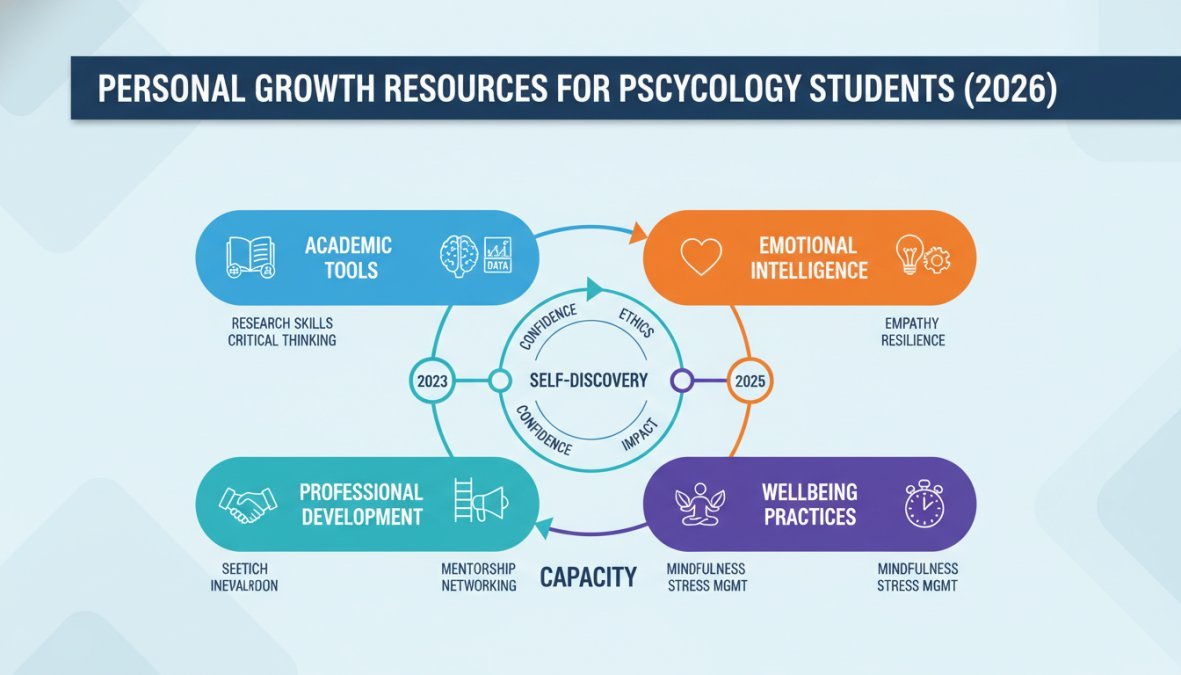
Psychology students occupy a strange position: they study the science of human behavior and mental health while navigating some of the most demanding academic and emotional terrain of any graduate program. Finding the right personal growth resources for psychology students is not just an academic exercise. It shapes whether you survive the program or genuinely thrive in it. This guide from Joseph Kelly covers the tools, strategies, and frameworks that address the full picture, from clinical skill-building to burnout prevention, so you can build a practice of intentional growth alongside your degree.
Here is what most guides get wrong: they treat personal development for psychology students as a list of study tips. The real challenge is integrating evidence-based self-development with academic rigor while managing the emotional weight of working in a helping profession. Below, we cover exactly how to do that.
Why Personal Growth Resources for Psychology Students Are Different
Personal growth resources for psychology students must do something no generic self-help content can: they need to hold up under the scrutiny of someone trained in research methods and psychological theory. A psychology student who encounters unsubstantiated claims in a wellness app is not going to find it credible, let alone useful.
The field also creates a unique emotional burden. Students regularly engage with trauma, psychopathology, and human suffering before they have fully developed the clinical supervision structures that protect working practitioners. That gap between exposure and professional support is where burnout begins.
This means the best student resources in psychology serve a dual purpose. They build professional competence while also functioning as genuine self-care tools. Reflective practice exercises for psychology students, evidence-based therapy worksheets, and positive psychology interventions are not separate categories. They are the same toolbox, used in different directions.
The throughline across every section of this guide is intentionality. Passive consumption of resources produces little growth. Structured, deliberate engagement with evidence-based tools produces psychological capital: the resilience, self-efficacy, and optimism that sustain a long career in mental health.
Evidence-Based Therapy Resources and Clinical Practice Tools
The gap between classroom theory and clinical practice is one of the most disorienting experiences in any psychology program. The good news is that the same tools clinicians use with clients can be applied to your own self-reflection and professional development.
Psychology Tools: Worksheets and Handouts for Students
Psychology Tools is one of the most comprehensive libraries of evidence-based therapy resources available to students. It hosts over 500 worksheets, psychoeducational handouts, and audio guides grounded in CBT, ACT, DBT, and other evidence-based modalities.
What makes it particularly valuable for students is the paired structure: many resources include both a therapist-facing version and a client-facing version. This lets you understand the clinical rationale while also experiencing the intervention from the inside. That dual perspective is difficult to replicate in a textbook.
The free tier provides meaningful access. Full institutional access requires a subscription, but many university libraries have arrangements that cover this. Check with your department before paying out of pocket.
Use Psychology Tools worksheets as part of your reflective practice routine, not just as clinical preparation. Running a thought record on your own academic stress is one of the fastest ways to internalize CBT principles while also managing your own wellbeing.
MindShift CBT: Applying Therapeutic Techniques to Your Own Life
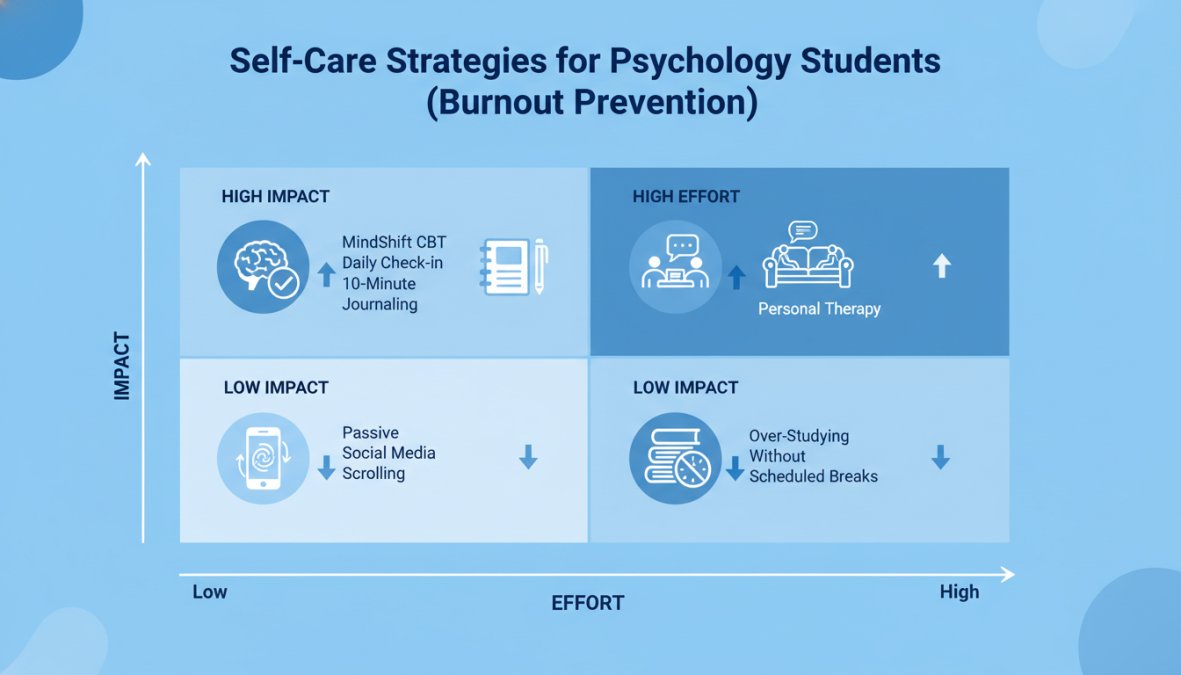
MindShift CBT, developed by Anxiety Canada, is a free app that applies cognitive behavioral therapy tools to anxiety management. For psychology students, it serves two functions simultaneously: it is a practical self-care tool and a live demonstration of how CBT interventions are structured for real users.
The app includes guided relaxation, thought-challenging exercises, and goal-setting features for facing fears. Its evidence-based strategies for test anxiety and social anxiety are directly relevant to the high-stakes evaluation environment of graduate school. The limitation is its narrow focus: MindShift CBT addresses anxiety specifically, not the broader range of emotional challenges students face.
Study Guides, Research Methods, and Academic Support Tools
Academic support is not separate from personal growth in psychology. Mastering research methods, statistical reasoning, and the peer-reviewed literature is how you develop the intellectual confidence to function as a practitioner and scholar. Weak academic foundations create chronic self-doubt that compounds over time.
APA PsycNet: Peer-Reviewed Research at Your Fingertips
APA PsycNet is the gold standard for psychological research, providing access to PsycInfo, PsycArticles, PsycBooks, and PsycTests databases through a single platform. For graduate students, it is the primary gateway to peer-reviewed literature across every subfield, from cognitive psychology to humanistic psychology to social constructionism.
The advanced search filters allow precise literature reviews by population, methodology, and construct. PsycTests is particularly underused: it catalogs validated psychological measures and scales, which is invaluable when designing research or understanding the instruments behind clinical assessments.
Individual access fees can be significant. Most universities provide institutional access, but if yours does not, the APA’s student membership resources offer reduced-cost options worth exploring.
Anki and Zotero: The Academic Integrity and Retention Stack
These two tools solve different problems and work best together.
Anki uses a spaced-repetition algorithm to schedule flashcard review at the exact intervals that maximize long-term retention. For psychology students memorizing neuroanatomy, DSM diagnostic criteria, research methods terminology, or biopsychology concepts, Anki is the most efficient study tool available. Community-shared decks for EPPP preparation are particularly well-developed. The desktop and Android versions are free; the iOS version carries a one-time fee.
Zotero handles the other side of academic life: reference management. It captures citations directly from your browser, generates APA-formatted bibliographies automatically, and annotates PDFs within the same interface. For anyone managing a literature review, thesis, or research project, Zotero eliminates the category of mistakes that come from manual citation management. Academic integrity failures due to citation errors are almost entirely preventable with this tool.
| Tool | Cost | Primary Use | Best For |
|---|---|---|---|
| Anki | Free (desktop/Android) | Spaced-repetition study | Exam prep, terminology retention |
| Zotero | Free | Reference management | Literature reviews, theses |
| APA PsycNet | Institutional/subscription | Research database | Peer-reviewed literature access |
| Psychology Tools | Free tier + subscription | Clinical worksheets | Theory-to-practice bridge |
Reflective Practice Exercises for Psychology Students
Reflective practice exercises for psychology students are among the most evidence-supported personal growth activities available, and among the most consistently skipped. The reason is structural: programs demand output (papers, presentations, clinical hours) while rarely building in protected time for genuine self-examination. Reflective practice is the deliberate process of examining your own reactions, assumptions, and patterns in response to clinical and academic experiences. It is foundational to both self-actualization and professional development, and it is what separates technically competent practitioners from genuinely effective ones.
Practical exercises worth building into a weekly routine:
- Process notes after supervision: Write 10 minutes of unfiltered reaction to supervision sessions. What challenged you? What did you avoid saying?
- Weekly emotional check-ins: Use a structured format, rating your stress, engagement, and sense of meaning on a 1-10 scale, then writing two sentences about each.
- Values clarification exercises: Revisit your core professional values quarterly. Clinical drift happens when daily pressures erode original motivations.
- Critical incident journaling: After any emotionally significant clinical encounter or academic experience, write a structured account: what happened, what you felt, what you would do differently.
- Peer consultation pairs: Arrange a monthly 30-minute call with a peer to discuss professional challenges. Structure beats ad hoc venting every time.
According to the British Psychological Society’s guidance on reflective practice, structured reflection is a core competency for professional psychologists, not an optional supplement. Building the habit during training is significantly easier than retrofitting it into a full clinical caseload.
Positive Psychology Interventions and Wellbeing Apps
Positive psychology is the scientific study of what makes life worth living, covering strengths, flow, meaning, and wellbeing. For psychology students, it offers a counterweight to the pathology-focused curriculum that dominates most programs.
Self-actualization, in the Maslowian sense, is not a destination but a practice. Positive psychology interventions make that practice concrete and measurable.
Happify: Turning Positive Psychology Into Daily Habits
Happify translates positive psychology research into a game-like daily practice. Its tracks address stress, anxiety, and resilience through activities grounded in gratitude, savoring, and cognitive reappraisal. Progress tracking lets users monitor emotional health over time, which satisfies the evidence-oriented psychology student’s need to see data behind the experience.
The free tier is genuinely useful. The paid subscription (starting at approximately $14.95/month) unlocks additional tracks and personalization. The honest limitation: Happify is a wellbeing support tool, not a therapeutic intervention. Students dealing with significant clinical-level distress should access professional support, not rely on an app.
Positive psychology interventions work best when practiced consistently over weeks, not as occasional mood boosters. Treat Happify or similar tools like a gym membership: the benefit comes from showing up regularly, not from any single session.
Self-Care Strategies for Psychology Students (Including Burnout Prevention)
Burnout in psychology training is not a character flaw. It is a predictable outcome of sustained emotional labor without adequate recovery structures. The students most at risk are often the most conscientious ones: those who over-invest in client welfare, academic performance, and professional identity simultaneously.
Effective self-care strategies for psychology students operate across four domains:
- Physical: Sleep hygiene, regular movement, and nutrition are not luxury considerations. Cognitive performance in clinical and academic settings depends directly on physical baseline.
- Relational: Maintain relationships outside the psychology world. Peer support within the program is valuable but insufficient on its own.
- Professional: Seek supervision proactively, not just reactively. Supervision is the profession’s primary burnout prevention mechanism.
- Psychological: Therapy for therapists-in-training is more common than programs acknowledge, and more useful than most students expect.
Recognizing and Navigating Imposter Syndrome in Graduate School
Imposter syndrome is the persistent belief that your success is fraudulent and that others will eventually discover your incompetence. It is disproportionately common in graduate psychology programs, particularly among first-generation students and those from underrepresented groups.
The thing nobody tells you about imposter syndrome in graduate school is that the environment actively cultivates it. Seminars reward confident contributions. Supervision exposes gaps in knowledge. Peers perform competence even when they feel the same doubts you do.
Practical navigation strategies:
- Name it explicitly. Recognizing imposter syndrome as a cognitive pattern, not a factual assessment, is the first step toward reducing its grip.
- Track evidence against it. Keep a running list of genuine accomplishments, positive feedback, and skills acquired. Review it monthly.
- Normalize it in peer conversation. When one person names it, others almost always recognize themselves.
- Separate performance anxiety from actual incompetence. The former is universal; the latter is addressable through supervision and skill-building.
According to research published in the International Journal of Behavioral Science, imposter phenomenon affects a significant proportion of high-achieving individuals across academic and professional contexts. Psychology students are not uniquely susceptible; they are simply better positioned to understand the mechanism.
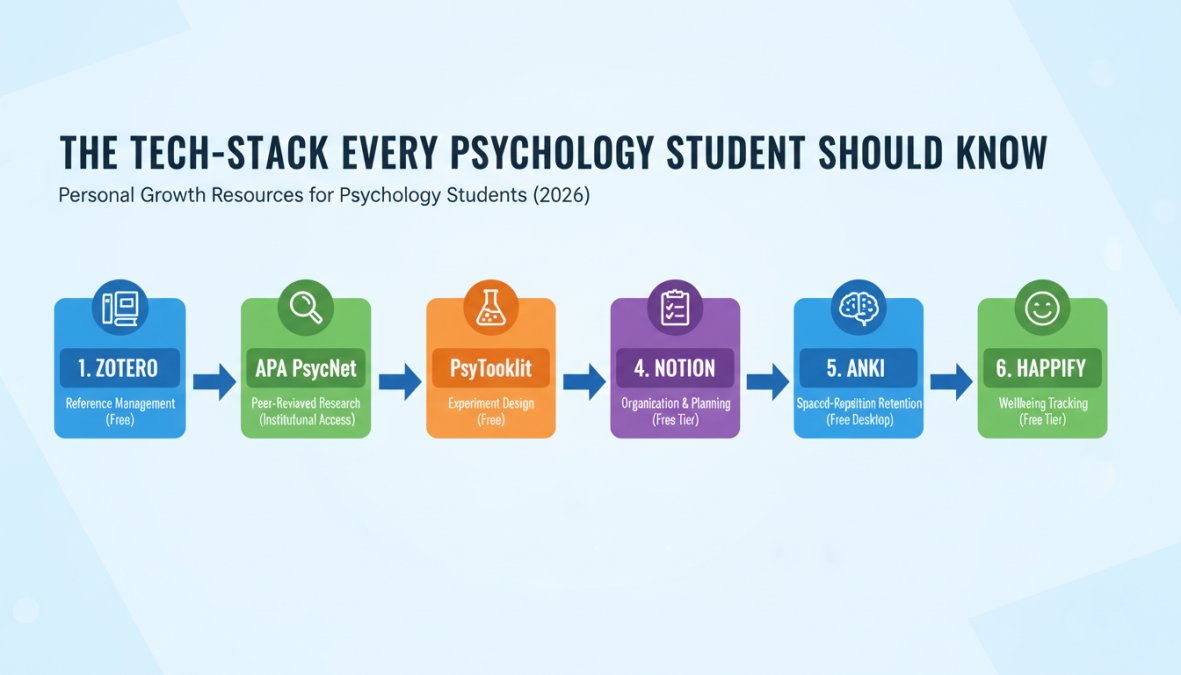
The Tech-Stack Every Psychology Student Should Know
Most technology guides for students focus on productivity in isolation. The better frame is to think about a coherent tech-stack: a set of tools that work together to cover research, organization, experimentation, retention, and wellbeing.
Notion: Organizing Your Academic and Personal Development Life
Notion functions as an all-in-one workspace for notes, project management, and personal development tracking. Its flexible database structure makes it well-suited to the non-linear nature of psychology study, where a single concept (attachment theory, for example) connects to clinical practice, research methodology, developmental psychology, and personal reflection simultaneously.
The most effective use for psychology students is building a personal knowledge management system: a database of concepts, linked readings, clinical observations, and reflective notes that grows across the entire program. Setup takes time initially. The payoff is a searchable, interconnected record of everything you have learned and thought, which is invaluable when writing theses or preparing for qualifying exams. The free personal tier covers most student needs.
PsyToolkit and 3D Brain: Research and Biopsychology Made Visual
PsyToolkit is a free platform for programming and running online psychology experiments and surveys. For research-focused students, it removes the barrier of needing institutional software licenses to design cognitive experiments or collect reaction-time data. The learning curve is real: effective use requires some technical familiarity. But for students working on experimental psychology projects, it is the most accessible research tool available at no cost.
3D Brain, developed by the Cold Spring Harbor Laboratory’s DNA Learning Center, provides interactive 3D models of 29 brain regions, each linked to functional information and current research. For biopsychology coursework, it is a more engaging and memorable learning tool than static textbook diagrams. Both tools are free.
Best Books for Psychology Students Personal Development
Most reading lists for psychology students either recommend dense academic textbooks or slide into generic self-help titles that would not survive a methods critique. The best books for psychology students personal development occupy a specific middle ground: they are grounded in peer-reviewed research, address the practitioner’s inner life alongside clinical skill, and hold up under the scrutiny of someone trained to evaluate evidence quality.
The following titles are organized by the developmental challenge they address, not by subfield, because that is how students actually experience their training.
For Understanding Your Own Psychology as a Practitioner
“The Mindful Therapist” by Daniel J. Siegel applies interpersonal neurobiology to the therapist’s own development. Siegel’s concept of “mindsight”, the ability to perceive the internal world of oneself and others, is directly applicable to both clinical work and personal growth. The book is rigorous enough to satisfy a neuroscience background and accessible enough to read during a demanding semester. It is one of the few texts that treats the therapist’s nervous system as a clinical instrument worth developing.
“On Becoming a Person” by Carl Rogers remains essential reading not because it is historically important (though it is) but because Rogers describes the process of psychological growth with a precision that most contemporary self-help books cannot match. His concept of the fully functioning person, open to experience, living existentially, trusting organismic valuing, gives psychology students a theoretically grounded framework for their own development that is entirely absent from generic growth literature.
For Managing the Emotional Weight of Clinical Training
“Trauma Stewardship” by Laura van Dernoot Lipsky addresses secondary traumatic stress and compassion fatigue with more specificity than any burnout-prevention article. Lipsky, who draws on decades of work in trauma-exposed settings, identifies sixteen specific trauma exposure responses, including hypervigilance, sense of persecution, and inability to empathize, and provides concrete practices for each. For psychology students entering clinical placements, this book functions as both a warning system and a recovery manual. It is not a light read, but it is the most practically useful book on this list for anyone entering a helping profession.
“The Gift of Therapy” by Irvin Yalom is structured as 85 short chapters of advice from an experienced therapist to trainees. Its brevity is strategic: each chapter addresses a specific clinical or professional challenge (self-disclosure, working with dreams, managing boredom in session) in a way that is immediately applicable. Yalom’s existential framework also provides a counterweight to the symptom-focused orientation of most clinical training, which is valuable for students developing their own therapeutic identity.
For Evidence-Based Personal Development
“Flourish” by Martin Seligman is the most academically credible positive psychology text accessible to a general reader. Seligman’s PERMA model, Positive emotion, Engagement, Relationships, Meaning, and Accomplishment, provides a measurable framework for wellbeing that psychology students can apply to their own lives without feeling they have abandoned scientific standards. Unlike many positive psychology books, “Flourish” engages seriously with the limitations of earlier happiness research and updates the framework accordingly.
“Mindset: The New Psychology of Success” by Carol Dweck is included here not because it is new (it is not) but because Dweck’s research on fixed versus growth mindsets has direct implications for how psychology students respond to academic failure, critical supervision feedback, and the steep learning curve of clinical training. The mechanism matters: students with a fixed mindset interpret a failed case conceptualization as evidence of incompetence; students with a growth mindset interpret it as information. That distinction has measurable effects on persistence and professional development.
For Navigating Graduate School Specifically
“Getting What You Came For” by Robert Peters is the most practical guide to graduate school survival available, covering everything from choosing an advisor to surviving the dissertation process. While not psychology-specific, its advice on managing advisor relationships, navigating departmental politics, and maintaining personal identity during an all-consuming program is directly applicable and more honest than most official program guidance.
When reading any of these books, treat them as you would a clinical text: annotate actively, connect concepts to your own experience, and discuss them in peer consultation. Passive reading produces recognition; active engagement produces integration.
A Note on E-Books and Accessibility
All titles listed above are available in e-book format through major platforms. Students with institutional library access should check whether their university subscribes to ProQuest Ebook Central or EBSCOhost, both of which carry academic and professional texts that would otherwise require individual purchase. Many psychology program libraries also maintain physical copies of foundational texts like Rogers and Yalom that can be borrowed without cost.
Professional Development, Networking, and Internships
Professional development for psychology students is not a post-graduation concern. The networks, experiences, and professional identity you build during training directly shape the opportunities available after it.
The most effective professional development activities for students:
- Join a professional organization early. The American Psychological Association (APA) and its divisions offer student membership rates, conference access, and networking opportunities that are significantly harder to access after graduation. Division membership connects you with practitioners in your specific subfield.
- Seek internships with intentionality. The best internships for psychology students are not necessarily the most prestigious ones. They are the placements that expose you to the population and modality you want to specialize in, under supervisors who invest in trainee development.
- Publish or present undergraduate and graduate research. Conference presentations and co-authored publications build credibility and professional identity while still in training.
- Build a supervision network, not just a supervisor. Relying on a single supervisor creates vulnerability. Consulting relationships with multiple senior practitioners produce more rounded professional development.
The APA’s resources for student professional development include mentorship programs, early career psychologist networks, and guidance on navigating the internship match process.
Financial Literacy and Growth Mindset for Psychology Students
Financial literacy is almost never included in personal growth resources for psychology students, and that omission has real consequences. Psychology graduate training is among the longest and most financially complex pathways in higher education: doctoral programs routinely run five to seven years, clinical internship stipends are frequently below living wage in high-cost cities, and the post-graduation income trajectory varies dramatically by specialization. Treating financial planning as a post-graduation concern is one of the most expensive mistakes psychology students make, not because of poor intentions, but because no one in their program tells them otherwise.
This section covers the financial structures specific to psychology training, not generic budgeting advice. The goal is to give you enough working knowledge to make informed decisions during training, not after it.
Understanding the Funding Landscape Before You Commit to a Program
The single most consequential financial decision most psychology students make is choosing between a funded and an unfunded program, and many make it without fully understanding the difference.
Funded doctoral programs (common in research-focused PhD programs) typically provide a tuition waiver plus a stipend in exchange for research or teaching assistantship work. Stipend amounts vary significantly by institution, program, and geographic location. The critical variable is not the stipend amount in isolation but the stipend-to-cost-of-living ratio. A stipend that covers living expenses in a mid-sized city may leave a student in significant debt in a high-cost urban area, even with a tuition waiver.
Unfunded programs (more common in PsyD programs and some clinical PhD programs) require students to pay tuition, often through federal loans. The total debt load at graduation from an unfunded professional psychology program can be substantial, and the repayment timeline intersects with a career phase, postdoctoral training, early licensure, when income is still limited.
Questions to ask before accepting any offer:
- Is the funding guaranteed for the full expected program duration, or is it contingent on satisfactory progress reviews?
- Does the assistantship stipend come with health insurance, or is that an additional cost?
- What is the average time-to-degree for funded students in this program? (Longer programs mean more years at stipend income before professional earnings begin.)
- Are there additional fellowship or grant opportunities available to students in years when assistantship funding is not guaranteed?
Public Service Loan Forgiveness: What Psychology Students Need to Know Early
Public Service Loan Forgiveness (PSLF) is a federal program that forgives the remaining balance on Direct Loans after 120 qualifying monthly payments made while working full-time for a qualifying employer. For psychology students planning careers in community mental health centers, public hospitals, university counseling centers, nonprofit organizations, or government agencies, PSLF is one of the most significant financial tools available, and one of the most misunderstood.
The key mechanisms to understand:
- Qualifying payments begin during repayment, not during training. Payments made during graduate school deferment do not count. The 120-payment clock starts when you enter repayment, which typically means after graduation or when you leave school.
- Income-Driven Repayment (IDR) plans are required. PSLF requires enrollment in an IDR plan (such as SAVE, PAYE, or IBR). These plans cap monthly payments at a percentage of discretionary income, which means payments during early-career, lower-income years are often very low, sometimes zero, and still count toward the 120.
- Employer certification matters. Not all psychology employers qualify. Private practice, for-profit behavioral health companies, and most private hospitals do not qualify. Verifying employer eligibility before accepting a position is essential, not optional.
- The timeline is ten years of qualifying employment. For psychology students who complete a doctoral program, postdoctoral fellowship, and early career position all within qualifying employers, PSLF forgiveness is achievable within a realistic career timeline.
Federal Student Aid’s PSLF information and employer search tool
PSLF rules and qualifying plan structures have changed multiple times in recent years. Always verify current eligibility requirements directly through the Federal Student Aid website rather than relying on program advisors or peer information, which may be outdated.
Paid Research Assistantships: Finding and Negotiating Them
Research assistantships (RAs) are among the most underutilized financial resources available to psychology students, particularly at the master’s level where funding is less common than in doctoral programs. An RA position provides stipend income and, in many cases, tuition remission in exchange for contributing to a faculty member’s research program.
Strategies for finding and securing RA positions:
- Look beyond your home department. Psychology research methods are applicable across departments, public health, education, social work, neuroscience, and business schools all run studies that benefit from psychology-trained research assistants. Expanding your search across departments significantly increases the pool of available positions.
- Identify faculty with active grant funding. Faculty with current NIH, NSF, or foundation grants have budget lines for research personnel. Grant databases like NIH Reporter are publicly searchable and show which faculty at your institution have active funding and in what amounts.
- Approach faculty before positions are posted. Most RA positions are filled through direct faculty outreach, not job postings. A well-crafted email demonstrating familiarity with a faculty member’s research and articulating specific skills you bring (SPSS, R, qualitative coding, participant recruitment) is more effective than waiting for a formal listing.
- Negotiate the scope, not just the stipend. If a stipend is fixed, negotiate for conference travel funding, co-authorship opportunities, or flexible hours that allow you to maintain other professional development activities.
Tracking Finances as a Data Practice
Psychology students understand the value of behavioral tracking: you cannot change what you do not measure. The same principle applies to personal finances, and the implementation does not need to be complex.
A minimal viable financial tracking system for graduate students:
- One spreadsheet or app tracking monthly income and fixed expenses. Free tools like YNAB (You Need A Budget) or even a Google Sheets template provide enough structure for a graduate student budget. The goal is not optimization, it is awareness.
- A separate line item for loan interest accrual. Many students on deferment or income-driven plans do not track how much interest is accumulating on their principal. Watching this number monthly creates the kind of behavioral feedback that motivates action.
- A quarterly review of IDR recertification deadlines. Income-driven repayment plans require annual income recertification. Missing the deadline can result in payment increases. Treating this as a calendar event, not an afterthought, prevents avoidable financial setbacks.
Financial literacy for psychology students is not about becoming a personal finance expert. It is about understanding the three or four structural decisions, program funding, loan repayment strategy, employer type, and assistantship access, that will shape your financial reality for the decade after graduation. Getting those decisions right during training is significantly easier than correcting them afterward.
Connecting Financial Planning to Professional Identity
Specialization decisions in psychology are often made on the basis of clinical interest alone, with compensation trajectories treated as secondary. This is understandable, most people enter psychology because they want to help people, not because of salary projections, but it creates avoidable financial stress when the reality of post-graduation income meets the reality of loan repayment.
Clinical psychology, counseling psychology, school psychology, neuropsychology, and industrial-organizational psychology have meaningfully different compensation structures, practice settings, and PSLF eligibility profiles. Understanding these differences during the specialization decision, not after it, is a form of professional self-care that programs rarely frame that way but should.
The APA’s Center for Workforce Studies salary and career data publishes regular surveys of psychologist compensation by specialization, setting, and career stage. It is one of the most reliable public sources for understanding what different psychology career paths actually pay, and it is free to access.
How to Build Your Personal Growth Resources as a Psychology Student
Building a sustainable personal growth practice as a psychology student requires a system, not a collection of apps and books. The distinction matters: a system has structure, feedback loops, and intentional design. A collection is what you accumulate when you respond to every recommendation without integrating anything.
Here is a practical framework for building your personal growth resources as a psychology student:
Step 1: Audit your current state (Week 1)
Assess four domains: academic performance and confidence, emotional wellbeing, professional development progress, and physical self-care. Rate each on a 1-10 scale and identify your lowest-scoring area.
Step 2: Select one tool per domain (Week 2)
Do not start with everything. Choose one academic support tool (Anki or Zotero), one reflective practice exercise (journaling or peer consultation), one wellbeing app (MindShift CBT or Happify), and one professional development action (joining a division or scheduling an informational interview).
Step 3: Build the habit before adding complexity (Weeks 3-6)
Consistency with simple tools outperforms occasional engagement with sophisticated ones. Four weeks of daily 10-minute journaling produces more self-knowledge than four sessions of elaborate reflection once a month.
Step 4: Review and iterate quarterly
Every three months, reassess the four domains from Step 1. What improved? What stagnated? Adjust your tool selection accordingly.
Step 5: Integrate professional and personal development
The most efficient approach to personal growth resources for psychology students treats professional skill-building and personal wellbeing as the same project. Reflective practice exercises build clinical competence and self-awareness simultaneously. Supervision addresses both professional development and emotional processing. This integration is what distinguishes psychology students from students in other fields: your professional tools are also your personal growth tools.
Joseph Kelly’s LifeCraft platform supports exactly this kind of structured, intentional approach to lifelong growth, with free resources alongside comprehensive programs designed for people who take self-development seriously. The Growing Light Series, in particular, offers the kind of evidence-based framework that psychology students will recognize as methodologically sound rather than aspirationally vague.
The American Psychological Association’s guidelines for self-care in psychology training reinforce that structured personal development is a professional competency, not an extracurricular activity.
Psychology training demands more than academic achievement. It asks you to develop yourself as the primary instrument of your professional work, which means that investing in personal growth resources for psychology students is not optional. It is the work. The challenge is doing it systematically rather than reactively. Joseph Kelly’s evidence-based programs, including the Growing Light Series and the LifeCraft platform, provide the structure and free resources to make that systematic approach accessible from day one of your training. Get started with Joseph Kelly and build the intentional development practice your training and your future clients deserve.
Frequently Asked Questions
Why is personal growth important for psychology students?
Psychology students are uniquely positioned where their personal wellbeing directly affects their academic performance and future clinical practice. Developing self-reflection, emotional intelligence, and resilience through personal growth resources helps students manage the emotional demands of the field, avoid burnout, and become more effective practitioners. Engaging with evidence-based tools also deepens understanding of the very theories being studied, bridging the gap between academic knowledge and real-world application.
How can psychology students practice self-care during their studies?
Effective self-care strategies for psychology students include using CBT-based apps like MindShift CBT to manage academic stress, building structured daily routines, and scheduling regular breaks using the Pomodoro technique. Journaling and reflective practice exercises are also highly effective. The key is consistency over intensity, small daily habits such as mindfulness, peer support, and setting firm boundaries around study hours can significantly reduce burnout risk and improve overall wellbeing throughout the degree.
What are the best books for personal development in psychology?
The best books for psychology students personal development blend humanistic psychology with practical self-actualization strategies. Titles grounded in positive psychology, growth mindset research, and cognitive psychology tend to be most applicable. Look for books that connect psychological capital concepts, hope, resilience, optimism, and efficacy, to everyday student life. Pair reading with reflective practice exercises to embed insights. Resources like the Joseph Kelly Growing Light Series offer structured, evidence-based frameworks designed specifically for intentional personal growth.
Do psychology students need their own therapy?
Many training programs and professional organizations strongly recommend that psychology students engage in their own therapy, and some require it. Personal therapy supports self-reflection, helps students process vicarious trauma from clinical placements, and builds empathy. It also offers first-hand experience of the therapeutic process, which enhances clinical practice skills. While not always mandatory at undergraduate level, therapy is widely considered one of the most valuable personal growth resources for psychology students at any stage.
How do psychology students balance academic stress with personal development?
Balancing academic stress with personal development requires treating growth as part of the curriculum, not separate from it. Use tools like Notion to schedule both study sessions and self-care activities. Apply positive psychology interventions, such as gratitude journaling or strengths-based goal setting, alongside your coursework. Recognize that building resilience and emotional intelligence is directly relevant to your degree. Structured platforms like Joseph Kelly’s LifeCraft can help integrate personal development goals with academic planning in a sustainable, intentional way.
What skills should a psychology student develop outside of class?
Beyond coursework, psychology students benefit from developing reflective practice habits, research literacy using tools like APA PsycNet and Zotero, and emotional intelligence through self-reflection exercises. Professional skills such as networking, understanding internships, and basic financial literacy are often overlooked but critical for career readiness. Building a growth mindset, remaining open to feedback and viewing setbacks as learning opportunities, is arguably the most transferable skill a psychology student can cultivate throughout their training.
Keep reading
- The Zeus in You: Why the Old Gods Still Describe the Mind
- Why I Am Guilty of Having No Shame
- The Unflappable You: How to Stop Letting Others Ruffle Your Feathers
- Don't Assume the Worst; Talk to Me About It First
- Possible vs. Probable: Why the Difference Shapes a Life
- Why Old Advice Suddenly Makes Sense Years After You Heard It
- Accept Belonging & Belong Acceptance
- Marcus Aurelius and Rumi: Two Paths to the Same Peace