Why Do Nervous People Make Me Nervous Before I Think To Ask Why?
Read "Why Do Nervous People Make Me Nervous Before I Think To Ask Why?" on Joseph Kelly's site.
| Emotional Contagion, Social Intelligence, Communication | 16 min read
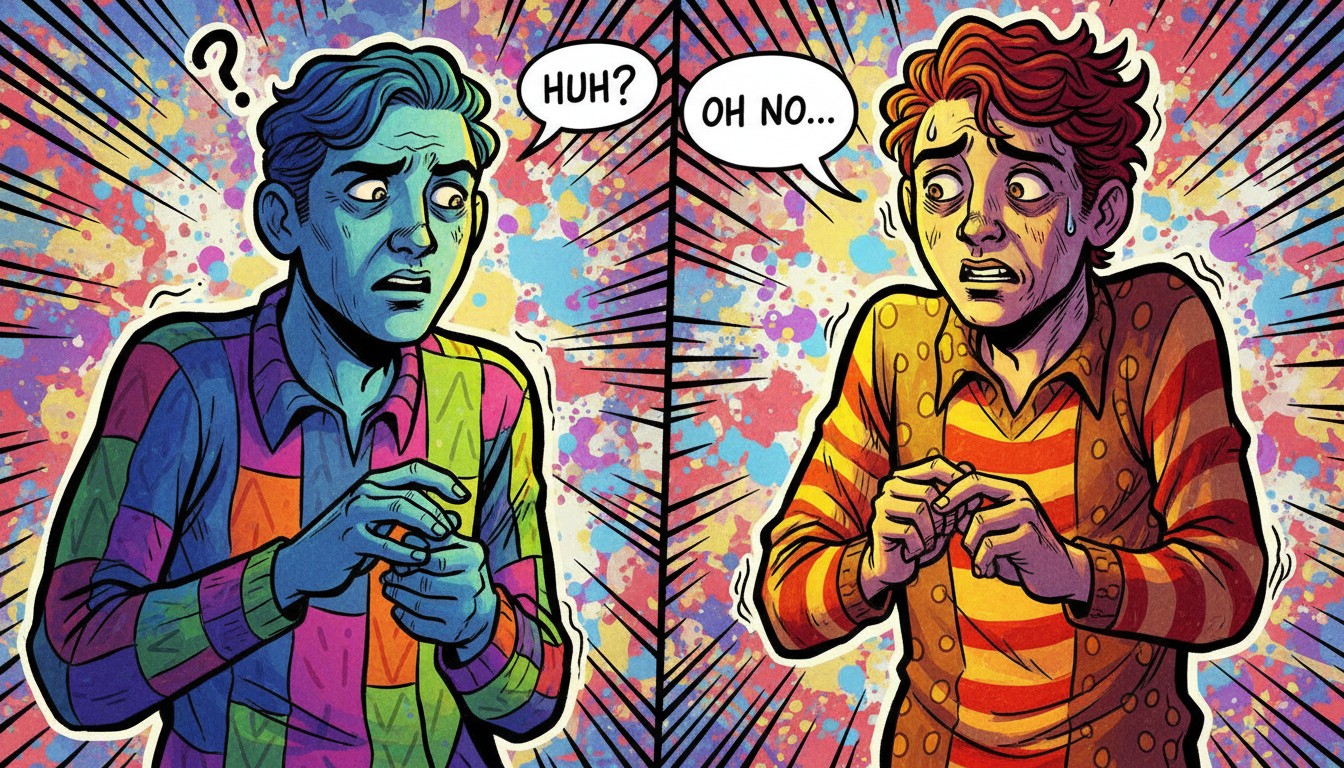
You're standing next to a coworker in the hallway a few minutes before he presents to the whole department, and he keeps checking his phone for no reason, clearing his throat, shifting his weight from one foot to the other. You haven't asked yourself why yet. You haven't even gotten as far as wondering what's making him tense. But your own stomach has already tightened, your own breath has already gone shallow, and whatever is moving through his body has started moving through yours before the question of why has had time to form.
This happens with more people than coworkers before a presentation. It happens with a friend whose voice keeps its usual rhythm but whose sentences have gotten shorter, clipped at the edges in a way you'd struggle to name even if someone asked you to point to the evidence. It happens on a crowded train when the person across from you starts glancing at the door every few seconds. In each case, something crosses the distance between another person's nervous system and yours, and it arrives before curiosity does. Not before explanation. Before the question itself. By the time you think to wonder what's wrong, your body has already answered a question your mind hasn't asked.
From there, your mind tends to do one of two things with a feeling it can't yet explain. It can decide the feeling belongs to you, absorbing his tension as your own free-floating unease. Or it can decide the feeling is evidence about him, some private guilt or hidden trouble you haven't identified and have made no real effort to ask about. Both responses are common. Both arrive fast. And both are assumptions, settled on before either of you has said a word about what's actually going on.
The Weather You're Standing In
There's a name for what happens in that gap, the space between feeling someone else's tension and even thinking to ask where it came from. Researchers call it emotional contagion, though the phrase sounds more mechanical than it feels from the inside. What actually happens is closer to something you already trust every day without examining it: you read weather in other people the way you read weather in the sky, gathering information from cues too fast and too subtle to name individually, and your own internal state shifts in response before your conscious mind has even gotten around to asking why.
This matters for a reason beyond curiosity. If you've spent time wondering why certain rooms exhaust you for no clear reason, why certain relationships leave you keyed up even when nothing overtly difficult was said, or why you sometimes carry a mood home that wasn't yours to begin with, part of the answer lives in how attuned your nervous system is to everyone else's, and how little say you have in that attunement.
What the Mirror Actually Does
In the early 1990s, a team of neuroscientists led by Giacomo Rizzolatti was recording the activity of individual neurons in the motor cortex of macaque monkeys, mapping which cells fired when a monkey reached for a peanut. Then something unexpected showed up in the data. The same neurons fired when the monkey simply watched a researcher reach for the peanut instead. The monkey's brain didn't distinguish cleanly between doing and watching. It modeled the researcher's action inside its own motor system, as though some part of it were reaching too, even while its hands stayed still.
The discovery of these mirror neurons, and the human research that followed, opened up a working explanation for a set of experiences you likely already recognize. Why watching someone yawn makes you yawn. Why a stranger's wince makes your own face tighten before you've registered what caused it. Why sitting across from someone anxious can leave your own body running a version of their alarm, your pulse quickening for reasons that belong to them. You're not simply observing another person's state from a safe distance. Some part of your nervous system is quietly simulating it, and that simulation carries real physiological weight whether or not you ever become aware it's happening.
Psychologists Elaine Hatfield, John Cacioppo, and Richard Rapson gave this pattern its working name in the early 1990s: emotional contagion, the tendency to automatically mimic and synchronize facial expressions, vocal tone, posture, and movement with the people around you, and, as a direct consequence, to converge with them emotionally. Their research found this synchrony happens largely outside conscious awareness. You don't decide to match someone's tense jaw or clipped breathing. Your body does it on its own, the way it adjusts its temperature without consulting you first, and that borrowed physiology becomes the raw material your brain later interprets, sometimes accurately and sometimes not, as a feeling that belongs to you.
Two Timelines, One Sensation
Here is where it becomes more specific to your own experience. Feeling something in your body and understanding what that sensation means are two different processes, running on two different timelines that rarely announce the gap between them. The neuroscientist Antonio Damasio spent decades studying how the body's internal signals, what he called somatic markers, inform emotional states before conscious reasoning arrives to offer an explanation. A tightening in the gut, a shift in heart rate, a subtle change in breath: these register first, as raw data, and the story about why you feel this way gets constructed afterward, often quickly enough that the delay goes unnoticed.
More recent research on interoception, the sense of your body's internal state, has sharpened this picture considerably. Sarah Garfinkel and her colleagues have shown that people vary substantially in how accurately they perceive their own internal signals compared with how strongly they believe they're perceiving them accurately. Some people feel their heartbeat quicken and correctly locate the cause outside themselves: someone else's anxiety, a shift in the room's tone, a conversation that's about to turn. Others feel the identical quickening and, lacking an obvious external explanation readily available, place the cause inside themselves instead, becoming quietly convinced that something is wrong with them specifically. The sensation is the same. The interpretation diverges completely, and that divergence shapes how anxious you end up feeling and how long the feeling lingers once its actual source has already left the room.
This is why you can stand next to someone for thirty seconds, never once wonder what's going on with him, and still walk away with your own pulse elevated. Your interoceptive system picked up the contagion in real time, well before your mind had gotten around to forming a single question about its source. Your interpretive system, working with incomplete information and a strong instinct to make meaning quickly, may have quietly assigned the feeling to you instead, closing the question before it ever opened.
The Circuitry Built Before You Had Words
The earliest version of this pattern gets built before you have language at all, which is part of why it operates below the threshold of conscious choice. In the late 1970s, developmental psychologist Edward Tronick ran what became known as the still-face experiment. A parent and infant would engage normally, faces animated, voices responsive, the ordinary back-and-forth of attunement moving between them like a conversation neither one could yet describe. Then, on cue, the parent's face would go flat and unresponsive for a short period. Infants who had been calm and engaged moments earlier became visibly distressed within seconds, reaching, vocalizing, trying every strategy available to restore the connection. When the parent's expressiveness returned, most infants recovered, though it sometimes took longer than the disruption itself had lasted.
What Tronick's research demonstrated is that regulation gets built first in relationship with others, through what psychiatrist Daniel Stern called affect attunement: the continuous, largely unconscious matching of emotional rhythm between caregiver and infant that teaches a developing nervous system what safety feels like in someone else's presence. You learned to read tension in other people's faces and voices before you learned to read a single word, because your survival once genuinely depended on it. That circuitry doesn't retire once you grow up and acquire a vocabulary for your own experience. It stays online, quietly running in every room you enter, which is part of why another person's unspoken anxiety can register in your body as clearly as spoken language, sometimes more clearly than the words they actually choose to say.
Psychiatrist Stephen Porges has described a closely related process he calls neuroception: the nervous system's continuous, non-conscious evaluation of whether an environment is safe, dangerous, or life-threatening, made through cues like tone of voice, the tension held in facial muscles, and the pace of someone else's breathing. Neuroception runs constantly, beneath the level of deliberate attention, adjusting your physiological state in advance of any conscious assessment you might otherwise perform. This is the mechanism behind the timing you notice in your own life: your body knows before you do, because the system built to protect you wasn't designed to wait for permission from your conscious mind before it acted.
When the Weather Moves Through a Whole Room
This pattern doesn't stay confined to one-on-one exchanges. Organizational psychologist Sigal Barsade studied what happens when emotional contagion moves through groups rather than pairs, running experiments with work teams making decisions together while one member, unknown to the others, had been trained to express either positive or negative mood. The results were consistent. Mood spread measurably through the group within the course of a single meeting, shaping not just how people felt but how they negotiated, how generously they interpreted each other, and how the group ultimately performed. Nobody in the room typically noticed it happening. Everyone simply experienced the meeting's mood as though it had arisen naturally from the substance of the conversation, rather than from one person's unprocessed tension quietly setting the emotional key for everyone else.
Anyone who has sat through a meeting that started tense and stayed tense, long after the original source of the tension had been resolved or simply forgotten, has felt this firsthand. The mood outlasts its cause. It circulates from person to person like something with a life of its own, because in a real sense it does, riding on faces and voices and the pace of people's breathing rather than on any argument being made out loud.
This is worth naming honestly, because it reframes something many people privately blame themselves for. If you leave certain meetings feeling drained in a way the actual content doesn't account for, if certain family gatherings leave your whole body in a state that has little to do with anything said at the table, you're not necessarily too sensitive or poorly regulated. You may be an accurate reader of an emotional climate that nobody in the room has named out loud, absorbing a weather system that was already moving through the space before you arrived.
The Story That Forms About Him
The first assumption stays inside you. The second one doesn't. It gets projected onto him, and it tends to have real consequences once it does.
Psychologist Fritz Heider, one of the founders of attribution theory, observed decades ago that people have a strong, largely automatic tendency to explain other people's behavior by pointing to something inside them, a trait, an intention, a hidden motive, rather than by looking at the situation surrounding them. Social psychologist Lee Ross later gave this tendency a name that has stuck: the fundamental attribution error, a systematic bias toward crediting a person's disposition over their circumstances when making sense of what they do. Applied to nervousness, the bias runs in a specific and consequential direction. Watching someone's hands shake or their eyes dart, the easier story to reach for isn't that almost anyone would look this way under similar scrutiny. It's that there's something wrong with him specifically. The situation itself, being questioned, being watched, being evaluated, tends to drop out of the explanation almost immediately, even though it's usually doing most of the actual work.
Paul Ekman, who spent much of his career studying the relationship between emotion and facial expression, gave the deception-specific version of this error its own name: the Othello error, after the moment in Shakespeare's play when Othello reads Desdemona's fear of not being believed as evidence of her guilt. An innocent person confronted with suspicion often becomes visibly anxious, not because she did anything wrong, but because she's afraid nobody will believe that she didn't. That fear produces the same outward signs, a racing pulse, shifting eyes, a catch in the voice, that people associate with the fear of being caught. From the outside, the two states can be almost impossible to tell apart. The nervousness of the wrongly suspected and the nervousness of the genuinely guilty run through remarkably similar physiological channels.
This has been tested directly, with consequences that extend well past a hallway. Psychologist Saul Kassin, who has spent decades studying police interrogations and false confessions, found that investigators trained in behavior-based deception detection, methods that instruct them to read gaze aversion, fidgeting, and nervous speech as signs of lying, perform no better than chance at actually telling truthful suspects from deceptive ones, and in some studies perform worse than untrained observers working from the same footage. Aldert Vrij's research reviewing decades of deception studies reaches a closely related conclusion from another angle: the nonverbal behaviors most people associate with lying, avoiding eye contact, fidgeting, a shaky voice, show up about as often in truthful people who are anxious about being disbelieved as they do in people who are actually lying. The cue that feels like the most obvious evidence of guilt carries, on the data, almost no diagnostic value at all.
Kassin's research on false confessions traces a troubling chain from there. Suspects who behave nervously under interrogation, often precisely because they are innocent and frightened, get read by investigators as more likely to be guilty. That misreading shapes how the interrogation proceeds, how long it lasts, and how much pressure gets applied, which in turn raises the odds of a false confession from someone whose only actual offense was being visibly afraid in a room built to make almost anyone afraid.
Part of what fuels that visible fear in the first place is a separate, well-documented bias: what psychologist Thomas Gilovich called the spotlight effect, the tendency to overestimate how closely other people are noticing and evaluating you. Someone being questioned or scrutinized, guilty or not, tends to feel intensely observed, and that feeling alone is often enough to produce visible nervousness with no wrongdoing required. The situation manufactures the exact behavior that later gets mistaken for its explanation.
This pattern shows up well outside interrogation rooms. It's the customs officer's gut read of a nervous traveler, the manager's suspicion of an employee who stammers through a routine question, the assumption that a hesitant teenager must be lying about where he was. In 2013, the Government Accountability Office reviewed the Transportation Security Administration's behavior-detection program, which trained officers to flag travelers displaying nervous behaviors, fidgeting, avoiding eye contact, excessive sweating, as potentially deceptive, and found no scientific evidence supporting the underlying premise. Nervousness at a security checkpoint, as it turns out, correlates reliably with exactly one thing: being at a security checkpoint. Most travelers, guilty of nothing beyond an ordinary fear of authority and delay, will produce some version of the very behavior the program was designed to catch.
Both assumptions, the one that lands inside you and the one that lands on him, start from the identical raw material: an ambiguous physiological signal and a mind that doesn't sit well with ambiguity. One path resolves the discomfort by absorbing the signal as your own. The other resolves it by converting the signal into a verdict about him. Both happen before either of you has said a single word about what's actually going on. Neither has asked a real question yet. Both are stories, arrived at quickly and felt as certainty, standing in for the inquiry that hasn't happened.
Learning What Belongs to You
None of this means you're at the mercy of everyone else's nervous system, carried along by whatever tension happens to walk into the room that day. It means the first question worth asking, when you notice unease arriving without an obvious cause, isn't "what's wrong with me" but "whose weather am I standing in right now." That single reframe does something practical. It returns the feeling to its actual source instead of leaving it to calcify into evidence about your own instability, which is what tends to happen when a borrowed feeling goes unexamined long enough.
This takes practice, mostly because the feeling arrives faster than the thought that could contextualize it. But it's a specific kind of practice, one you can build the same patient way you'd build any skill of noticing. When you feel your chest tighten or your breath shorten in someone else's presence, you can pause long enough to ask what you actually know, distinct from what you're currently absorbing. Sometimes the honest answer is that something genuinely concerning is happening and your body picked up on it accurately, well ahead of your conscious understanding, which is worth taking seriously rather than talking yourself out of. Other times the answer is that you've stepped into someone else's contagion field, their unprocessed stress moving through you the way weather moves through an open window, and the appropriate response isn't to solve it as though it belongs to you but to notice it, name it silently, and let your own system settle back toward its baseline.
Kristin Neff's research on self-compassion offers something useful here, even though it wasn't developed specifically for this problem. The practice of common humanity, recognizing that a difficult internal state connects you to shared human experience rather than exposing a personal failing, tends to lower the physiological intensity of distress. Applied to borrowed anxiety, this looks like reminding yourself, in the moment, that feeling someone else's tension isn't a flaw in your nervous system. It's evidence that the system is working exactly as it was built to, doing what it has done since long before you could speak a word about it.
One useful, unglamorous practice is something somatic researchers sometimes call orienting: letting your eyes move deliberately around the actual physical space you're in, naming a few things you literally see, rather than staying locked onto the person whose tension triggered the response in the first place. The practice works quietly, by handing your nervous system current, verifiable information about your own safety, information that got skipped over when your body reacted first and your conscious mind scrambled to catch up afterward. A few seconds of this, done quietly while someone else keeps talking, is often enough to loosen the grip of a feeling that wasn't fully yours to begin with, and to give you a clearer read on what, if anything, actually needs your attention.
There's also a boundary question worth naming plainly. Some relationships run on a steady current of unprocessed anxiety: a parent who narrates worst-case scenarios as a way of managing his own fear, a coworker whose stress becomes everyone's stress by the end of a meeting, a partner whose unspoken tension fills a room before he's said a word about what's actually bothering him. Being attuned to other people is not the same thing as being obligated to absorb whatever they haven't found a way to hold themselves. You can care about someone deeply and still decline to be the container for feelings they haven't named, even to themselves. That distinction, between empathy and absorption, is one most people learn slowly and often the hard way. It's worth learning on purpose instead, before the hard way finds you.
The second assumption asks something different of you, mostly because it doesn't feel like an assumption while you're making it. It feels like a read, an instinct, evidence gathered honestly. Working against it starts with a small, deliberate pause between noticing someone's nervous behavior and deciding what it means, a pause spent asking what else, besides guilt, could produce this exact set of signs. Being watched produces it. Being disbelieved in advance produces it. A bad night's sleep, an unrelated worry, a personality that runs anxious under any scrutiny at all, produces it. Guilt is one possible source among several plausible ones, not the default explanation the signal comes pre-labeled with. The only way to actually narrow the list is the step both assumptions skip: asking, directly and without accusation, what's going on, and then listening to the answer as real information rather than as confirmation of a verdict you'd already reached.
This has a second application worth naming, closer to home. If you've ever worried that your own visible nervousness, in an interview, in front of an authority figure, in a hard conversation where you badly wanted to be believed, might get misread as evidence that you did something wrong, that worry isn't paranoid. It's an accurate read of how the Othello error actually functions in other people's minds. Understanding the mechanism doesn't make the nervousness disappear, but it can loosen its second layer, the fear that being anxious about being misunderstood will itself look suspicious, which is precisely the loop Kassin's research documents happening to genuinely innocent people in genuinely consequential rooms.
---
You're standing in that hallway again sometime, next to someone whose foot won't stop tapping, and this time you notice two things happening in yourself, almost at once. You notice the tightening in your own chest arrive before the question does. And just behind it, you notice the beginning of a story about him, the quiet, fast conviction that he must be hiding something, guilty of some infraction you haven't identified and have made no effort to ask about. You let both sit there for a second, information rather than instruction, and only then do you go looking, out loud this time, for the question neither of you has actually asked yet. Not what's wrong with you. Not what's wrong with him. Something closer to: are you all right, and is there anything that would help.
Maybe it's the presentation. Maybe it's something else entirely, a phone call he got that morning that has nothing to do with either of you. Either way, you've done something quietly significant, twice over. You've let your own body's answer arrive first without mistaking it for a verdict about your state, and you've let the story forming about him arrive without mistaking it for evidence about his. Your nervous system will keep doing what it has long done, reading the room before you're consciously aware there's anything to read, and your mind will keep reaching for a story to resolve whatever it can't yet explain. What familiarity with this pattern makes possible, over time, is a small redirection at the moment that matters most: less quiet verdict, less private absorption, more of the plain, unglamorous offer that was available the whole time, spoken instead of assumed. The work runs in both directions at once: stay curious about what belongs to you, what belongs to him, and what you're simply, briefly, assuming, and let the question you finally ask be an offer rather than an accusation, the kind that treats someone else's nervous system as a reason to reach toward him, not a verdict to quietly reach about him.
Keep reading
- The Zeus in You: Why the Old Gods Still Describe the Mind
- Why I Am Guilty of Having No Shame
- The Unflappable You: How to Stop Letting Others Ruffle Your Feathers
- Don't Assume the Worst; Talk to Me About It First
- Possible vs. Probable: Why the Difference Shapes a Life
- Why Old Advice Suddenly Makes Sense Years After You Heard It
- Accept Belonging & Belong Acceptance
- Marcus Aurelius and Rumi: Two Paths to the Same Peace