The Borrowed Life: Vicarious Living & Social Learning for Self-Awareness & Life Lessons From The Experiences of Others
Other people's lives hold lessons your one life cannot afford to buy. Vicarious living as a deliberate practice, and what it quietly changes in you.
| Emotional Contagion, Connection, Compassion, Social Intelligence, Consideration, Communication, Mindful Listening, Understanding, Metacognition, Cognition, Emotional Intelligence, Interconnection, Prospection, Trust In Intimacy, Trust In Inner Wisdom, Trust In The Universe, Cognitive Reframing, Positive Inner Dialog, Emotional Wellness, Self-Care, Resilience, Boundaries, Vulnerability, Identity, Authenticity, Self-Authorship, Personal Energy, Transformation, Conscious Creation, Intentional Living, Lifelong Learning, Baseline Elevation, Sustainable Inner Peace, Lasting Contentment | 14 min read
A friend of mine spent two years and most of his savings opening a restaurant, and I heard the whole story twice: first while it was happening, over coffees that grew longer the closer the opening came, and then a year later, after it closed, in one long evening that started apologetic and ended somewhere wiser. I have never owned a restaurant. I never will. And I know things about it now that no book about the restaurant business taught me: how the mistake is never the menu, how the second year is lonelier than the first, how a man can do everything the experts advise and still watch the room stay half empty on a Friday. His experience did not become mine. Something more useful happened: it became available. I have made three decisions since that evening with his story open in my mind, and each one went differently than it would have before, and cheaper, which is the whole point of this essay.
Everyone lives exactly one life. Everyone knows this and mostly walks around pretending otherwise, since the pretending is load-bearing: it keeps the horizon open and the dread at bay. But the arithmetic does not care about our pretending. One body, one hometown, one career's worth of mornings, one vantage point from which no other mind is ever directly visible. A hundred years, if fortunate, and every one of them spent inside the same weather.
And yet you have stood at the edge of the Grand Canyon. You know the smell of a hospital corridor and the particular silence of a house the morning after a party. You know what it does to a person to be publicly wrong, to be suddenly unemployed, to hold a newborn whose entire dependence arrives as a weight in the chest. Much of what you know, you never lived. It arrived by other roads: a friend's account at a kitchen table, a memoir that held nothing back, a story told by a grandmother until the grandchildren could recite it. The first piece in this series called the imagination a second channel of experience. This piece is about the traffic that travels into that channel from other people, the oldest and most consequential freight of all, and about the strange truth that the experience is not diminished by being borrowed. It is concentrated.
The kitchen table deserves its history, since the practice is older than any name it will be given here. Before writing, before printing, before the screen, human experience traveled in exactly one format: the account of a life, told by the people who survived it to the people who would need it. The elders' stories were not entertainment. They were the species' only storage system, the compressed survival knowledge of every life before yours: which winters to fear, which relatives to trust with a dowry, what grief does to the person who will not speak of it. The grandmother telling the story until the grandchildren can recite it was running the deepest technology her era possessed. The technology never went away. It just stopped being honored with attention, which is not the same as being replaced, and part of what this essay hopes to restore is the receiving side of an arrangement that deserves better than a half-listened podcast.
Two currents of the same river: learning from other lives
The psychologists who study learning split the traffic into two currents, and both matter, so take them in turn. The first current runs through story. Call it vicarious living: receiving another person's lived experience through their account of it, the memoir, the kitchen table, the testimony, the novel that makes you into someone else for three hundred pages. The second current runs through observation. Psychology calls it social learning, and Albert Bandura spent a fifty-year career establishing that human beings learn massively, constantly, and often unconsciously from watching what other people do and what follows. The child who spanks a doll after witnessing aggression was demonstrating something adults prefer not to notice about themselves. The apprentice who absorbs the master's habits without a word of instruction was doing the oldest thing learners do.
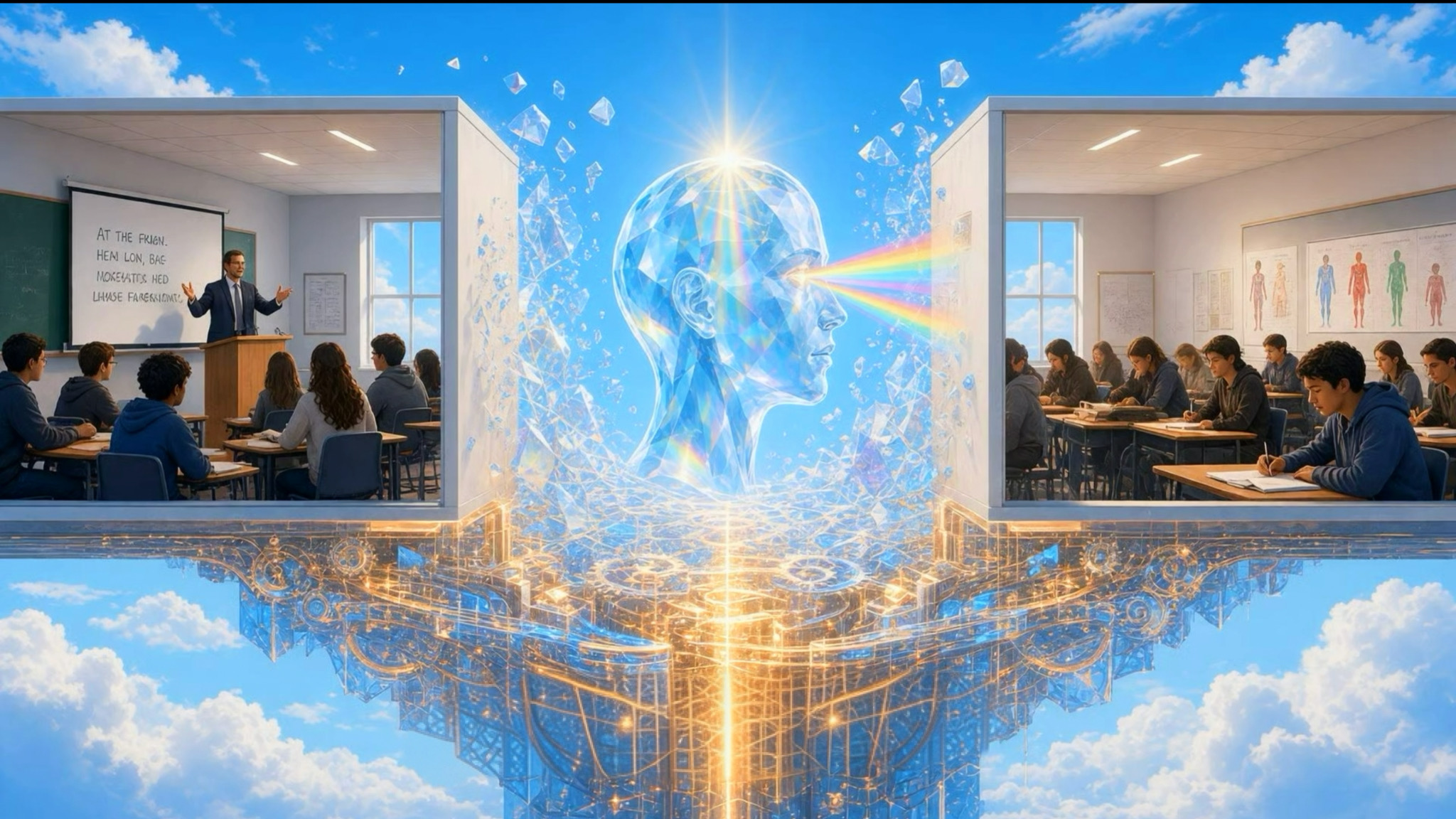
The two currents are usually taught separately, in different textbooks, by different departments. The separation obscures what they share, which is the machinery underneath. Both run on the simulator this series has been mapping. A story is installed in you and then run: your own mental machinery produces the feel of the events, the fear in the second act, the relief in the resolution. Observation does the same thing at lower resolution: watching someone wince at a bad deal sends your own wince through you, at a discount, with their face on it. Learning from other lives is imagination fed by an external source, and the four questions this essay will teach you to ask are addressed to that feed.
The four states of an experience
Here is the heart of the piece, and it asks for a small act of trust before it earns its keep. When an experience arrives, yours or anyone's, it arrives through four channels at once. There is the energetic: the arousal and depletion, the aliveness or flatness, the tempo of a life in a period. There is the mental: the beliefs, the assumptions, the story the person told themselves about what was happening. There is the emotional: the feelings as felt, and the feelings as later understood, which are rarely the same feelings. And there is the practical or material: what actually happened in the world of money, bodies, places, and consequences.
Most people absorb other lives through one channel at a time, and usually the wrong one. The gossip economy of other people's decisions runs almost entirely in the practical: she left the job, he lost the house, they moved to the coast. Facts move, and nothing is learned, which is why the same mistakes can be watched a dozen times in other families and still be made, freshly, by each new member. The memoir industry mostly sells the emotional channel: the feel of the fall and the triumph, moving as art, thinning as instruction. What survives as instruction is the integration, all four channels held together until they fuse into something like having been there. The energetic without the practical is mood with no map. The practical without the emotional is news. The four together, fused, are experience, and experience is the only teacher that has ever worked.
So the practice this essay teaches is a discipline of reception, and it can be stated in one sentence: when an experience of another person reaches you, take it through all four states deliberately, as if you had lived it yourself. The phrase as if is doing the heavy lifting, so let it be defended. You will never live their life. The nervous system, remarkably, does not require the fact. What it requires is fidelity of attention, the same fidelity the craftsman's rehearsal demanded in the last piece, pointed at a life instead of a skill.
The practice also runs backward, and for most readers this is where its first real payoff waits. You are already full of borrowed lives, taken in thin and before you had any say: a parent's way of handling money or refusing to discuss it, a teacher's contempt delivered without warning, a sibling's role in the family theater, a coach's idea of what you were worth under pressure. These were installed as social learning installs things, all at once and below inspection, and they run to this day as your reflexive beliefs about money, authority, and worth. Take any one of them through the four states now, deliberately, with the years you have: what did it cost that parent in aliveness, what did the teacher believe about themselves that day, what did the child feel then and what do you make of it now, what actually happened in dollars and consequences. Lives received thin can be re-received thick, and a reflex examined across all four states loses a portion of its reflexiveness. Some readers will find in this paragraph the origin of a belief that has been running their practical life unexamined for decades. That discovery is the practice working, and the retrospective version requires nothing from anyone but you.
How the practice is done
Consider how it runs. Choose one experience, one account, held by one person, received well: a friend's divorce told honestly over a year of coffees, a memoir read slowly rather than devoured, an elder's story of the decision that split the family. Give it what television gives nothing: a second pass. The first pass of any story is consumed in the present tense, carried along, feeling what arrives. The second pass is where the work lives, and the four states are its map.
Begin with the energetic, since it is the channel most receivers skip. What did it cost them in aliveness? Not in happiness, which is a later question, but in electricity: the weeks of the marriage failing when they describe their sleep, the strange lightness of the weeks after the decision that could not be taken back. An account told well answers this question without being asked, in tempo and detail: notice how the storyteller speeds up here, goes flat there, and what the flatness sat next to.
Move to the mental, and linger, since this is where vicarious wisdom actually gathers. What did they believe at the time, before the ending was known? What did they assume was permanent that turned out not to be? The beliefs a person holds mid-crisis are the invisible cargo of every story, and the storyteller will usually hand them over if asked one question: what did you think was happening, at the time?
Then the emotional, twice: as felt then, as understood now. The tears in the telling belong to the then. The calm sentences years later, the ones delivered slowly and with strange precision, are the now, and the distance between the two is the lesson. Ask directly: what do you make of it now, that you did not make of it then?
And last the practical, which most receivers mistook for the whole story: what actually happened, in decisions, dollars, addresses, and days. The money channel of other people's experience is the one everyone watches and no one absorbs, since hearing about a bankruptcy teaches nothing about the feel of signing the papers. Facts complete the picture without dominating it.
The method may need one worked example to be fully honest about its cost. Take a memoir read slowly, an account of a family business lost, and watch the states stack. Energetic: the account of the final winter, told in flat sentences with no detail, the tempo itself reporting the depletion. Mental: what the founder believed the whole time, that the building and the name were the business, when the business was actually two customers who paid late. Emotional, then versus now: the humiliated fury in the remembered scenes, and the strange tenderness of the version told thirty years later, the same events carrying an entirely different weight. Practical: the exact debts, the dates, the house that went, the job taken at fifty-four. Separately, four observations. Fused, something with the unmistakable weight of having been there, and the transfer question writes itself: what am I currently calling the business, when the actual customers are two and one of them pays late?
If it appeals to you, the practice fits into an evening. One experience, one account, a second pass through four states: what it cost in energy, what they believed, what they felt then and now, what actually happened. Then one transfer question, asked of yourself, out loud or on paper: what would I do differently, holding what they hold? And then, since wisdom unapplied is trivia: one small real-world application attempted within days, because the research on observational learning has long shown that modeled behavior consolidates best through enactment. A borrowed lesson that never touches your own life remains a borrowed lesson. Touched, it becomes yours.
Reception has a budget, whatever the feed suggests. A person can genuinely absorb only so many lives in a season, and the hours given to one account are hours not given to another, which makes the choosing worth doing on purpose. The thin sources have a marketing budget and the thick ones do not: nobody advertises an evening with an elder, and everything advertises the surge of the latest everyone. So curate like the craftsman you have already become in the workshop piece: favor accounts told slowly by people who stayed for the consequences, close and recent over distant and curated, the divorce told over a year of coffees over the divorce announced in a caption. And favor the lives that ended where you would not like to, since failure told honestly carries more transferable freight than triumph told promptly, for the reason this series keeps meeting: the survivors of their own decisions know things the winners of good luck were never required to learn.
Watching, the second current, runs through the same four states with one adjustment: nothing is narrated to you, so you supply the account yourself, and the discipline is asking the questions of what you can see. Watch a colleague walk into the meeting that has been looming for a month. Energetic: the tempo of their morning, the flatness or the crackle. Mental: what they believe this meeting is about, which is almost never the agenda. Emotional: the difference between what their face is doing and what their sentence structure is betraying. Practical: what they actually ask for when the moment comes. A year of meetings watched this way is a quiet education in the people around you, and it has a side effect worth naming: watching others through four states trains a habit that turns, eventually and usefully, on yourself.
The evidence of borrowed experience
The research underneath all this runs deeper than one would guess from how rarely it is taught. Bandura's observational learning established the foundation: humans acquire behaviors, skills, and emotional responses by watching models, and what they watch they rehearse internally, which is why the famous Bobo doll experiments found children reproducing aggression they had merely witnessed, and why the pedagogical implication has never stopped arriving: behavior shown is behavior taught, for better and worse. Later work on narrative finds the same machinery running on story. Research on narrative transportation, the state of being absorbed into a story, shows that transported readers change beliefs and intentions in the direction of the story, and that the changes persist in ways that outlast the reading. And the famous claim that reading literary fiction improves theory of mind, arrived at by David Comer Kidd and Emanuele Castano in 2013, has weathered into something more honest and more interesting: the single-session studies failed to replicate cleanly, while the correlation across lifetimes holds. Reading a short story is not a vitamin. Decades of borrowed lives is a regime, and the regime is what correlates with a sharper social mind.
The workshop current deserves its own note, since the last piece taught craft and this one would be incomplete if it stayed in the kitchen. The apprenticeship tradition ran on exactly the observation current this essay describes: watch the work for a year, do the edges of it for two more, and absorb what was never said aloud. What the apprentice absorbs includes the invisible states the four-channel practice makes explicit: the master's tempo when the work goes wrong, the beliefs about materials that were never in any manual, the felt standards that made the master redo a joint no customer would ever have inspected. What was transmitted was not technique. Technique can be written down. What was transmitted was a way of being at the work, which is why the guilds lasted centuries and why their collapse into coursework left something missing that no curriculum fully replaced: the model, in person, whose standards you could feel before you could name them.
An honest accounting of borrowed experience has to include the borrowings that taught the wrong thing, since the same machinery runs without supervision. The child absorbing a parent's contempt for a neighboring family learns it as thoroughly as any trade. The teenager calibrating a body image from a screen full of curated faces is running social learning on the highest-resolution equipment ever pointed at a human insecurity. Two generations of advertising is social learning deployed by professionals, against civilians. The four-state practice is also a defense: experience taken through all four channels, energy, belief, feeling, fact, cannot easily be installed by a thirty-second version that carries only the practical promise and the emotional glow. The thick version of an experience is also the antidote to the thin ones.
Something subtler than wisdom also travels the four channels, and the practice develops it whether aimed at or not. Taking an experience through all four states is the deepest form of listening a person can do, and people who have been received this way describe it the same way across contexts: they say they felt met. The difference between hearing a story and taking it through energy, belief, feeling, and fact is the difference between knowing someone's news and knowing their weather, and the receiver is changed by the receiving. This is one of the reasons close friendship deepens with the telling, and it explains why the practice works best received slowly: a life taken in at four states cannot be rushed without becoming again the thin version the gossips trade in.
One boundary needs drawing in ink, since the practice runs close to something that looks like it and is not it. Taking in another person's experience as if yours is not the same as dissolving into it, and the difference matters most for the people who love hardest. Emotional fusion, feeling another's state so completely that their panic becomes your panic, helps no one and helps least the person drowning: a rescuer in the water is a second casualty. The four-state discipline keeps its border crossings deliberate by design. You visit the experience; you were never required to move in. The energetic gets received and then set down; the practical gets learned and stays learnable; the return is built into the practice, a second pass with edges, an evening with an end. Receiving a life this way is closer to what the artisans call lost-wax casting than anyone has said in polite company: the original goes into the mold, and what comes out is not the person, but the shape of what they survived, held now in a form that can do new work.
What the borrowed life cannot do
And yet the borrowed life has a hard limit, and honesty about it belongs here rather than in a footnote. Experience taken from another person, however deliberately received, however integrated across all four states, is still a simulation run on your machinery, fed by their account. It is not their life. Some of what they knew will never reach you, and the deepest part of their experience may be exactly the part that does not translate: the private texture of their fear, the meaning they made that their words only point at. The next piece in this series sits with that limit directly, because the limit has a practical face: the more vividly you imagine another person's inner world, the more confidently you risk confusing your projection with their reality. Borrowing lives is for wisdom, and asking is for truth, and the two are often confused with disastrous politeness.
But the limit does not humble the practice into uselessness, and the closing arithmetic belongs to my friend with the restaurant. I never signed a lease, hired a kitchen, or watched a dining room stay empty on a Friday. And I know, in a way that has changed decisions and saved me real money and real years, what the second year of a small business does to a person's inner life: the aliveness it drains, the beliefs it dismantles, the feelings it reorders, the practical ledgers it writes. His experience did not become mine. It became available, and available has been enough to work with. The life you are living is the only one you will have, and it is enough, and the lives around you, honestly received, multiply what that one life can teach. That multiplication is old, quiet, free, and running tonight at a kitchen table near you, if you bring it all four states and a second pass.
Keep reading
- The Craftsman's Workshop: Process Visualization & Mental Rehearsal for Skill Mastery & Continuous Improvement
- The Calming Rehearsal: Guided Imagery & Relaxation Imagery for Stress Relief & Anxiety Management
- The Simulator in Your Head: What Imagination Is Actually For
- The Zeus in You: Why the Old Gods Still Describe the Mind
- Why I Am Guilty of Having No Shame
- The Unflappable You: How to Stop Letting Others Ruffle Your Feathers
- Don't Assume the Worst; Talk to Me About It First
- Possible vs. Probable: Why the Difference Shapes a Life