The Care Bears, Their Opposites, and the Case for Caring Well
The Care Bears have ten opposites who answer every crisis with a shrug. What do they get right, and why does caring still matter? Come take a closer look.
| Self-awareness, Emotional Wellness, Self-Care, Trust In Inner Wisdom, Personal Energy, Meaningful Contribution, Sustainable Inner Peace, Anxiety & Stress, Wisdom, Perspective, Consideration, Emotional Intelligence, Affect Regulation, Social Intelligence, Connection, Compassion, Empathy, Emotional Contagion, Interconnection | 15 min read
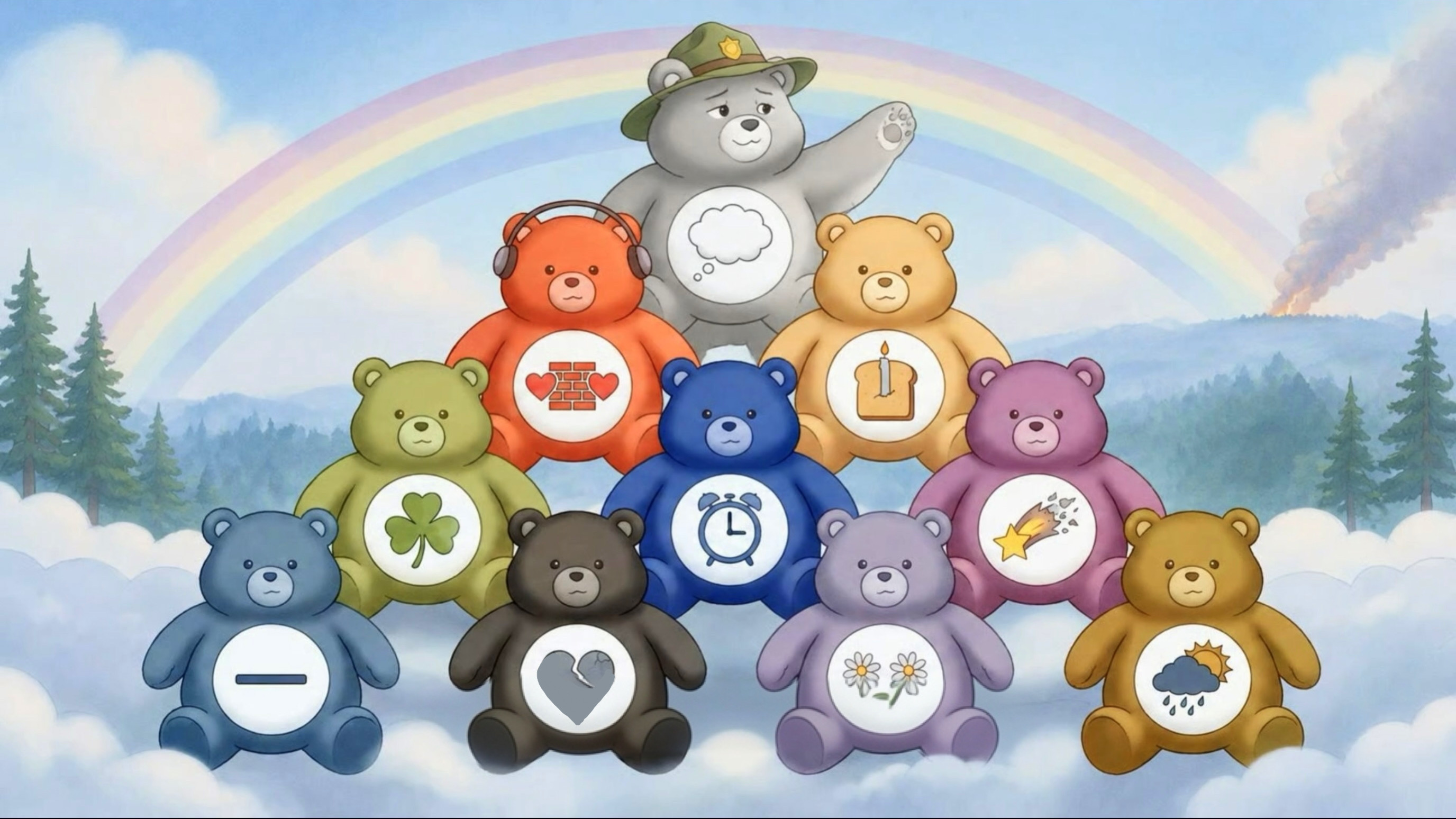
Do Indifferent Bears Care About the Woods?
The Care Bears, Their Opposites, and the Case for Caring Well
At 4:45 on a Friday afternoon, a message arrives asking whether the hex codes on slide fourteen might be slightly off-brand. It carries three exclamation points, a small flashing siren, and the hopeful suggestion that a quick sync before the weekend would help everyone get aligned. Your pulse climbs a few beats. Nothing about slide fourteen is on fire, and some quieter part of you knows it, but another part has already begun composing the reply, rearranging Saturday, and rehearsing the voice of someone who cares a great deal.
You were trained for this moment, and the training was gentle. Somewhere on a long run of Saturday mornings, between the couch and the cereal bowl, you absorbed a rule so completely that you stopped noticing it was a rule: the people worth being are the people who care, they care out loud, and they care about everything that crosses their path. The rule had a mascot. Ten bears in pastel fur lived on a cloud, each with a symbol on its belly, and whenever someone below felt sad, lonely, or out of sorts, the bears lined up, pointed their bellies at the trouble, and beamed feeling at it until the trouble gave way. In all those episodes, nobody asked what the person on the receiving end might have preferred. Some of them may have wanted to be left alone.
I want to take that cloud seriously enough to build a mirror of it, and I should say where I stand before the experiment starts. Connection, compassion, and community sit among the values I hold most precisely, which means I come to this as a defender of caring, and I'll try to be fair to the other side anyway. Give each of the ten original bears an equal and opposite counterpart, a bear whose whole outlook runs the other way, and call the clan the Indifference Bears. They aren't villains, since malice takes far more energy than they're willing to spend. They meet the same situations the Care Bears do (a bad day, a broken plan, a birthday, a stranger's emergency) with a shrug, a closed laptop, and a calm refusal to be moved. This piece follows that joke to see what the shrugging bears get right, what they get wrong, and why I land where I do.
The single move on the cloud
Look closely at how Care-a-Lot handles feeling and you'll find one move repeated in ten costumes. Something uncomfortable appears, a bear identifies it, and a stronger dose of the opposite feeling gets applied until the discomfort leaves. The Stare turns the volume up. Nothing in the bears' repertoire turns it down. They can celebrate, comfort, cheer up, and cheer on, but none of them can say with a clear conscience that a particular thing isn't theirs to feel anything about. Grumpy Bear comes closest, and the story permits him to frown mainly so it can show him being talked out of it.
That design suits a child, and I mean that plainly. A small person needs the adults nearby to care loudly and reliably, and the bears model it well. The difficulty arrives when the design becomes the whole philosophy of an adult life, because adults live with far more incoming than one nervous system was built to hold. A group chat, a news cycle, a workplace channel, and an inbox are each asking for a small donation of feeling, and they ask all day long. If caring at full volume is the only setting you were taught, every one of those requests lands as a test of your character.
The commercial version of this has been with us for a long while. Workplaces that ask for your enthusiasm, your smile, and your whole self are asking for a performance of caring, and I suspect the performance is what exhausts people, more than the caring underneath it. When an employer invites you to bring your whole self to work, the invitation sounds like warmth, and sometimes it is. In a good many workplaces it also functions as a request for more of your feeling than the job description ever priced.
What the cloud gets right
Before the mirror goes any further, the original deserves a fuller defense than childhood nostalgia. A frightened child needs an adult who shows up and stays, and so does a frightened adult. Attention given freely to someone who's lonely is among the most valuable things one person can offer another, and I hold that conviction without much hedging. It rests partly on values and partly on evidence. Julianne Holt-Lunstad's review of well over a hundred studies at Brigham Young University found that people with stronger social relationships had roughly a 50 percent greater likelihood of survival across the study periods, an effect the authors compared to well-established risks like smoking. Connection is a health matter as well as a pleasant one.
The Stare, absurd as it looks, is full attention aimed at a single person, and most of us have felt the difference between being watched and being truly regarded. The trouble comes from scale. Care-a-Lot is a small cloud with a manageable supply of problems, each close enough to point a belly at. Adult life delivers thousands of requests for feeling a day, most from people and systems you'll never meet, and the bears have only the one setting. Carry that setting into the open-plan office, the group chat, and the news cycle, and everything becomes a Care-a-Lot emergency, including the hex codes. The Indifference Bears exist, in this thought experiment, to supply what the cloud never needed: a way of turning feeling down.
Three bears who ration energy
Cheer Bear treats joy as a duty owed to everyone in range. Her counterpart, Apathy Bear, wears a flat gray line across her belly, the drawn version of a resting reading on a heart monitor, and she holds that enthusiasm is a limited supply that doesn't refill on command. She spends hers accordingly. When a minor, non-urgent crisis lights up your phone, her suggestion is to look at it for four seconds, feel nothing in particular, get bored, and look away. That sounds like laziness until you notice how seldom anyone grants themselves the option.
Funshine Bear radiates a solar eagerness that wants every hour to be an occasion. Glumshade Bear carries a charcoal cloud over a dull sun and offers permission to have an ordinary afternoon. He's content with the beige wall. In a culture that asks every meal to be artisanal, every trip to change you, and every hobby to find an audience, there's real relief in a bear who wants none of that.
Bedtime Bear treats sleep as a gentle hand-off into sweet dreams. Restless Bear wears an alarm clock stopped at 3:00 AM and sits up in the dark without drama. Reason suggests he has the better argument on one point: the harder you try to force sleep, the more awake the trying keeps you, so a bear who lets the thoughts pass without assigning them moral weight has probably found the quicker road back to rest. He offers no cure. What he gives is release from treating a bad night as a failure of character.
Three bears who revise your expectations
Good Luck Bear's four-leaf clover implies that the universe keeps accounts. Hard Luck Bear's clover has three leaves and a gap where the fourth should be, and he doesn't mourn it. He answers a belief sometimes called the just-world belief, the quiet assumption that good people are rewarded and that misfortune must therefore have been earned. It's a comfort until something bad happens to someone kind, at which point the belief offers a single explanation: they, or you, didn't care hard enough. Hard Luck Bear refuses that explanation. The Stoic habit of sorting what's yours from what isn't would recognize him at once, and so would anyone who has watched rain fall on their wedding.
Wish Bear keeps a standing appointment with a star. Cynic Bear's badge shows a shooting star burning down to gray ash before it ever reaches the horizon. He practices a stance sometimes called defensive pessimism: expect the system to be flawed and the odds to be poor, and you'll be spared the sting when they are. When things go well, he's mildly and pleasantly surprised. Of all ten, he strikes me as the most seductive.
Birthday Bear insists that a date on the calendar is an occasion with cake attached. Forgotten Bear's badge is a single unlit candle stuck sideways in a slice of plain wheat toast, and his view is that every day is a Tuesday, the milestone ones included. You can strip a promotion or a setback of its story and file it as a Tuesday. A good deal of disappointment lives in the expectation that a special day will feel different from the days around it, and a bear who has released that expectation has released the disappointment too.
Three bears who guard the perimeter
Tenderheart Bear holds that love is an active duty, and his belly carries a heart to prove it. Callousheart Bear sits at a plain oak desk, wears a cracked gray stone for a badge, and treats detachment as a form of conservation. Return to your Friday message and you can hear what he'd say. Nothing about slide fourteen is a crisis. It has only dressed like one, and answering the costume with your whole weekend feeds the habit of urgency without improving the slide. His advice is unglamorous: lower the laptop lid with the neutrality of a garage door, since slamming it would imply passion, go for a walk, and on Monday morning reply with a single sentence thanking your colleague for flagging it and promising a look during the regular weekly review. No exclamation points. No apology.
Friend Bear's crossed flowers promise permanent availability. Aloof Bear's two identical flowers face away from each other, rooted in the same soil and looking in different directions. A person reachable at every hour by every person has very little left that's private, and Aloof Bear treats an empty evening as a sanctuary rather than a gap that needs filling. Human connection seems to breathe, with reaching out and pulling back each taking a turn, and the cloud only ever taught the first half.
Love-a-Lot Bear's twin hearts lean toward each other. Leave-alone Bear's two red hearts sit on either side of a well-built brick wall, and he wears headphones plugged into nothing. His point is that closeness nobody can decline stops being closeness. The ability to say "not now, and not that near" is what gives a yes its meaning, and a bear who can't refuse an embrace can't really accept one either.
The bear who doesn't flinch
Grumpy Bear loves his surroundings so intensely that a broken zipper registers as an offense. His opposite, Unbothered Bear, carries a blank thought bubble on his belly and looks at the same downpour with a different result. He notes that it's raining, adjusts his posture, and keeps his pulse exactly where it was. He doesn't care enough to complain, and he doesn't care enough to be angry, which leaves a great deal of his day available for other things.
Unbothered Bear is the clan's most complete portrait because he shows what the others are reaching toward: a mind that can meet an irritation without being taken over by it. Anyone who has watched a skilled person stay level through a bad afternoon knows how rare and how restful that is. The blank bubble also hides something the other nine bears reveal in their badges, and that something is where this experiment starts to get honest.
Where the shrug runs out
The clan is easy to love, and the ease deserves a second look. Each of the ten names a real relief, which is exactly what makes them persuasive, and each is offered, like the original ten, as a setting you can leave switched on. A bear who answers every input with a shrug carries the same flaw as a bear who answers every input with a Stare. The Care Bears assume everything is within reach of a belly beam. The Indifference Bears assume nothing is. I think the second assumption does more harm, because a world of people who each decided nothing was theirs to reach would be a world where nobody sat with the lonely, fed the neighbor, or showed up to the meeting about the broken streetlight.
The harder problem is that detachment has two origins, and they look identical from outside. One person steps back because they've considered what's being asked and decided it isn't theirs. Another steps back because there's nothing left to give, and the stepping back is simply what the emptiness looks like. Both show the same flat voice and the same closed laptop. Callousheart Bear and a worn-out nurse at the end of a double shift might wear the same expression, and only one of them chose it. I suspect the second kind is far more common than the first, and that the person living it often mistakes it for wisdom.
A few questions can help tell the two apart, and you're the only one positioned to answer them. You might ask whether you chose the distance or whether it arrived on its own, whether it stays the size of the thing it answers or has been spreading to people and work you used to love, and whether it lifts when something that truly matters shows up. Chosen detachment tends to lift on cue. Depletion tends to stay flat even when you'd like it to move, and if the flatness lingers, that's a conversation worth having with someone trained to listen for it.
Two of the bears deserve particular suspicion. Cynic Bear's forecast of disappointment protects you from disappointment, and it also quietly removes the reason to try, because hope is what makes a person build the thing that might beat the odds. A bear who treats miracles as statistical accidents will never be the one who makes one. Hard Luck Bear's equanimity is wisdom when the subject is weather and something closer to an excuse when the subject is a fire someone could have put out.
Which brings me to the woods in the title: picture a bear in a ranger's hat, one paw lifted toward a campfire that has begun to climb the trees, remarking that you probably can't prevent a forest fire anyway. It's a joke built on an old public-service slogan that told people only they could prevent such fires, and it's funny because it's half true. One person can't stop a wildfire season. A great many people each leaving one ember burning can start one. The Indifference Bears have a ready answer for the first half and nothing at all to say about the second.
Caring behaves something like fire in one respect: it needs fuel and air, and a flame fed everything within reach leaves ash where the fuel was. Neither clan has a way to ask the two questions that matter most about any given problem, which are how big it is and how near.
What actually wears caring out
If the shrug is a poor answer to exhaustion, it helps to know what the exhaustion is made of. Two experiences hide under the single word empathy. One is feeling another person's pain as though it were your own, and it tends to end in withdrawal. The other is warm concern oriented toward helping, and it appears to hold up far better. That split shows up in the lab: research from Tania Singer and Olga Klimecki at the Max Planck Institute for Human Cognitive and Brain Sciences in Leipzig found that the two engage different neural systems, and that compassion training was associated with more positive feeling while empathy training alone raised negative feeling.
Seen through that distinction, the Care Bears' difficulty is easier to name. The cloud runs on absorbed feeling, each bear taking on the whole weight of someone else's sadness and answering it with more intensity, and absorbed feeling is the form of caring that depletes. The Indifference Bears answer by feeling less, which treats the strain by removing the caring along with it. The research suggests a third option, and it's the one I'd choose: keep the warmth, and change its shape, from taking on someone's pain to turning toward them with steady goodwill and something useful to offer.
I don't want to oversell this. A training effect measured in a lab is a different thing from a Tuesday with an unreasonable boss, and structural conditions like understaffing and low pay exhaust people whatever shape their compassion takes. Some people also carry histories that make closeness itself costly. For them, distance is a sensible protection, and no bear on either cloud should ask them to stand nearer than they can.
Who does the sorting
If neither clan holds the answer, the useful work moves to the sorting itself: deciding where your caring goes, and in what form. One tidy way to sort the world is into two regimes, a care regime for the nearby, the actionable, and the relational, and an indifference regime for manufactured urgencies, algorithmic outrage, and failures too large for one person to repair. I'd adjust that division. Indifference works best as a tool for particular inputs and makes a poor foundation for a life, since the care regime is where most of a life's meaning accumulates.
One detail of the cloud is easy to miss: there were ten of them. Whenever the Stare fired, the work was shared, and no bear carried the world's sadness alone. The modern version asks one person with one phone to carry what a cloud of ten was built for, and community is the oldest answer we have to that arithmetic. The Indifference Bears, tellingly, are each pictured alone, in separate rooms. If I had to choose a first remedy for depleted caring, I'd choose more people sharing it before I'd choose less caring from the ones already tired.
Three things tend to do most of the sorting: whether anything you could do would actually reach the problem, whether it belongs to someone you're in real relationship with, and whether it will still matter in a month. A friend who called twice scores high on all three. A stranger's offense in a comment thread scores low on all three. The hard cases sit between them: the neighbor whose problem you could help with and could also avoid, the headline about a place you'll never visit that nonetheless involves people. Those get no tidy answer, and I think it's honest to say so. The same person will answer them differently in different seasons of a life.
One more category deserves attention, because the sorting can be rigged. When a system fails and the failure arrives framed as a shortage of your caring (a fundraising page for a basic medical procedure, say, captioned with a plea to show you care), the framing is doing a job. It converts a question about institutions into a test of your feelings, and the institutions are then free to leave the conversation. Giving to such a page can be right. Asking whom the framing protects can also be right, and both can happen in the same afternoon.
Nobody can hand you the criteria. The Care Bears issue a verdict for every occasion, the Indifference Bears issue the opposite verdict for every occasion, and what neither clan offers is the sorter's seat, which stays empty until you sit in it. You'll probably want both clans, a Stare for the friend on the phone and a shrug for the slide deck, though they aren't equal partners in my accounting. The shrug is a tool you pick up for an afternoon. The caring is the reason you're picking up tools at all.
A week with the bears
If you'd like to experiment, you might spend a week noticing where your body goes in the first second after an input arrives, whether a message, a headline, or a request. Then hand the input, quietly, to one of the bears and see how the afternoon changes. Apathy Bear can take the notification that will keep until morning. Callousheart Bear can take the emergency that was only ever an emergency for someone else. Leave-alone Bear can take the invitation you would decline if you weren't dreading the explanation. Tenderheart Bear can keep the friend who called twice. At the end of the week, you could write down three things: something you stopped caring about and didn't miss, something you let slide and found that you did, and something you gave real attention to that gave something back.
The fire at your feet
So do indifferent bears care about the woods? In the cartoon, the answer is whatever the joke requires. In a life, I'd say the better question is who's standing in the woods with you. You probably can't prevent a forest fire alone, and the bear in the tilted ranger's hat is welcome to that observation. Fires have long been put out by people passing buckets down a line, each handing along a small share of the weight. Whether the small fire nearest to you this week is yours to join, and who you'll find beside you when you do, is a question no bear on either side of the cloud can settle for you.
Keep reading
- The Zeus in You: Why the Old Gods Still Describe the Mind
- Why I Am Guilty of Having No Shame
- The Unflappable You: How to Stop Letting Others Ruffle Your Feathers
- Don't Assume the Worst; Talk to Me About It First
- Possible vs. Probable: Why the Difference Shapes a Life
- Why Old Advice Suddenly Makes Sense Years After You Heard It
- Accept Belonging & Belong Acceptance
- Marcus Aurelius and Rumi: Two Paths to the Same Peace