If You Have More Than 4 Priorities At Once, You Have None
Read "If You Have More Than 4 Priorities At Once, You Have None" on Joseph Kelly's site.
| Intentional Living, Resource Allocation | 9 min read
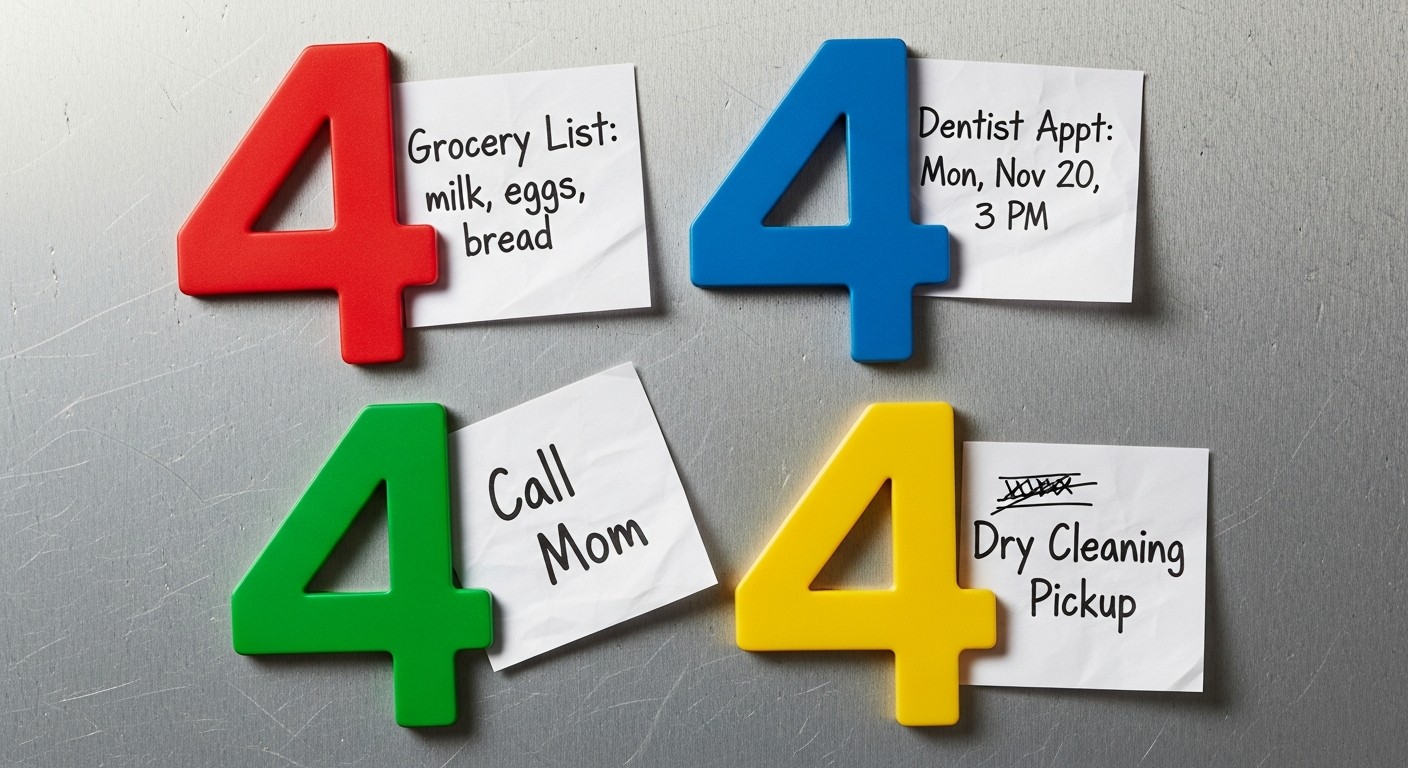
By ten in the morning you've already opened four different documents, answered two emails you told yourself you'd get to later, and started a task list where everything is marked urgent, because at the moment you wrote each one down, each one genuinely felt urgent. By early afternoon, you can't quite account for what you actually finished, only that you were busy the entire time, moving fast enough to feel productive without ever quite landing anywhere.
The line "if you have more than four priorities at any given time, you have none" gets repeated often enough that it's earned a certain suspicion, the kind reserved for anything that sounds too tidy to be entirely true. In the strict sense, that suspicion is fair. Nothing in the research on attention and goal pursuit locks onto four as a hard biological ceiling, the way working memory research once settled, however imperfectly, on a rough number of items a mind can hold at once. What the research does support is something worth taking seriously anyway: when people are carrying too many active goals at once, competing tasks, high cognitive load, their prioritizing stops being careful and starts being reflexive, more vulnerable to interference, less able to hold steady across everything it's being asked to manage. The number four may be more slogan than threshold. The warning underneath it is real.
Why Prioritizing Well Is a Cognitive Problem Before It's a Planning Problem
Choosing among goals that compete for the same limited time, attention, and working memory depends on a specific set of mental capacities researchers call executive functions, the machinery responsible for inhibition, working memory, and cognitive flexibility. Adele Diamond's influential review of this research describes these three capacities as the foundation underneath nearly everything we'd call focus, self-control, or adaptability: the ability to resist an obvious but unhelpful impulse, hold information in mind long enough to use it, and shift approach when circumstances actually change.
This matters more than it first appears, because prioritizing well isn't only about deciding what matters most. It's about holding onto that decision long enough to act on it, which turns out to be the harder half of the job. These same executive capacities have real limits, and under strain, a mind simply can't process all the goal-relevant information competing for its attention at once. The practical result is that prioritization tends to become less careful and more simplified exactly when the stakes are highest, not because anyone is doing it wrong, but because the underlying machinery has a genuine ceiling.
What Judgment Actually Does Under Pressure
A 2024 study led by psychologist M. Alister and colleagues gives this pattern a concrete shape. When deliberation time was limited or cognitive load was high, people were considerably less likely to weigh every goal carefully against every other one, and considerably more likely to reach for a simpler shortcut instead. The shortcut that showed up most often leaned heavily on deadlines, more than on how difficult a task actually was or how much it genuinely mattered. That makes intuitive sense once you sit with it. A deadline is concrete and easy to compare against another deadline. Difficulty and value are harder to weigh honestly, especially with limited mental bandwidth to spend on the comparison.
None of this means deadline-driven prioritizing is always the wrong call. It means that under real constraint, people simplify, reliably and predictably, and a priority system that depends on rich, careful comparison across many competing goals is likely to degrade at precisely the moment you need it to hold. A prioritizing method worth trusting has to survive contact with stress and time pressure, not just work well on a calm Tuesday morning when nothing is actually on fire.
The More Goals You're Holding, The More You Split Yourself
This is where the research comes closest to the spirit of the original saying. Ewa Szumowska and Arie Kruglanski's work on goal activation found that the number of goals a person is actively holding in mind shapes multitasking directly: the more goals stay live and available, the more likely someone is to plan multitasking and to switch between tasks once they're underway. An interruption can make this worse by activating still more goals rather than simply pulling attention away from the one you were on. The reverse also held. Reducing the number of goals held simultaneously active, either by making one goal more important than the rest or by strengthening real commitment to it, reduced multitasking measurably.
This is the closest the literature comes to validating the folk number. Four isn't a special threshold your brain was built around. But the more active priorities crowding your attention at once, the more your behavior tends to fragment into partial progress on many fronts rather than real completion on any of them, which is precisely the outcome the saying is warning against, even if the specific number is more useful as shorthand than as science.
The Real Cost of Switching, and of Never Quite Finishing
Task switching carries measurable costs even when people adapt to it over time. An integrative review by Iring Koch and colleagues traces these costs to several distinct sources: structural bottlenecks in how the mind processes one thing at a time, the added control demands of managing a switch itself, and the way practice can partially, though never fully, smooth those costs over. A separate line of research found switching costs weren't well explained by general measures like processing speed or working memory capacity alone, suggesting multitasking draws on several separate limitations rather than one single bottleneck you could simply train away. Every switch costs something real in time, attention, and control effort, whether or not it feels that way in the moment.
Something related happens even when you haven't switched away from a task, but simply left it unfinished. Roy Baumeister and E. J. Masicampo's research found that unfulfilled goals stay cognitively active well after you've stopped actively pursuing them, quietly interfering with later tasks that require real executive effort, solving a hard problem, working through unfamiliar logic, while leaving simpler, more automatic tasks largely unaffected. The interference disappeared once participants were allowed to return and actually finish what they'd left open. An unfinished goal isn't neutral. It keeps a quiet claim on your attention until you either complete it or consciously close the loop some other way.
Why the Easiest Task Isn't Always the Right One
Workload itself shapes what gets chosen, often in ways that feel productive in the moment and cost something real later. Research led by Diwas KC and colleagues, studying task selection inside a hospital emergency department, found that as physician workload rose, they increasingly chose easier tasks over harder ones. That choice helped manage the variance in how long each task took, a genuine short-term benefit. It also correlated with worse overall throughput once task complexity was accounted for, and with less learning accumulating in how quickly similar tasks got handled over time. Similar patterns showed up in laboratory settings, driven partly by fatigue and partly by the simple satisfaction of finishing something, anything, when the day already feels unmanageable.
There's a real, honest tension worth sitting with here rather than resolving too quickly. Choosing the easier task under real pressure isn't a failure of discipline. It's often a reasonable, self-protective response to genuine overload. The cost only shows up later, in throughput and in learning that never quite accumulates, which is worth knowing the next time reaching for the easy item starts to feel less like strategy and more like habit.
Priority Also Bends to Context
None of this happens in a vacuum. How much difficulty, importance, or reward shapes a person's choices shifts depending on how demanding the overall situation already is. When the surrounding workload is relatively light, people tend to lean more on how hard a given task actually is when deciding what comes first. When the surrounding workload climbs, importance starts to matter more than difficulty, and people stop weighing every factor evenly, leaning hard on whichever variable feels most decisive in the moment rather than averaging everything together the way a careful decision might.
Task structure itself can limit how flexibly anyone allocates attention, regardless of intention. Studies of pilots managing competing cockpit demands found their prioritizing shaped by a genuine mix of factors: how consistent a procedure was, how directly a task connected to flight safety, and how much a given signal or alert simply demanded notice on its own. Real-world prioritizing, in a cockpit or in an ordinary week, tends to run on this same blend of explicit goals, environmental cues, and procedural habit rather than on abstract intention sitting alone in a vacuum. People also don't adopt a new prioritizing instruction instantly. In controlled experiments, formal priority instructions could override a person's natural preference for what to tackle first, but only after real repeated exposure to the situation demanding the choice. A single reminder to reprioritize rarely changes behavior on the spot. It tends to take practice before a new ordering actually sticks.
What This Actually Suggests You Do
Taken together, this research points toward a small set of practices worth building rather than a rulebook to follow exactly. The clearest one is separating what's important in your life generally from what's actively competing for your attention right now, and keeping only a small set in that second category at any given time, letting everything else stay genuinely parked rather than quietly competing in the background. This distinction matters more than it sounds. Plenty of things deserve a place in your life without needing a place on this week's list, and confusing the two is often where the overload actually starts.
Deadlines are worth using deliberately, since you'll likely lean on them anyway under real pressure, though it helps to build in some space for weighing difficulty and value too, even imperfectly, before the deadline becomes the only variable left standing. Reducing how many goals stay simultaneously active tends to matter more than reorganizing your list, and the most reliable way to do that is choosing one dominant goal for a given block of time or season of life and letting the rest genuinely wait their turn, rather than trying to hold all of them at once out of a sense of responsibility. When you can, grouping similar tasks together and finishing one stream before opening another spares you some of the switching cost that comes from constant reshuffling. And when something can't be finished right now, giving it a real next step and a real time to return to, rather than leaving it ambiguously open, seems to matter more than the specific method you use to close that loop. The evidence doesn't prescribe one particular system here. It simply suggests that leaving things vaguely unfinished carries a cost worth avoiding when you can.
It's worth building in real points to reassess, too, since what deserves attention shifts as workload shifts, and yesterday's ranking doesn't automatically hold today. What felt like the right order on Monday can genuinely stop being right by Thursday, and treating your priority list as fixed once it's written tends to work against you here rather than for you. It's also worth watching honestly for the moment reaching for the easiest task on your list stops being strategic and starts being avoidance dressed up as productivity. That instinct is understandable under real pressure, and it isn't a character flaw. It's simply worth naming when it's happening, since the relief it offers tends to be short-lived and the cost tends to show up later, in work that never quite deepens.
And because all of this runs on executive resources that are themselves finite, sleep, stress, and basic recovery aren't separate from prioritization so much as the foundation underneath it. A tired, depleted mind won't hold four priorities well either, whatever the number turns out to be. Protecting the conditions that keep your attention and working memory intact is, in a very real sense, part of the prioritizing work itself, not a wellness add-on sitting outside of it.
The Honest Answer to Whether the Number Is Real
So is the saying actually true. In the strict sense, no. Nothing in this research identifies four as a demonstrated cognitive threshold rather than a useful round number that happens to be memorable. In the broader sense the saying is reaching for, yes, and more solidly than the tidy phrasing might suggest. Human cognitive control has real limits. More active goals reliably produce more switching and more fragmentation. Under load, people simplify in ways that can distort good judgment. Unfinished goals keep costing attention long after you've stopped consciously thinking about them.
A more honest version of the saying might sound less quotable but hold up better: if you're carrying more simultaneously active priorities than your attention, working memory, and time can actually support, you'll likely switch more, commit less deeply to any one of them, and finish less than you would with fewer things genuinely in play. Whether that number happens to be four, three, or five depends on the day, the person, and the demand. What doesn't seem to depend on any of that is the underlying pattern: a mind holding fewer things at once tends to hold them better. By early afternoon, on the days you've actually kept your list short enough to manage, you tend to remember exactly what you did instead of only that you were busy the whole time doing it.
Keep reading
- The Zeus in You: Why the Old Gods Still Describe the Mind
- Why I Am Guilty of Having No Shame
- The Unflappable You: How to Stop Letting Others Ruffle Your Feathers
- Don't Assume the Worst; Talk to Me About It First
- Possible vs. Probable: Why the Difference Shapes a Life
- Why Old Advice Suddenly Makes Sense Years After You Heard It
- Accept Belonging & Belong Acceptance
- Marcus Aurelius and Rumi: Two Paths to the Same Peace