The Art of Seasonal Living: Embracing Nature's Rhythms for Personal Growth
Learn how to synchronize your lifestyle with natural seasonal rhythms for profound connection, balance, and personal transformation.
| Natural Rhythm Cycles | 11 min read
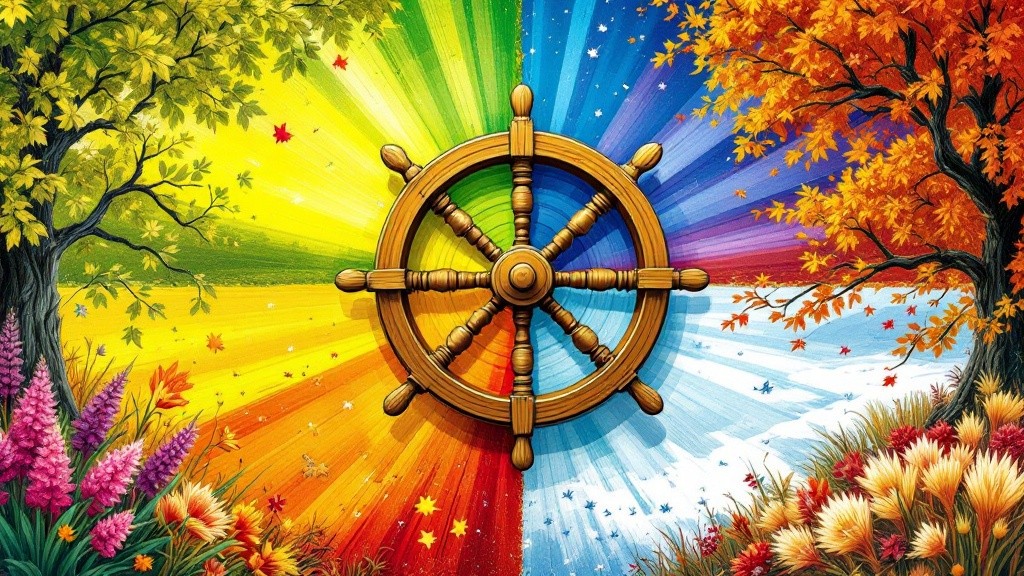
By February, you're sitting at your desk forcing yourself through a task list that was clearly built for a different version of you, the one from June who had energy to spare and ideas arriving faster than you could write them down. This version of you, the February version, keeps rereading the same line of a report and wondering what's wrong. Nothing is actually wrong. You've just quietly assumed, the way most of us do in a world lit the same wattage every month of the year, that a person is supposed to run at identical speed in January and July alike.
We live inside climate control and electric light thoroughly enough that it's easy to forget how recently, in the scope of human history, our ancestors lived in close, unavoidable relationship with seasonal change. That relationship left a real mark. Our bodies still carry patterns shaped by daylight, temperature, and the turning of the year, even now that we can override every one of them with a thermostat and a light switch. Seasonal living, at its most honest, isn't a lifestyle aesthetic. It's the practice of noticing those older patterns again and working with them instead of quietly fighting them every day of your life.
What the Research Actually Tells Us
Chronobiology, the study of biological rhythms, has spent decades documenting how thoroughly our internal clocks respond to daylight, and the findings extend well past simple sleep timing. Psychiatrist Norman Rosenthal's early clinical work describing Seasonal Affective Disorder, in the 1980s, showed how directly reduced winter light can affect mood, energy, and motivation in people whose systems are especially sensitive to the shift. Chronobiologist Till Roenneberg's research on what he calls social jetlag has documented something related and more universal: most of us carry an internal clock that drifts somewhat out of sync with the demands of a standard workweek, a mismatch that tends to deepen as daylight hours shrink through the darker months.
None of this means every mood shift across a year has a tidy biological explanation, and the research is genuinely more settled on some pieces of this than others. Sleep timing and daylight exposure have a well-documented relationship. The precise mechanisms connecting season to motivation, creativity, or sociability are still being worked out, and it's worth holding that honestly rather than treating every seasonal feeling as a confirmed neurochemical fact. What does seem clear, across a wide body of research, is that reduced daylight reliably shifts sleep architecture and energy for a meaningful portion of people, and that fighting this shift head-on tends to cost more than working alongside it.
This reframes something many of us have quietly judged in ourselves. What gets labeled inconsistency, restlessness in spring, low motivation in winter, a dip in sociability as the days shorten, may be less a character flaw than a system doing something it was built to do. The useful move isn't diagnosing every mood as seasonal. It's holding a little more curiosity, and considerably less judgment, about why some seasons ask more of you than others.
It's also worth noticing how much of the difficulty here is a mismatch of pace rather than a mismatch of biology alone. Roenneberg's research on social jetlag points to something specific: most modern schedules assume a single, fixed rhythm that everyone is supposed to maintain year-round, when the underlying biology wasn't built for that kind of uniformity in the first place. The friction you feel forcing a winter body through a summer schedule isn't a personal failing showing up as low willpower. It's closer to what happens whenever a system gets asked to run against its own actual conditions for long enough.
Spring: Where Renewal Actually Starts
Spring arrives inside you before it fully arrives outside the window, an unmistakable lift that shows up as restlessness, an appetite for something new, a sense that whatever's been sitting dormant is ready to move. It's the season that most directly rewards beginning again, dreaming a new version of something, taking the first uncertain step toward a change you've been circling.
Lengthening days tend to correspond with real shifts in mood and motivation for many people, and there's some evidence that neuroplasticity, the brain's capacity to form new patterns, responds favorably to this kind of seasonal lift, making spring a genuinely useful window for starting projects, making decisions you've been avoiding, or trying something that asks you to stretch past your usual comfort. You don't need a neurochemical explanation to notice this working in your own life. Most people already know spring is when they finally clean out the closet they've been avoiding since November.
That impulse toward clearing space is worth taking seriously rather than treating as incidental. Decluttering a room, or a calendar, tends to free up more than physical space, it reduces the low-grade cognitive load that comes from being surrounded by unfinished business and half-considered obligations. Spending real time outdoors as the days lengthen, letting actual daylight regulate your circadian rhythm rather than relying entirely on artificial light, tends to support this shift further. And spring is a genuinely good season to plant something, literally or otherwise: herbs on a windowsill, a new skill you've been meaning to start, a habit you're finally ready to build. The nurturing itself, watching something respond to attention over time, connects you to exactly the energy the season is already offering.
Summer: Full Expression Without Apology
Summer is the season of least resistance, the point in the year when energy, daylight, and motivation tend to align rather than compete with each other. Days stretch long, extended daylight supports mood and energy for a meaningful stretch of people, and many of us naturally need less sleep and crave more social contact during these months than we do in December.
This is the season that rewards bringing things to completion rather than starting them, expanding your circle rather than protecting it, saying yes to gatherings and adventures that light you up rather than holding back out of habit. Summer also asks something specific of you: to notice what's actually reaching fruition in your life right now, the things you planted in spring that are finally ready to be acknowledged, and to actually acknowledge them, out loud, with other people, rather than quietly moving past your own progress toward the next thing on the list. Sharing what's going well, celebrating it honestly instead of downplaying it, tends to deepen the season's natural abundance rather than diminish it.
The real lesson summer offers is about sustainable generosity, how to give freely from what you have without running yourself empty in the process. It rewards full expression. It doesn't reward abandoning every boundary just because the season makes it easier to say yes to everything.
Picture the person flipping through their calendar in early September, only to notice that every single weekend since Memorial Day has had something on it, a barbecue, a wedding, a trip, a friend passing through town, and somewhere inside all that saying yes, they never actually landed on one unstructured Saturday to simply exist without an agenda. That's not summer's fault. The season offers abundant energy. It doesn't require spending every last bit of it. The people who burn out hardest by Labor Day are usually the ones who mistook that natural ease for an obligation to add without ever subtracting, filling every open evening with something rather than letting some of that abundant energy simply be enjoyed without producing anything at all.
Autumn: The Season That Teaches You to Let Go
Autumn turns you inward well before winter forces the issue, calling you toward harvest and reflection the same way the natural world begins preparing for rest. This is the season for gathering what the year has actually taught you, and for releasing whatever you've been carrying that no longer earns its place.
As daylight recedes, melatonin production shifts earlier for many people, supporting deeper, more restorative sleep and a natural pull toward introspection that's worth honoring rather than resisting. This tends to make autumn a genuinely productive season for reflective practice. Psychologist James Pennebaker's decades of research on expressive writing found something concrete here: putting difficult experiences into words on paper, even briefly and imperfectly, measurably supports psychological processing in ways that simply thinking about the same material doesn't. Writing down what you're ready to release this season, an old belief, a resentment, a version of a plan that didn't work out, isn't a symbolic gesture alone. It's a documented way of helping your mind actually finish processing something rather than carrying it forward unresolved.
Picture doing this literally: an October evening, a mug gone lukewarm on the table beside you, writing out, in your own handwriting, the plan that didn't come together this year, the job that fell through, the version of yourself you assumed you'd be by now. You're not performing a ritual for an audience. You're giving your mind permission to stop quietly replaying something it's been carrying since spring. Whether you keep the page afterward or throw it away matters far less than the fact that you actually put the thing into words instead of letting it circle indefinitely, half-formed, taking up more room than it needs to.
Autumn also rewards honest assessment of the year behind you, done with real compassion rather than harsh judgment. What actually bore fruit. What didn't work out as planned but taught you something you couldn't have learned any other way. That kind of honest accounting, gentle rather than critical, becomes the foundation the next cycle of growth actually stands on.
Winter: Rest as Preparation, Not Failure
Winter takes a real beating in a culture that treats constant output as the only evidence of a life going well, but this season may hold the most underrated opportunity for real change. Like seeds sitting in dark soil through the coldest months, winter's apparent stillness is doing more than it looks like from the outside.
Reduced daylight tends to pull energy inward for many people, supporting less social activity and more introspection, a shift worth working with rather than treating as a problem to override with sheer will. This shows up in small, specific ways long before anyone would think to call it seasonal. It's the version of you lying on the couch at six in the evening in December, genuinely worn out, running a quiet inventory of everything left undone today, and measuring that flat feeling against how alive you felt on some ordinary Tuesday in July. The comparison itself is the actual problem, not the tiredness. December was never going to feel like July, and holding it to that standard is what turns ordinary winter rest into something that feels like failure instead of what it actually is.
Winter rewards genuine rest, quiet reflective practice, and honest inner work, the kind that's harder to do when the rest of your life is moving at summer speed. It's also, often, when the clearest thinking about the future actually happens, in the same way a difficult problem sometimes resolves itself not through more effort but through the quiet incubation that comes from finally setting it down for a while.
None of this argues for treating winter's darkness as something empty. It's closer to something gestating, doing real work you can't always see from the surface. Creating conditions that support this, warmth, quiet, unhurried time, genuinely helps rather than indulging avoidance. Winter is also a reasonable season to do the actual thinking that spring's momentum will later carry forward: clarifying what actually matters to you, setting intentions with more honesty than a January 1st resolution usually allows, before the pace of the year picks back up around you.
Living This Without Rebuilding Your Whole Life
Practicing seasonal awareness in a modern context doesn't require returning to an agrarian calendar, and it doesn't need to be complicated to matter. Consider something as small as changing the lamp on your desk when the clocks fall back in November, trading a bright, task-lit bulb for something warmer and dimmer, a five-minute change that quietly tells your body the season has shifted before your calendar gets around to admitting it. Small, honest rituals like this one, adjusting light and routine as daylight changes, letting exercise and food choices track loosely with the season instead of a rigid year-round formula, scheduling ambitious work during the months your energy actually supports it, tend to do more than an elaborate system you'll likely abandon by March.
One of the more useful shifts is setting intentions seasonally rather than only once a year. Growth-oriented goals tend to fit spring's actual energy. Expansive, social goals tend to fit summer. Consolidation and reflection fit autumn far better than they fit a fluorescent-lit December, and honest rest and clarification belong to winter more than to any resolution written in a rush on New Year's Eve. The point is matching your effort to what each season is actually offering you rather than maintaining identical focus and output across all twelve months, which tends to produce steadier progress than forcing constant intensity ever does, and tends to leave considerably less burnout in its wake.
Becoming Someone Who Isn't the Same Person All Year
Seasonal living, followed far enough, changes more than your calendar. It suggests something worth sitting with directly: you weren't built to be identical in January and July. Nature expresses different aspects of itself through its seasons without treating any of them as the failure of the others, and the same holds for you. The outward, ambitious energy of summer serves a different purpose than winter's quieter wisdom, and neither one invalidates the other.
This tends to bring real relief to anyone who has spent years quietly judging their own seasonal variation, lower energy in winter, restlessness in spring, as inconsistency rather than what it more honestly is: a complete, multifaceted person responding to real conditions rather than failing to maintain an artificial constant. Understanding your own rhythm this way builds a specific kind of patience with your own growth, a trust that what looks like dormancy is often quiet preparation, and that your most vivid seasons of expression tend to arrive reliably when the actual conditions support them.
Start small if this is new to you. Step outside in the morning and notice, honestly, what the current season seems to be asking of you, rather than what your calendar assumes it should be asking. Pay attention across a full year to when you feel most creative, most social, most inward, most energized, and let those honest observations, rather than a framework borrowed from somewhere else, become your actual guide. This practice rewards curiosity considerably more than it rewards discipline.
That February version of you, the one rereading the same line of the report, isn't broken and isn't behind. That version of you is running on a rhythm that isn't built to match June's in the first place, and once you can see that clearly, the report tends to get easier to finish, not because you forced your way through it, but because you stopped fighting the season you were actually in.
Keep reading
- The 5-5-5 Breathing Technique for Managing Racing Thoughts & Stress Reduction
- When The Light Changes: Evidence-Based Guide to Seasonal Effective Disorder
- The Zeus in You: Why the Old Gods Still Describe the Mind
- Why I Am Guilty of Having No Shame
- The Unflappable You: How to Stop Letting Others Ruffle Your Feathers
- Don't Assume the Worst; Talk to Me About It First
- Possible vs. Probable: Why the Difference Shapes a Life
- Why Old Advice Suddenly Makes Sense Years After You Heard It