How Does Applied Psychology Support Daily Decision Making?
Read "How Does Applied Psychology Support Daily Decision Making?" on Joseph Kelly's site.
| Cognition, Wisdom, Emotional Intelligence, Wholeness | 16 min read
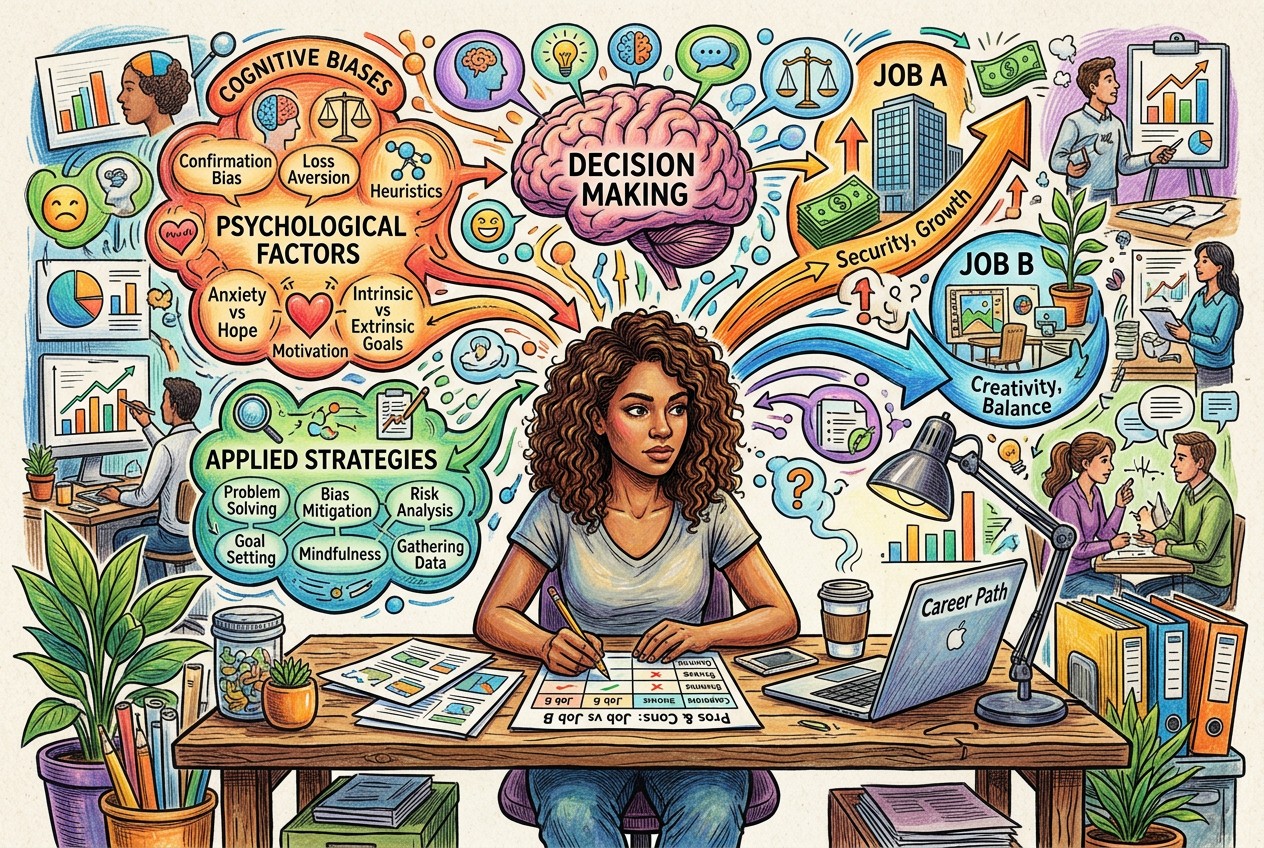
In my research interviews, I used to ask people to walk me through a decision that mattered to them, something they'd chosen on purpose rather than drifted into. The stories varied wildly on the surface, a career change, a move across the country, the decision to finally leave a relationship that had stopped working. But underneath the specifics, the same handful of patterns kept showing up. People who felt good about a choice years later, even a hard one, almost always described a process. People who felt haunted by a choice, even a reasonable one, almost always described a moment, a single instant where something took over and the thinking stopped.
That distinction is most of what applied psychology actually offers you. Not a way to predict the future or guarantee good outcomes, because no framework does that. What it offers is a way to understand the machinery running underneath your choices, the shortcuts your brain takes without asking permission, the emotions doing more steering than you'd like to admit, the habits quietly making decisions before you ever consciously weigh in. You make thousands of these choices a day, most of them too small to notice. A few of them will shape the next decade of your life. The same mind handles both, which means understanding how it works is worth the effort regardless of which kind of decision you're facing.
The Shortcuts Your Mind Takes Without Asking
Your brain didn't evolve for the volume of decisions modern life demands of it, so it developed shortcuts, fast, efficient rules of thumb that work well enough most of the time and badly enough some of the time that they're worth knowing by name.
Confirmation bias is the most familiar one, and also the easiest to underestimate because it doesn't feel like bias from the inside. It feels like being right. Once you've leaned toward a job offer, a relationship, a plan, you start noticing the evidence that supports it and quietly discounting the evidence that doesn't. I've watched this happen with something as concrete as a job decision, where every positive detail about a company gets full weight and every uneasy signal about its culture gets explained away before it's even been examined. The bias doesn't weaken with more thought. It tends to strengthen, because each piece of confirming evidence makes the next piece of disconfirming evidence easier to wave off.
The availability heuristic works differently. It has you judging how likely something is based on how easily an example comes to mind rather than how often it actually happens. A plane crash on the news can make flying feel more dangerous than driving for weeks afterward, even though the actual numbers run in the opposite direction by a wide margin. Your mind isn't doing math here. It's doing memory, and vivid memories crowd out quiet statistics every time.
Anchoring bias shows up anywhere a number gets introduced early in a conversation and quietly becomes the frame for everything after it. The first salary mentioned in a negotiation tends to define the entire range that follows, even when that number was arbitrary or strategically inflated. The same thing happens with price tags, time estimates, almost any situation where a number arrives before your own independent judgment has had a chance to form one.
It's worth separating these biases from something that gets lumped in with them unfairly: intuition. Intuition is your mind's rapid recognition of a pattern it has real experience with, the seasoned nurse who senses something is wrong before the monitors confirm it, the experienced negotiator who feels a deal souring before anyone's said a word about it. Bias is a predictable error. Intuition is compressed expertise. The way to tell them apart is to ask whether you actually have the relevant experience behind the feeling, or whether the feeling just arrived because something felt familiar and comfortable to believe.
Catching a Bias While It's Still Happening
None of this is useful as trivia. The actual skill is catching a bias while it's shaping a decision rather than only recognizing it afterward, once the choice is already made and the regret has set in.
Metacognition, thinking about your own thinking, is the starting point. Before a decision that matters, pause long enough to ask what assumptions you're working from and what's actually backing them up. This sounds simple and isn't, mostly because the moment usually arrives wrapped in urgency, the sense that the decision needs to happen now, today, before the feeling fades. That urgency is frequently the bias talking, not the situation. Genuinely time-sensitive decisions are rarer than they feel in the moment.
Seeking out a genuinely different perspective helps in a way that seeking reassurance doesn't. Talk to someone who's likely to see the situation differently than you do, not to be talked out of your instinct, but to pressure-test it against a vantage point you don't naturally have. When several people with real differences in background and experience land on similar conclusions independently, that convergence is worth more than any single confident opinion, including your own.
Building small rituals into your decision process catches what speed misses. Sleeping on a major choice before committing to it. Writing your reasoning down rather than leaving it as a feeling. Coming back to a pros-and-cons list after a day has passed, when the original emotional charge has faded and you can read your own reasoning with some distance. None of this eliminates bias completely. It just slows the process down enough for your slower, more deliberate thinking to catch what your fast thinking missed.
And when the decision keeps circling without resolving, when you've gathered the information available and you're still stuck, that's usually a different problem than bias. That's analysis paralysis, the state where more information stops helping and starts becoming another form of avoidance. The way through isn't more research. It's setting an honest deadline, naming the minimum information you actually need rather than the maximum you could theoretically gather, and trusting that most decisions can be adjusted later if they turn out wrong. Very few choices are as irreversible as they feel while you're standing in front of them.
What Your Emotions Are Actually Telling You
Emotional intelligence in decision-making doesn't mean suppressing feeling in favor of cold logic. It means learning to read what a feeling is actually telling you instead of either obeying it blindly or dismissing it entirely.
A decision made in anger, fear, or a rush of excitement often looks different once that emotional weather has passed. This is worth taking literally. If you can predict that you tend to make sharper, more reactive choices under stress, you can build that prediction into your planning, deliberately delaying anything significant until the emotional intensity has settled rather than pretending you'll think clearly regardless of state. Sleep and physical health matter more here than people give them credit for. A short night of sleep measurably impairs judgment and risk assessment, and a body running on stress hormones and low blood sugar doesn't produce the same clarity as one that's rested and fed. If something important is coming, protecting your sleep beforehand isn't indulgence. It's preparation.
At the same time, a feeling of discomfort about a choice that you can't fully explain is data worth taking seriously rather than ignoring. A gut sense that something is off about a deal, a relationship, an opportunity, often reflects pattern recognition happening faster than conscious articulation can keep up with. The skill isn't choosing between emotion and logic. It's learning which feelings are signal and which are noise, and that distinction usually comes down to whether you can trace the feeling to something real once you slow down enough to look, or whether it dissolves the moment you examine it closely.
Building a small pause between impulse and action gives you room to make that distinction. Noticing anger rise during a conversation and choosing not to speak from inside it yet. Feeling the pull toward an immediate yes and waiting one day before acting on it. That pause doesn't silence the emotion. It just keeps the emotion from making the decision alone.
The Habits Making Decisions Before You Do
Most of what looks like daily decision-making isn't decision-making at all. It's habit, running quietly enough that it doesn't register as a choice, even though a choice is exactly what built it in the first place.
Habits stick through repetition in a consistent context, which is why the same action performed in the same setting eventually stops requiring conscious effort. The first weeks of a new habit feel effortful precisely because the neural pathway hasn't been worn in yet. Months later, the same action requires almost nothing, which is both the appeal and the danger of habit, since it works exactly as well for patterns you'd like to keep as for ones you'd like to be rid of.
Your environment is quietly voting on your behalf the entire time. Books left visible on a coffee table get read more than books shelved out of sight. A remote control within arm's reach gets used more than one that requires getting up. None of this is really about willpower, despite how often it gets framed that way. It's about reducing the friction in front of the behavior you want and increasing the friction in front of the one you don't, so the easier path and the better path point in the same direction more often than not.
Small, immediate rewards reinforce a habit far more reliably than distant ones. The satisfaction of checking something off, a brief sense of completion, a moment of genuine enjoyment right after the behavior, these are often enough to make your mind want to repeat the action tomorrow, without needing some elaborate reward structure layered on top.
Breaking an unwanted pattern usually starts with naming its trigger rather than attacking the behavior directly. Most habits you'd like to change follow a predictable sequence: a feeling of stress leads to checking your phone, walking past the kitchen leads to a snack you weren't actually hungry for. Once you can name the trigger specifically, you can plan an alternative response for that exact moment rather than hoping willpower shows up when you need it. This is where implementation intentions, sometimes called if-then planning, do real work. Deciding in advance that if you feel the pull to skip your morning routine, then you'll commit to just five minutes of it, removes the need to negotiate with yourself in the moment you're least equipped to negotiate well. You're not relying on motivation. You're just following a plan you made when you were thinking clearly.
Tracking these patterns over time turns vague frustration into something you can actually work with. A simple log of when you followed through and when you didn't will usually reveal a shape you couldn't see day by day, a pattern tied to certain times, certain people, certain kinds of stress. That shape tells you exactly where to focus instead of trying to white-knuckle your way through every moment equally. People often ask how long this kind of change takes, and the honest answer depends more on complexity than on willpower. A simple habit can feel close to automatic within a couple of months of consistent practice. A more complicated pattern, the kind tangled up with emotion or identity, often takes longer, sometimes several months of deliberate attention before it stops requiring conscious effort. Consistency matters more than intensity here. A modest, steady practice outperforms an intense one that burns out after two weeks.
Frameworks Worth Borrowing for the Harder Choices
Some decisions are too complex for instinct alone, and this is where a structured framework earns its keep, not by replacing your judgment but by making sure your judgment actually considers the whole picture instead of the first frame that occurred to you.
One I come back to often is built around four moves, sometimes summarized with the acronym WRAP. Widen your options before narrowing them, asking what else is possible rather than collapsing too quickly into a yes-or-no choice. Reality-test your assumptions by actively seeking out the evidence that would prove you wrong, not just the evidence that would confirm what you already believe. Attain some distance before deciding, often by imagining what you'd tell a close friend facing the exact same choice, since advice to others tends to be clearer than advice to ourselves. And prepare to be wrong by genuinely considering how things might unfold differently than you expect, building in enough flexibility that surprise doesn't become catastrophe.
I've watched this framework change a choice simply by forcing the widening step. Someone facing what feels like a binary decision, stay or leave a job, often hasn't actually considered the third or fourth option sitting just outside the frame, a different role at the same company, a conversation that could change the terms entirely. The framework doesn't tell you what to choose. It makes sure you're choosing from the real range of options instead of the artificially narrow one your stress constructed.
Cost-benefit thinking gets more useful once it stops pretending that only financial and practical outcomes matter. A higher-paying role that quietly conflicts with your values carries a cost that never shows up on a spreadsheet, and pretending otherwise just delays the reckoning rather than avoiding it. Weighing a choice's effect on your sense of identity and your closest relationships alongside its effect on your bank account gives you a fuller, more honest accounting than either factor alone.
A decision journal does something neither framework can on its own. You write down what you chose, why you chose it, and what you expected to happen, then come back later and record what actually happened. Over time this builds something closer to a personal research record than a diary, showing you exactly which kinds of decisions you tend to make well and which kinds consistently surprise you. That's a kind of self-knowledge no single framework can hand you, because it only emerges from watching your own pattern across many choices rather than examining any one of them in isolation.
Knowing Your Own Decision Style
Understanding your values and your tendencies lets you make choices that actually feel like yours, rather than choices that technically work but leave you uneasy in some way you can't quite name. This is where self-awareness and decision-making overlap most directly. Knowing what you care about most makes saying no easier and saying yes more wholehearted, simply because you're no longer relying on guesswork to know whether an option fits.
Part of this is recognizing your own decision style honestly. Some people gather extensive information before choosing anything significant, building confidence through research. Others decide quickly, trusting a fast read and moving forward. Neither tendency is wrong on its own, but each carries a particular blind spot. If you're a fast decider, building in a mandatory pause before major choices compensates for the thing you're naturally inclined to skip. If you're an extensive researcher, setting a firm deadline compensates for the tendency to keep gathering information well past the point of diminishing returns. No personality type holds a monopoly on good judgment here. The advantage goes to whoever knows their own pattern well enough to correct for it deliberately.
Mindfulness supports this kind of clarity by quieting the noise that usually crowds out present awareness, the replay of yesterday's conversation, the rehearsal of tomorrow's worry. Decisions made from inside that noise are rarely your clearest thinking, simply because your attention is split between the choice in front of you and everything else competing for it. A consistent meditation practice, even a brief one, builds the capacity to notice a thought or an emotion without being immediately swept into acting on it, which directly translates into steadier decision-making, not because it eliminates urgency but because it creates a half-second of space inside the urgency where choice still lives.
This kind of self-knowledge is also what makes you genuinely useful when someone else is wrestling with a decision. The instinct to hand over advice is strong, especially when you can see the situation clearly from the outside, but the more durable help usually comes from asking rather than telling. Helping someone clarify what actually matters to them, offering a framework without steering them toward your own preferred outcome, naming a consideration they might have missed without insisting on its weight. Their decision criteria may not match yours, and the most respectful support trusts them to apply their own judgment once it's been sharpened rather than substituting yours for it.
How Other People Shape Choices You Think Are Yours Alone
A surprising amount of what feels like individual decision-making is actually happening inside a social context that quietly shapes the outcome.
Groups don't make decisions the same way individuals do, and not always for the better. Groupthink can pull a team toward a weak decision simply because no one wants to be the person who breaks an apparent consensus, even when several people privately have doubts. Social loafing means people often contribute less effort inside a group than they would working alone, diffusing responsibility until no one feels fully accountable for the outcome. Knowing these patterns by name helps you build better group processes, deliberately creating space for dissent before a decision locks in, rather than discovering the doubts only after something has gone wrong.
Social influence operates on individual choices too, often without announcing itself. You're surrounded by signals about what's normal, desirable, expected, and these signals shape decisions you'd otherwise describe as entirely your own. Awareness of this doesn't make you immune to it, but it does give you the option to pause and ask a useful question: do I actually want this, or am I responding to pressure I haven't fully noticed.
Relationship patterns deserve the same scrutiny, since they tend to operate well below conscious awareness. Do you avoid conflict reliably, even in moments where speaking up would clearly serve the relationship better? Do certain kinds of partners or friendships keep recurring, with the same eventual outcome each time, while the specific names and faces change? These aren't character flaws so much as patterns that formed somewhere and never got examined since. Naming them is usually the first step toward choosing differently the next time the pattern shows up.
Closing the Gap Between Deciding and Doing
Making a sound decision is only the first half of the work. Following through on it asks for a different set of tools, because willpower alone rarely survives contact with a busy week.
Commitment devices work by making it harder to quietly abandon a decision once it's made. Telling a friend about a goal creates social accountability that's harder to ignore than a private intention. Putting something at stake, even something small, raises the cost of backing out in a way that makes the choice to follow through easier in the moment it actually matters.
Pre-commitment strategies remove the decision from your daily plate entirely by settling it in advance. Deciding once that exercise happens on specific days at a specific time, rather than negotiating with yourself fresh every morning, eliminates an entire category of decision fatigue. Setting up an automatic transfer the day a paycheck arrives accomplishes the same thing for saving money. These strategies work by protecting you from a future version of yourself who might be tired, distracted, or simply less committed than you are right now.
Tracking progress closes the loop. What you measure tends to stay visible, and visibility alone changes behavior more than people expect. A simple log shows you whether your strategy is actually working, gives you something to adjust when it isn't, and keeps you connected to the reason you made the decision in the first place, which is easy to lose sight of once the original motivation has faded into routine.
Judging a Decision by How It Was Made, Not How It Turned Out
The final piece of this, and maybe the one people skip most often, is learning to evaluate a decision by the quality of the process behind it rather than the outcome that followed.
This distinction matters because outcomes and process don't always travel together. A well-reasoned decision can still produce a bad result because of something genuinely outside your control. A careless decision can occasionally work out through pure luck. Judging only by results teaches you the wrong lesson either way, either punishing good thinking that happened to meet bad luck, or rewarding sloppy thinking that happened to get lucky. The more useful question is whether you used the information available to you, considered the factors that mattered, and reasoned your way to the choice honestly.
A learning review, done well, looks for lessons rather than someone to blame, including yourself. When a decision doesn't produce what you expected, ask what you'd do differently with what you know now, what information was missing at the time, what you underweighted in your original thinking. This kind of curious, specific review builds real wisdom over repeated decisions. Self-criticism aimed at your character rather than your process tends to produce shame instead of improvement, and shame rarely makes anyone a better decision-maker.
Conditions change, too, which means a decision that made sense six months ago can need revising now without that revision meaning the original choice was wrong. A career path that isn't developing the way you expected isn't necessarily evidence of poor judgment back when you chose it. It might simply be new information asking for an adjustment, which is a different thing entirely from failure.
I think about those research interviews often, the people who described a decision they trusted years later and the ones who described one they still flinched at remembering. The difference was rarely about which choice was objectively correct, because plenty of good decisions led to hard outcomes and plenty of impulsive ones happened to work out fine. The difference was whether the person had been present for their own decision, aware of the bias pulling at them, the emotion steering underneath, the habit running on autopilot, or whether the decision had simply happened to them while their attention was somewhere else.
That presence is what all of this actually adds up to. Not a guarantee of better outcomes, because nothing offers that honestly, but a way of being awake inside your own choices instead of discovering them after the fact. The next decision in front of you, whatever its size, is an opportunity to practice exactly that kind of presence. Most of what determines how you'll feel about it later isn't the choice itself. It's whether you were genuinely there for the making of it.
Keep reading
- The Zeus in You: Why the Old Gods Still Describe the Mind
- Why I Am Guilty of Having No Shame
- The Unflappable You: How to Stop Letting Others Ruffle Your Feathers
- Don't Assume the Worst; Talk to Me About It First
- Possible vs. Probable: Why the Difference Shapes a Life
- Why Old Advice Suddenly Makes Sense Years After You Heard It
- Accept Belonging & Belong Acceptance
- Marcus Aurelius and Rumi: Two Paths to the Same Peace