Self-Determination Theory: What Actually Makes Motivation Last
A close look at self-determination theory and why lasting motivation depends on autonomy, competence, and genuine connection, not willpower alone.
| Interconnection, Self-awareness, Motivation, Purpose, Passion, Understanding, Mindful Listening, Communication, Wisdom, Meaning-Making, Anxiety & Stress, Perspective, Conflict Resolution, Consideration, Decision-making, Emotional Intelligence, Affect Regulation, Social Intelligence, Connection | 9 min read
Think about the last time someone told you that you needed more willpower. Maybe it was about exercise, or a work project you kept avoiding, or a habit you'd promised yourself you'd change. The advice usually comes wrapped in the same assumption: that motivation is a kind of internal fuel tank, and your job is to fill it up and grit your way through. If you've ever followed that advice and found the motivation evaporating within weeks, it's worth asking whether the problem was your discipline at all, or whether it was the model of motivation you'd inherited.
Self-determination theory, developed over four decades by psychologists Edward Deci and Richard Ryan, offers a genuinely different account. Rather than treating motivation as a single quantity that varies in strength, Deci and Ryan's research distinguishes between different kinds of motivation, some of which reliably produce lasting engagement and wellbeing, and others which tend to collapse the moment external pressure lifts. The distinction isn't about how badly you want something. It's about where the wanting originates.
Two kinds of wanting, and why the difference matters
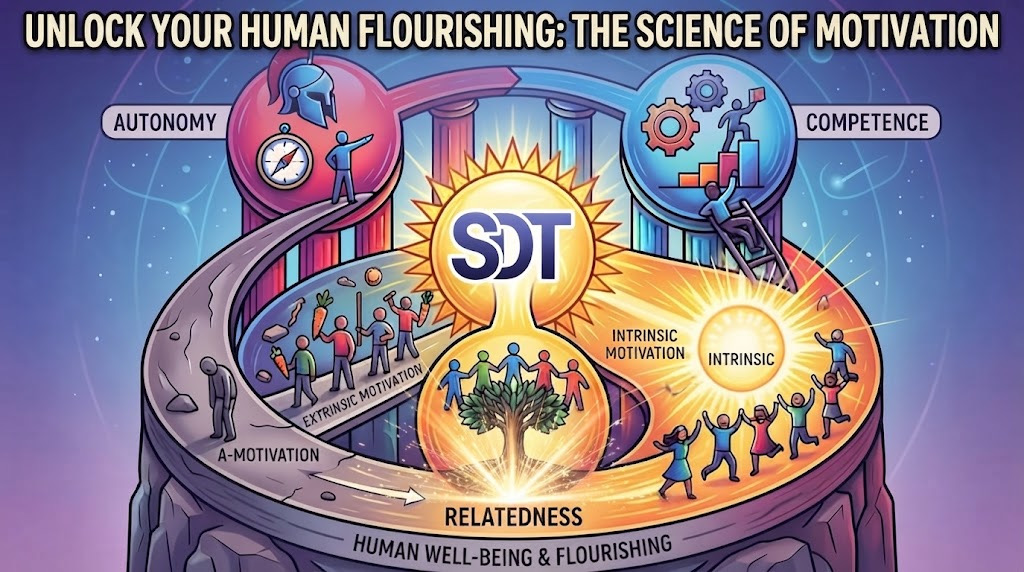
Deci and Ryan's foundational insight, developed through decades of controlled research beginning in the 1970s, is the difference between autonomous motivation and controlled motivation. Autonomous motivation means doing something because you endorse it, because it aligns with your values or genuinely interests you. Controlled motivation means doing something because you feel pressured, whether that pressure comes from an external reward, a looming punishment, guilt, or an internalized sense that you should want this even if you don't quite.
What makes this distinction useful rather than merely academic is that the research consistently shows these two forms of motivation produce different outcomes, even when the behavior looks identical from the outside. A 2008 meta-analysis by Ng and colleagues, later expanded in subsequent reviews, found that autonomous motivation predicts better performance, greater persistence, and higher psychological wellbeing across domains ranging from education to healthcare to the workplace. Controlled motivation, by contrast, tends to produce compliance that's brittle. It works as long as the reward or the threat is present, and it tends to dissolve quickly once that external structure is removed.
This is worth sitting with, because it reframes a common experience. If you've started a new habit with real enthusiasm, only to find it collapsing a month later once the novelty wore off, the issue might not have been insufficient willpower. It might have been that the motivation was borrowed from somewhere outside you, perhaps a productivity culture message, an image you wanted to project, or someone else's expectation, rather than grown from something you actually valued.
The three needs the theory identifies
Deci and Ryan's central claim is that autonomous motivation flourishes when three basic psychological needs are satisfied: autonomy, competence, and relatedness. These aren't luxuries or personality preferences. The research frames them as necessary conditions for psychological growth and wellbeing, in much the way water and sunlight are necessary conditions for a plant's growth, regardless of the individual plant's temperament.
Autonomy, in this context, doesn't mean independence from other people or doing everything alone. It means experiencing your actions as genuinely chosen, as expressions of your own values rather than impositions from outside. Competence refers to the felt sense of being capable, of making progress, of encountering challenges that stretch you without overwhelming you. Relatedness names the need to feel connected to others, to matter to people and have people matter to you, a need woven through nearly every psychological theory that takes human beings seriously as social creatures.
What's notable is how consistently these three needs show up across contexts that otherwise look nothing alike. Research by Ryan and Deci across workplaces, schools, healthcare settings, and even video game design has found that when environments support autonomy, competence, and relatedness, people report higher engagement and wellbeing, regardless of the specific activity. When environments undermine these needs, even objectively pleasant activities start to feel hollow. A well-compensated job that offers no autonomy, for instance, can produce significant dissatisfaction despite the financial security it provides.
Why rewards sometimes backfire
One of the more counterintuitive findings to emerge from this research tradition concerns extrinsic rewards. Deci's early experiments in the 1970s found that when people were paid to do a task they already found interesting, their intrinsic interest in that task often decreased once the payment stopped, a phenomenon later termed the overjustification effect. In other words, adding an external reward to an already meaningful activity can, under certain conditions, crowd out the internal motivation that was doing the work in the first place.
This finding has been refined considerably since the original studies, and it isn't a blanket argument against rewards or compensation. Subsequent research has clarified that the effect is strongest when rewards are experienced as controlling, that is, when they feel like a subtle message that says: I don't trust you to do this without incentive. Rewards that instead affirm competence, offered as recognition of skill or effort rather than as a bribe, tend not to produce the same undermining effect. The distinction lies less in the reward itself than in what it communicates about the giver's trust in your capacity to choose.
This has real implications beyond workplace design. If you've ever noticed a hobby losing its appeal once you started monetizing it, or a creative practice feeling different once it became something you had to produce for others, you've likely experienced this dynamic directly. The activity didn't change. What changed was the psychological frame around it, from something chosen to something owed.
Interconnection as a psychological need, not a preference
Relatedness deserves particular attention here, because it's the piece of self-determination theory most often underestimated in cultures that prize individual achievement. It would be easy to read autonomy and competence as the serious psychological needs and relatedness as something softer, more optional. The research doesn't support that hierarchy. In fact, studies applying self-determination theory to relationship contexts, including work by Sheldon and colleagues examining need satisfaction across life domains, have found that relatedness satisfaction predicts wellbeing as strongly as the other two needs, and that deficits in relatedness are associated with some of the steepest declines in psychological health.
This connects to a broader body of research on social connection and mortality risk, most notably Holt-Lunstad's 2010 meta-analysis, which found that the protective effect of strong social relationships on longevity was comparable to quitting smoking. Human beings are not incidentally social. The need for genuine connection appears to be built into the architecture of psychological functioning itself, which means that a life organized entirely around individual autonomy and competence, without adequate relatedness, is missing a structural support rather than an optional extra.
What makes this especially relevant to self-determination theory is that relatedness doesn't operate independently of autonomy. Deci and Ryan's research suggests that the highest quality relationships are ones where both people feel free to be themselves, where connection doesn't require the suppression of individual identity. This complicates any simple opposition between independence and closeness. The theory suggests these aren't competing goods that must be traded off against each other, but interdependent needs that, when both satisfied, reinforce one another.
Where this shows up in daily texture
Consider how this plays out in something as ordinary as a work assignment. Two people might be asked to complete the identical task. One experiences it as an imposition, something dictated from above with no room for input, evaluated purely on output, disconnected from any colleague who might understand the effort involved. The other experiences some latitude in how the task gets done, receives feedback that acknowledges genuine skill development, and works alongside people who notice the effort. The task is the same. The psychological experience, and very likely the quality and sustainability of the effort, is not.
This same pattern extends into parenting, education, and healthcare, three domains where self-determination theory has generated substantial applied research. Ryan and Deci's work with autonomy-supportive teaching, for instance, has found that when teachers offer meaningful rationales for requirements rather than simply issuing directives, and when they acknowledge students' perspectives even while maintaining structure, students show greater engagement and deeper learning than in more controlling classroom environments. Notably, this isn't an argument for permissiveness or the absence of structure. Autonomy support and clear expectations are not opposites. A well-designed environment can hold both.
Similarly, in healthcare contexts, research applying self-determination theory to chronic illness management has found that patients who feel genuinely informed and respected as decision-makers, rather than simply instructed, show better adherence to treatment over time. This matters because it reframes what looks like noncompliance. A patient who isn't following medical advice may not be lacking discipline. They may be responding, entirely reasonably, to an interaction that left no room for their own agency in the process.
The limits worth naming honestly
It would be dishonest to present self-determination theory as though satisfying these three needs guarantees flourishing regardless of circumstance. The theory itself doesn't claim this, and neither should any account of it. Structural realities, including economic precarity, discrimination, chronic illness, and the simple unavailability of autonomy-supportive environments, shape how much room a person actually has to exercise psychological choice. Someone working multiple jobs to make rent has less structural latitude for autonomy than someone with financial security, regardless of their internal disposition toward self-determination.
This is where the theory's honesty becomes valuable rather than limiting. Deci and Ryan's later work increasingly acknowledges that need satisfaction is shaped by social and institutional context, not solely by individual mindset. A workplace can be redesigned to offer more autonomy. A classroom can be restructured to support competence development. A healthcare system can shift toward more collaborative decision-making. These are structural interventions, not just personal ones, and the research supports pursuing change at both levels simultaneously.
For an individual reader, this means the theory isn't best used as a tool for self-blame when circumstances constrain your options. If you find yourself in an environment that actively undermines autonomy, competence, or relatedness, that's useful information about the environment, not necessarily evidence of a personal failing. The question worth asking isn't only how you can generate more autonomous motivation internally, but also what, realistically, within your actual constraints, might shift the conditions around you.
What this looks like from the inside
One of the quieter implications of this research concerns how you might evaluate your own choices and commitments. Rather than asking whether you have enough willpower to sustain a given behavior, you might ask a more diagnostic question: does this choice feel like an expression of something I value, or does it feel like an obligation imposed from outside, even if I'm the one imposing it on myself? The two can feel remarkably similar from a distance and quite different up close.
This connects to work in acceptance and commitment therapy on values clarification, which similarly distinguishes between actions taken in service of a freely chosen value and actions taken to avoid guilt or meet an internalized should. Both frameworks, developed somewhat independently, converge on a similar insight: sustainable behavior change tends to depend less on the intensity of the motivating feeling and more on whether the action connects to something the person genuinely endorses. A useful practice here, borrowed loosely from ACT, involves noticing the language you use internally when describing a commitment. “I have to” and “I want to” often point to the same behavior but signal very different psychological relationships to it.
Similarly, the theory offers a useful lens for examining relationships, both personal and professional. If a relationship consistently requires you to suppress your own perspective in order to maintain connection, that's a relatedness need being met at the direct expense of an autonomy need, and the research suggests this trade-off tends to erode wellbeing over time rather than stabilize it. Genuinely healthy connection, according to this body of research, doesn't ask you to disappear in order to belong.
An interdependent view of human motivation
What self-determination theory offers, at its core, is a corrective to a very old and very persistent myth: that independence and connection exist on opposite ends of a single spectrum, and that psychological maturity means moving steadily toward the independence end. The research points somewhere else entirely. Autonomy, competence, and relatedness function together, each supporting the others, none of them optional, none of them sufficient alone.
This has implications well beyond individual motivation. It suggests that a person's capacity for self-directed, meaningful action is never purely internal. It's relational and structural from the start, built in relationship with the people and institutions and environments that either support or undermine these three needs. Consequently, the question of how to live a motivated, engaged life is never only a question about your own internal resources. It's also a question about the conditions you're embedded in, and whether those conditions leave room for the kind of person you're actually trying to become.
Where does that leave the search for lasting motivation? Perhaps not with a formula, but with a different set of questions to carry forward: what would it look like to build environments, relationships, and daily structures that treat autonomy, competence, and connection as necessities rather than extras? And what might become possible, both for you and for the people around you, once that question is taken seriously?
Keep reading
- The Zeus in You: Why the Old Gods Still Describe the Mind
- Why I Am Guilty of Having No Shame
- The Unflappable You: How to Stop Letting Others Ruffle Your Feathers
- Don't Assume the Worst; Talk to Me About It First
- Possible vs. Probable: Why the Difference Shapes a Life
- Why Old Advice Suddenly Makes Sense Years After You Heard It
- Accept Belonging & Belong Acceptance
- Marcus Aurelius and Rumi: Two Paths to the Same Peace