When Insight Burns Bright: Mania, Ecstasy, and Creative Fire
An exploration of altered states, creative insight, and overwhelm through Greek myth and psychological research, offering language for intensity without losing yourself in it.
| Consciousness, Identity, Personal Energy, Transformation, Creative Expression, Authenticity, Flow, Self-Authorship, Behavioral Activation, Conscious Creation, Intentional Living, Resource Allocation, Natural Rhythm Cycles, Lifelong Learning, Kaizen, Profound Gratitude, Metacognition, Understanding, Mindful Listening, Communication, Wisdom, Meaning-Making, Perspective, Anxiety & Stress, Consideration, Decision-making, Connection, Compassion, Empathy, Intuition, Emotional Contagion, Memorialization, Integration, Shadow Work, Wholeness, Self-Transcendence, Interconnection, Spiritual Autonomy, Legacy, Prospection | 12 min read
There is a particular kind of morning, or sometimes a particular kind of 3 a.m., when your mind feels lit from the inside. Thoughts connect in patterns you have never noticed before. Colors seem sharper. Ideas arrive faster than you can write them down, and there is a sense, however fleeting, that you have finally seen something true. If you have felt this, you also likely know what tends to follow: the same intensity that felt like clarity can tip, sometimes within hours, into something closer to static. The signal becomes noise. The insight becomes overwhelm. And the question worth sitting with is not whether this happened to you, but what it actually was.
Psychology and neuroscience have spent decades circling this territory from different directions, sometimes calling it hypomania, sometimes flow, sometimes creative incubation, sometimes anxiety, sometimes the felt sense of the numinous. What they are often describing, in different vocabularies, is a single underlying phenomenon: a state of heightened neural and psychological activation that can express itself as brilliance, terror, artistic breakthrough, or exhausting dysregulation, frequently within the same afternoon. The ancient Greeks, long before neuroimaging existed, built an entire mythological architecture around this exact experience. They did not have fMRI data, but they had something almost as useful: precise language for the different flavors this fire can take, and warnings about what happens when you mistake the fire for yourself.
The light that reveals and the light that blinds
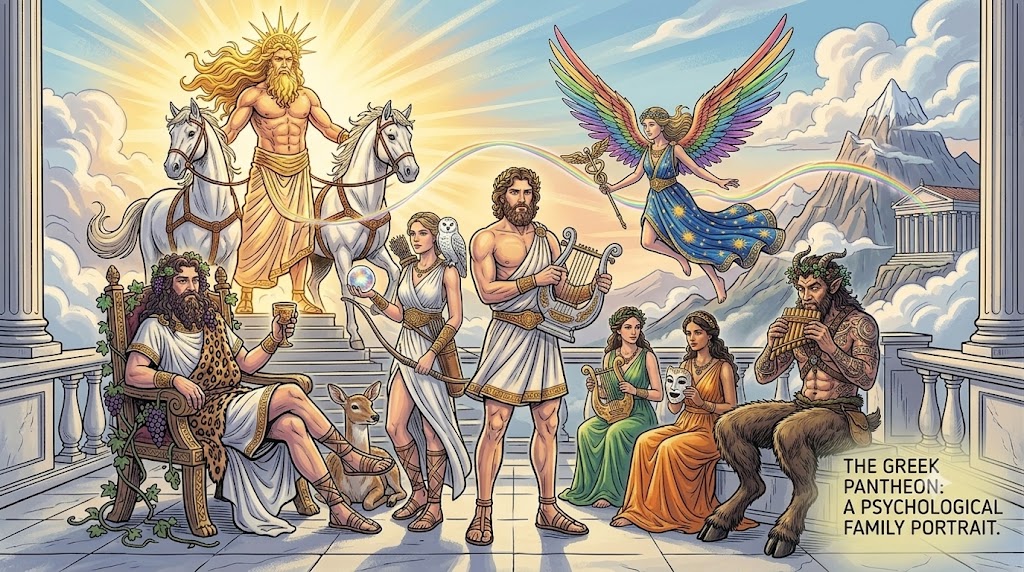
Helios drives the sun chariot across the sky, indifferent and total, the source of all illumination and also capable of scorching the earth if his course wavers even slightly. Apollo, by contrast, is the god of ordered light: prophecy, music, medicine, reason. He represents clarity that has been given form, insight that has been shaped into something communicable. The distinction matters more than it might first appear.
Raw heightened awareness, the kind that arrives during a surge of dopaminergic activation or a genuine creative breakthrough, is Helios-light. It is total, undifferentiated, and enormous. Researchers studying hypomanic states, including work by Johnson and colleagues (2012) on the relationship between reward sensitivity and bipolar spectrum experiences, have documented how surges in approach motivation and positive affect can produce genuine cognitive advantages: faster association-making, increased confidence, a felt sense of expanded possibility. This is not imaginary. The neural substrate is real, and the subjective experience of seeing further and faster is not a delusion so much as a temporarily altered signal-to-noise ratio in how the brain processes incoming information.
The trouble is that Helios-light, left unshaped, tends to overwhelm exactly the system meant to receive it. This is where Apollo becomes useful, not as a replacement for the intensity but as its translator. Apollo does not dim the sun. He gives it a lyre to play through, an oracle to speak through, a discipline of form. If you have ever had a rush of creative insight and immediately reached for a notebook, a musical instrument, or a canvas, you were doing something Apollonian: taking undifferentiated intensity and giving it a shape narrow enough to be carried without shattering.
This matters clinically, too, even outside diagnosable conditions. Cognitive behavioral frameworks around emotional regulation, including Linehan's work on distress tolerance within dialectical behavior therapy, emphasize that intense states are not inherently dangerous. What tends to create harm is the absence of a container. The practice of naming an internal state precisely, what some traditions call affect labeling, has been shown in research by Lieberman and colleagues (2007) to reduce amygdala reactivity simply by giving the experience language. Apollo, functionally, is what happens when you name the fire instead of only burning in it.
Artemis and the discipline of the edge
Artemis is Apollo's twin, but she governs something distinct: the wilderness, the hunt, the untamed periphery just outside civilization's boundary. She is precise, self-possessed, and utterly herself, moving through territory that would overwhelm someone less grounded. If Apollo represents insight given form, Artemis represents the capacity to stay oriented while moving through genuinely wild internal terrain.
This distinction is worth making because heightened states are not always calm enough to shape immediately. Sometimes you are simply in the woods, so to speak, moving through an intensity that has not yet resolved into anything communicable. What Artemis offers is not the transformation of chaos into order, but the capacity to remain coherent while inside chaos. Research on interoceptive awareness, particularly the work of Sarah Garfinkel and colleagues on heartbeat perception and emotional regulation, suggests that people who maintain a clearer, steadier connection to their own bodily signals during activation tend to navigate emotional intensity with more stability, not because the intensity is reduced, but because their internal compass keeps functioning inside it.
Practically, this might look like grounding through the body rather than the mind when you notice a surge of energetic overwhelm building. Orienting to physical sensation, temperature, the weight of your own feet on the floor, can function as an Artemis-practice: a way of staying tethered to your own territory even as the internal weather turns wild. This is not about suppressing the intensity. It is about not losing yourself inside it.
Dionysus and the risk of dissolution
No honest examination of altered states and creative ecstasy can avoid Dionysus, and for good reason. He is the god of wine, theater, ritual madness, and the dissolution of the ordinary self. Euripides captured him with genuine ambivalence in The Bacchae: liberating and destructive in the same motion, capable of releasing people into ecstatic communion and also capable of tearing apart anyone who resists or misunderstands him, sometimes literally.
This ambivalence is not incidental to the myth. It is the point. Dionysian states, the loss of ordinary self-boundary, the merging with something larger than individual identity, describe something real in human neurology. Research on flow states by Csikszentmihalyi (1990) and later work on ego-dissolution experiences, including studies by Robin Carhart-Harris on altered states of consciousness, describe a genuine reduction in default mode network activity, the neural system associated with self-referential thinking. When that system quiets, people frequently report a sense of expanded connection, timelessness, and creative flow. Artists across history have described something like this: the sense that the work is arriving through them rather than from them.
The danger Euripides was tracking, however, is what happens when dissolution becomes total and unanchored. Without something like Apollo's form or Artemis's orientation, Dionysian intensity can become genuinely disorganizing, not metaphorically but functionally. This is where energetic overwhelm and creative ecstasy sit closer together than most people expect. The same neurological loosening that allows extraordinary connection-making can, without containment, tip into the kind of dysregulation that feels like panic, dissociation, or the sense of having lost your own edges entirely.
What this means in practice is that ecstatic or expansive states are not inherently risky, but they do ask for some structure around them. This might mean returning, gently and repeatedly, to a physical anchor. It might mean having a person you trust who can help you find your way back to ordinary orientation if the intensity outpaces your capacity to hold it. It might simply mean recognizing, as Dionysus's mythology insists, that even joy this large deserves respect for its power.
Pan and the physiology of panic
The word panic comes directly from Pan, the goat-legged god of wild places, whose sudden appearance was said to cause the kind of instant, bodily, unreasoning terror that has no clear external cause. This etymology is not decorative. It is a precise piece of ancient psychological observation: panic, unlike fear, often arrives without a clear object. You are not afraid of something specific. You are simply, suddenly, overwhelmed.
Contemporary research on panic states, including foundational work by David Clark on the cognitive model of panic disorder, describes something remarkably close to what the Pan myth encodes: a catastrophic misreading of internal bodily sensations, a racing heart or shortness of breath interpreted as evidence of imminent danger, which then intensifies the very sensations being feared. The loop feeds itself. This is worth naming clearly because the connection between heightened creative states and panic is not incidental. Both involve significant physiological activation, elevated heart rate, sharpened attention, a flood of internal signal. The nervous system, in the moment, cannot always distinguish inspired intensity from threatening intensity. The interpretation is what determines the experience.
This is where cognitive reappraisal, a core mechanism within cognitive behavioral approaches, becomes genuinely useful, not as a technique to suppress the sensation but as a way of accurately naming it. If a surge of activation arrives, the question worth asking is not only "how do I make this stop" but also "what is this actually a signal of." Sometimes the honest answer is exhaustion or dysregulation. Sometimes it is the early architecture of a genuine insight that has not yet found its form. Pan does not distinguish; he simply announces that something wild has entered the clearing. What you do next is yours to determine.
The Muses and the discipline of receiving
If Dionysus represents dissolution and Pan represents sudden overwhelm, the Muses represent something quieter and, in some ways, more difficult: the practice of staying present enough to receive what arrives without immediately grasping or fleeing it. In the Greek tradition, the Muses were not sources of chaotic inspiration but of ordered creative gift, daughters of Mnemosyne, memory itself, suggesting that genuine creative insight is inseparable from the capacity to hold and retain what comes.
This connects to something researchers studying creative incubation have documented consistently: insight tends to arrive not during forced effort but during states of relaxed, diffuse attention, what cognitive scientist Arne Dietrich has described as a shift toward the brain's associative rather than executive processing mode. Consequently, the practice most useful for creative reception is not straining toward inspiration but creating enough internal stillness that it becomes possible to notice it when it arrives. The Muses, notably, were said to require invocation. You had to ask, and then wait.
If you have ever tried to force a creative breakthrough and found it eluding you, only to have it arrive later while walking, showering, or falling asleep, you have experienced something the Greeks understood intuitively: insight favors a particular quality of attention, alert but not gripping, present but not grasping. This is a genuinely different orientation than the anxious vigilance of Pan-panic, even though both involve heightened awareness. The distinction is in the relationship to the intensity, not the intensity itself.
Iris, the messenger, and the work of translation
Iris, goddess of the rainbow, carries messages between the gods and mortals, moving along the spectrum of light itself as a kind of living bridge between registers of experience that would otherwise remain incommunicable. She is a useful figure here because she names something specific: the work of translation between an internal state and its expression is not automatic. It requires a bridge.
This is precisely the work many people find themselves needing when they are moving through heightened states, particularly when navigating the territory between raw insight and articulate expression. The internal experience of an idea, especially at its most intense, is rarely identical to its communicable form. Something is always lost or transformed in translation, and this is not a failure. It is the actual mechanism by which private intensity becomes shareable meaning. Writers describe this constantly: the idea in the mind feels vast and total, and the sentence on the page is necessarily smaller, more specific, more limited. This is not a diminishment. It is Iris doing her work, carrying something across a genuine gap between registers.
If this feels frustrating, particularly during periods of heightened creative energy when the gap between the felt intensity and its expressible form seems especially wide, it might help to remember that the translation itself is the craft. Nobody experiences their own creative insight in fully formed sentences. The forming is the labor, and it takes time that the original flash of insight did not require.
The Oracle, Cassandra, and the burden of unmet insight
Perhaps no figures in Greek mythology speak more directly to the psychological weight of heightened perception than the Oracle at Delphi and Cassandra of Troy. The Oracle, speaking from a trance state induced partly by geological vapors rising through the temple floor (a detail confirmed by later geological research into the site), delivered prophecy that was often ambiguous, requiring interpretation, requiring a listener willing to sit with uncertainty rather than demand clean answers. This is worth noting because heightened states of insight rarely arrive pre-organized. They arrive raw, and the demand for immediate clarity can itself become a source of distress.
Cassandra's story is darker and, in some ways, more instructive for the specific overlap between insight and overwhelm. Granted true prophecy by Apollo and then cursed so that no one would believe her, Cassandra saw clearly and was met with disbelief at every turn. Her mythological fate names something real: the isolation that can accompany heightened perception when it exists without a community capable of receiving it. This is not only ancient poetry. Contemporary research on social support and emotional regulation, including work by researchers studying co-regulation in relationships, consistently finds that the presence or absence of a receptive witness significantly shapes whether intense states resolve into insight or calcify into distress.
In other words, whether a heightened state becomes generative or corrosive is not determined solely by what happens inside you. It is also shaped by whether there is somewhere for it to go, someone able to hear it without flinching or dismissing it. This is a structural reality, not merely a personal failing when it is absent. If you have ever had an experience of genuine insight met with blank incomprehension or outright dismissal, you know something of Cassandra's particular grief, and it is worth naming clearly that this is not a private inadequacy but a relational absence.
Holding the fire without losing yourself in it
Taken together, these figures do not describe a hierarchy where Apollo's order defeats Dionysus's chaos, or where Artemis's discipline should permanently replace Pan's wildness. Rather, they describe a genuine range of registers that heightened consciousness can move through, sometimes within a single day, sometimes within a single hour. The goal is not to eliminate the intensity, which would likely also eliminate much of what makes creative and perceptual life vivid in the first place. The goal, if there is one, is closer to what the Greeks were reaching for across this entire cast: developing enough internal architecture that intensity becomes navigable rather than either suppressed or uncontained.
This might mean, practically, learning to notice early which register you are in. Is this Apollo-clarity, organized and expressible? Is this Dionysian dissolution, expansive but requiring an anchor? Is this Pan-panic, physiological activation misread as threat? The noticing itself, what contemplative and cognitive traditions alike describe as metacognitive awareness, tends to be the actual lever. Bishop and colleagues' influential work on operationalizing mindfulness (2004) describes exactly this capacity: not the elimination of intense states, but a shift in one's relationship to them, observing rather than being wholly consumed.
None of this resolves neatly, and it would be dishonest to suggest otherwise. Heightened states will likely keep arriving throughout a creative or contemplative life, sometimes as gift, sometimes as genuine difficulty, often as both simultaneously. What the mythology offers is not a cure but a vocabulary, a way of recognizing which god has entered the room so that you might respond with something more precise than either total surrender or total suppression.
Living with the whole cast
The ancient Greeks did not resolve the tension between these figures because the tension is not actually resolvable. Apollo and Dionysus were worshipped at the same temple in Delphi, sometimes even said to share custody of it across different seasons of the year, a detail that feels less like coincidence and more like an admission: ordered clarity and ecstatic dissolution are not enemies locked in permanent conflict. They are seasons within the same terrain, and a life lived only in one register, endlessly ordered or endlessly ecstatic, would likely be a diminished life either way.
If you find yourself moving through a period of heightened perception, whether it arrives as creative surge, anxious overwhelm, or something that refuses easy categorization, the invitation is not to force it into a single frame. It might be worth asking, gently and without demanding an immediate answer, which figure feels closest to what you are experiencing right now. That question alone, held with curiosity rather than urgency, is often the beginning of the translation Iris was always meant to carry.
What remains true across every figure in this particular myth-cluster is that none of them acted alone. Even Apollo needed the Muses. Even the Oracle needed an interpreter. The fire, whatever form it takes in you, was likely never meant to be carried in isolation.
External Resources
External Resources
External Resources
Keep reading
- The Zeus in You: Why the Old Gods Still Describe the Mind
- Why I Am Guilty of Having No Shame
- The Unflappable You: How to Stop Letting Others Ruffle Your Feathers
- Don't Assume the Worst; Talk to Me About It First
- Possible vs. Probable: Why the Difference Shapes a Life
- Why Old Advice Suddenly Makes Sense Years After You Heard It
- Accept Belonging & Belong Acceptance
- Marcus Aurelius and Rumi: Two Paths to the Same Peace