Executive Dysfunction and the Gap Between Intention and Action
A close look at executive dysfunction and the intention-behavior gap: what causes it, how it shows up as inadvertence and omission, and what research says helps.
| Cognition, Metacognition, Anxiety & Stress, Decision-making, Consideration | 12 min read
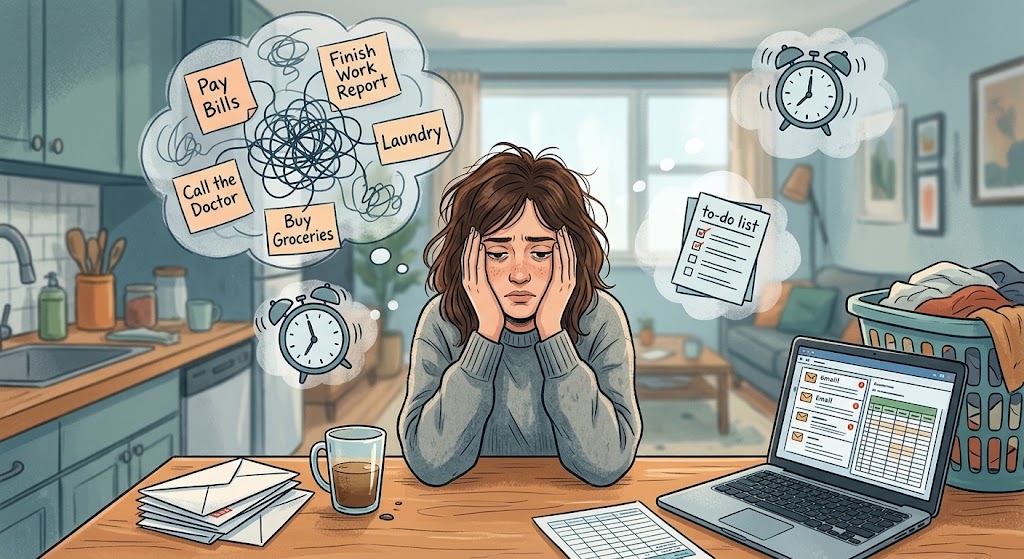
You meant to call. You genuinely intended to renew the registration before it lapsed, to answer the email that's been sitting in bold for eleven days, to start the project the night before instead of the hour before. None of this was a lie you told yourself. The intention was real, formed with sincerity, sometimes even accompanied by a small private promise. And yet the action never arrived. If you've lived inside this pattern long enough, you've probably already ruled out laziness as the explanation, because laziness doesn't explain the anxiety, the shame, or the genuine bewilderment of wanting something and still not doing it. What you're describing has a name, and it's more precise and more structural than most people realize.
What executive dysfunction actually names
Executive function is the umbrella term cognitive scientists use for the set of mental processes that let you plan, initiate, sequence, monitor, and adjust goal-directed behavior. Russell Barkley, whose work has shaped much of the contemporary understanding of self-regulation, describes executive functions as the neurocognitive systems responsible for what he calls self-directed action across time, essentially the machinery that lets a future goal exert influence over a present moment. Executive dysfunction, then, is not a personality trait or a moral failing. It's a disruption somewhere in that machinery, most often localized to the prefrontal cortex and its connections to other brain regions responsible for attention, working memory, and emotional regulation.
It's worth being precise here, because the term gets used loosely in casual conversation, often as a catch-all for any kind of procrastination or forgetfulness. Clinically and neuropsychologically, executive dysfunction involves measurable impairments in specific domains: working memory, cognitive flexibility, inhibitory control, planning, and task initiation. These domains don't operate independently. They interact, which is precisely why the experience of executive dysfunction rarely feels like one clean problem. Instead, it feels like several problems wearing the same coat: you forget the thing, then you can't start the thing, then you can't stop doing the wrong thing long enough to do the right one.
Executive dysfunction shows up across a wide range of contexts. It's a defining feature of ADHD, but it also appears in depression, anxiety disorders, traumatic brain injury, chronic stress, sleep deprivation, and normal aging. Barbara Sahakian's research on cognitive function and mood has demonstrated that even transient states, prolonged stress or insufficient sleep among them, can measurably degrade executive performance in people with no underlying condition at all. In other words, executive function exists on a continuum, and most people will experience some version of dysfunction at some point, whether chronically or situationally. Understanding this distinction matters, because it reframes the conversation away from a binary of broken versus fine and toward something more accurate: a spectrum of capacity that shifts with circumstance, health, and load.
The intention-behavior gap, examined closely
Here's where the territory becomes genuinely interesting, and where most popular writing on this subject stays frustratingly vague. Psychologists have long studied what's called the intention-behavior gap, the well-documented finding that forming an intention to do something is a remarkably poor predictor of actually doing it. Peter Gollwitzer's research on implementation intentions, conducted across several decades, found that even strong, sincere intentions translate into corresponding action only about half the time in many studied contexts. That statistic alone should reframe how you think about your own follow-through. The failure to act on an intention isn't rare or aberrant. It's closer to the norm, and executive dysfunction widens what's already a fairly common gap into something far more disruptive.
What makes this gap so disorienting is that it doesn't operate as a single mechanism. It fractures into several distinct failure points, each with its own texture and its own consequences, and distinguishing between them is one of the more useful things you can do for yourself.
Inadvertence: the intention that never became conscious again
Inadvertence describes the situation where the intention was real, but it simply failed to resurface at the moment action was possible. You intended to take the medication with breakfast, but breakfast happened and the intention didn't. This isn't about caring insufficiently. It's a failure of what cognitive scientists call prospective memory, the capacity to remember to execute an intention at a future point without an external cue prompting you. Prospective memory relies heavily on working memory and sustained attention, both of which are frequently compromised in executive dysfunction. Consequently, the intention doesn't die from neglect. It dies from never being retrieved at the moment it needed to surface.
Negligence: knowing and still not acting
Negligence, in this context, is distinct from inadvertence in an important way. Here, the intention does resurface, sometimes repeatedly, and the person is fully aware of the task at hand. And yet the action still doesn't follow. This is often where the most acute shame lives, because from the outside, and often from the inside as well, it looks indistinguishable from not caring. But the research on executive dysfunction suggests something more specific is happening: a breakdown in what's sometimes called task initiation, the neurocognitive step between knowing you should do something and generating the actual motor and motivational sequence to begin. Task initiation deficits are among the most consistently reported executive impairments in ADHD research, and they operate independently of desire or values. You can want something intensely and still be unable to locate the internal lever that starts it.
Deprioritization: when everything competes for the same attention
Deprioritization happens when multiple intentions exist simultaneously, and the executive system, tasked with ranking and sequencing them, fails to protect the ones that matter most. This is closely tied to what researchers call cognitive load, a concept originating in educational psychology but highly relevant here. When working memory is already occupied, whether by stress, competing demands, or simply too many open loops, the executive system defaults to whatever is loudest or most immediate rather than what's most important. The bill doesn't get paid not because you forgot it exists, but because twelve other things were also shouting for the same limited attentional bandwidth, and the system, overwhelmed, simply picked wrong.
Omission and the erosion of follow-through
Omission is the quiet accumulation of small unfinished pieces, the reply you meant to send, the form you meant to submit, the loop you meant to close. Individually, each omission seems minor. Cumulatively, they build what might be called a debt of incompletion, and this debt has its own psychological weight. Zeigarnik's classic research on unfinished tasks found that incomplete actions tend to remain more cognitively active, more intrusive, than completed ones. This means the very tasks executive dysfunction causes you to leave undone are also the ones most likely to keep resurfacing as background noise, contributing to the sense of mental clutter and low-grade anxiety that so many people with executive dysfunction describe, often without connecting it back to its actual source.
Taken together, these four patterns, inadvertence, negligence, deprioritization, and omission, describe not a single mechanism but a family of related failures, each occurring at a different point in the chain between forming an intention and completing an action. Recognizing which pattern is operating in a given moment is itself a useful diagnostic act, because each one calls for a different kind of intervention.
The relational and psychological aftermath
Executive dysfunction rarely stays contained to the task itself. It has consequences that ripple outward into relationships, self-concept, and emotional wellbeing, and these secondary effects are often more damaging than the original missed task. If you've disappointed people repeatedly, not from indifference but from a genuine inability to convert intention into action, you've likely encountered a particular kind of relational fatigue: partners, friends, or colleagues who've learned, reasonably, to distrust your stated intentions even when your intentions were sincere. This is a painful position to occupy, because the gap between what you meant and what you did becomes, to others, indistinguishable from not meaning it at all.
This repeated experience also tends to generate what psychologists studying ADHD and related conditions have termed rejection sensitivity, a heightened emotional reactivity to perceived criticism or failure, often rooted in a long history of falling short of expectations despite genuine effort. Over time, many people internalize the pattern as a character judgment rather than a cognitive one. The story becomes I am unreliable, I am lazy, I can't be trusted, rather than the more accurate and considerably kinder story: my executive system struggles with initiation and follow-through under certain conditions. This distinction matters enormously, not as a semantic technicality but because self-concept shapes future behavior. Research on self-compassion, particularly Kristin Neff's body of work, suggests that harsh self-judgment tends to increase avoidance and shutdown, while a more accurate, less punitive self-framing tends to support the kind of steady, incremental effort that executive function actually requires to improve.
What actually helps: research-supported approaches
There is no single technique that resolves executive dysfunction, and any framework promising a clean fix should be regarded with some skepticism. What the research does offer, however, is a set of approaches with genuine empirical support, each addressing a different point in the intention-behavior chain. None of these guarantee outcomes. All of them shift the odds in a meaningful direction, particularly when used consistently and adapted to your specific pattern of difficulty.
Implementation intentions: closing the gap between deciding and doing
Gollwitzer's research offers one of the most well-supported tools available: the implementation intention, a specific if-then plan that links a situational cue directly to an action. Rather than intending to exercise, you form the plan: if it's seven in the morning and I've had coffee, then I put on my shoes and walk to the door. The specificity matters. Vague intentions rely on the executive system to generate both the reminder and the action from scratch, at the exact moment it's least equipped to do so. Implementation intentions offload that work onto an external or environmental cue, meaning the moment itself does the remembering, rather than your working memory doing it under load. Meta-analyses of implementation intention research have found meaningful effects across a wide range of behaviors, from health habits to academic tasks, suggesting this isn't a minor trick but a structurally sound way of working with, rather than against, a taxed executive system.
Externalizing the executive function
One of the more practically useful reframes in this territory is the idea that when internal executive function is compromised, the solution often isn't to try harder internally, but to externalize the function itself. This means using visible, physical, or environmental systems to do the work your internal working memory struggles to do reliably. A task written on paper and placed where you'll physically encounter it functions as an external prospective memory system. A calendar with specific times, rather than a vague to-do list, functions as an external sequencing tool. This approach draws on research in cognitive scaffolding, which has consistently found that offloading cognitive tasks onto the environment reduces the burden on limited internal resources and improves follow-through, particularly for people whose working memory is already strained by anxiety, fatigue, or attentional difficulty.
Reducing the activation energy of a task
Task initiation deficits respond particularly well to a specific strategy: reducing the size of the first step until it no longer requires meaningful executive resources to begin. This isn't about lowering standards or accepting less. It's a recognition that the executive system that struggles to initiate a large, ambiguous task can often initiate a small, extremely specific one. Rather than write the report, the actual first action becomes open the document, a task so minimal it doesn't trigger the same initiation barrier. This principle draws on behavioral activation, a technique with substantial empirical support in the treatment of depression, where the core insight is that action often needs to precede motivation, rather than the reverse. Waiting to feel ready is, for many people with executive dysfunction, a wait that never resolves on its own.
Working with attention rather than against it
Deprioritization, the pattern where important tasks lose out to louder, more immediate ones, responds well to structured external prioritization rather than relying on internal judgment in the moment. One practical application, drawn loosely from cognitive behavioral approaches to attention management, involves identifying no more than one or two priority tasks each day, written down before the day begins, when the executive system is typically less depleted. This isn't a productivity framework in the conventional sense. It's a recognition that decision-making about priority is itself executive work, and that work is best done in advance, at a moment of relative cognitive strength, rather than deferred to the moment of highest competing demand.
Addressing the emotional residue directly
Because executive dysfunction so often generates shame, guilt, and relational damage, addressing only the behavioral mechanics without attending to the emotional aftermath tends to leave something important unresolved. Acceptance and Commitment Therapy, developed largely through the work of Steven Hayes, offers a useful framework here: rather than fighting the discomfort of having fallen short again, the practice involves acknowledging the feeling honestly while still orienting toward what matters to you. This isn't a call to suppress disappointment or to perform positivity. It's a recognition that the shame spiral itself, the harsh internal narrative that follows a missed intention, often consumes the very executive resources needed to try again. Self-compassion research supports this directly: people who respond to their own failures with understanding rather than harsh judgment tend to show greater subsequent effort and resilience, not less, which runs counter to the common assumption that self-criticism is what keeps people accountable.
A practical sequence for working with executive dysfunction
If you're looking for somewhere concrete to begin, the following sequence draws together the research discussed above into a workable, non-prescriptive starting point. None of these steps require perfection, and none of them need to happen in a single sitting.
First, identify which specific pattern is operating for a given task: inadvertence, negligence, deprioritization, or omission. This matters because a memory cue helps with inadvertence but does nothing for task initiation difficulty, and misdiagnosing your own pattern often leads to applying the wrong tool repeatedly.
Second, for tasks affected by inadvertence, build an external prospective memory system, a visible reminder placed at the exact location and moment the action needs to occur, rather than relying on remembering to remember.
Third, for tasks affected by negligence or initiation difficulty, reduce the first step to something almost absurdly small, small enough that beginning it requires close to no executive effort at all.
Fourth, for tasks affected by deprioritization, decide your one or two most important actions the night before or first thing in the morning, when your executive system typically has more available capacity, rather than deciding in the moment of competing demands.
Fifth, for the accumulated debt of omitted tasks, resist the urge to resolve everything at once. Instead, choose one small overdue task to close this week, allowing the psychological relief of closure, documented in Zeigarnik's research on unfinished tasks, to do some of the motivational work for you.
Sixth, and perhaps most importantly, build in a specific practice for responding to the inevitable moments when this still doesn't work. This might mean a short, honest acknowledgment, something as simple as noting that the executive system had a hard day, rather than escalating into a broader indictment of character. This step isn't about lowering accountability. It's about keeping the door open for the next attempt, rather than closing it through shame.
Structural and environmental realities worth naming
It would be incomplete, and somewhat dishonest, to frame executive dysfunction purely as an individual cognitive matter to be solved through personal technique. Chronic stress, financial precarity, inadequate sleep, caregiving demands, and under-resourced work environments all measurably degrade executive function, and these are not equally distributed across people's lives. Someone managing a demanding job, unpredictable income, and caregiving responsibilities is operating with a smaller executive reserve than someone with more stable structural conditions, regardless of underlying neurology. This isn't an excuse offered to soften accountability. It's an accurate account of how executive capacity actually works, drawing on research into cognitive load and scarcity, notably the work of Sendhil Mullainathan and Eldar Shafir, which found that scarcity itself, whether of time, money, or stability, consumes cognitive bandwidth in ways that mimic and often compound executive dysfunction. Recognizing this matters, because it reframes some of what looks like personal failure as a reasonable response to genuinely constrained conditions, and it points toward structural change, alongside individual technique, as part of any honest solution.
Living with an imperfect system
None of what's outlined here resolves executive dysfunction in the way a a broken bone gets set. Executive function exists on a spectrum, shaped by neurology, circumstance, health, and load, and it will likely continue fluctuating throughout your life rather than arriving at some fixed, solved state. What changes, over time and with practice, isn't the underlying system so much as your relationship to it: your capacity to recognize the specific pattern at play, to build external supports that do some of the work your internal system struggles with, and to meet the inevitable gaps between intention and action with something closer to understanding than condemnation.
The gap between who you intend to be and what you actually do isn't a verdict on your character. It's a description of how a genuinely complex cognitive system operates under real conditions, some of which are within your control and many of which aren't. That distinction alone is worth sitting with, not as a solution, but as a different kind of question to keep asking as you go.
Keep reading
- The Simulator in Your Head: What Imagination Is Actually For
- The Zeus in You: Why the Old Gods Still Describe the Mind
- Why I Am Guilty of Having No Shame
- The Unflappable You: How to Stop Letting Others Ruffle Your Feathers
- Don't Assume the Worst; Talk to Me About It First
- Possible vs. Probable: Why the Difference Shapes a Life
- Why Old Advice Suddenly Makes Sense Years After You Heard It
- Accept Belonging & Belong Acceptance