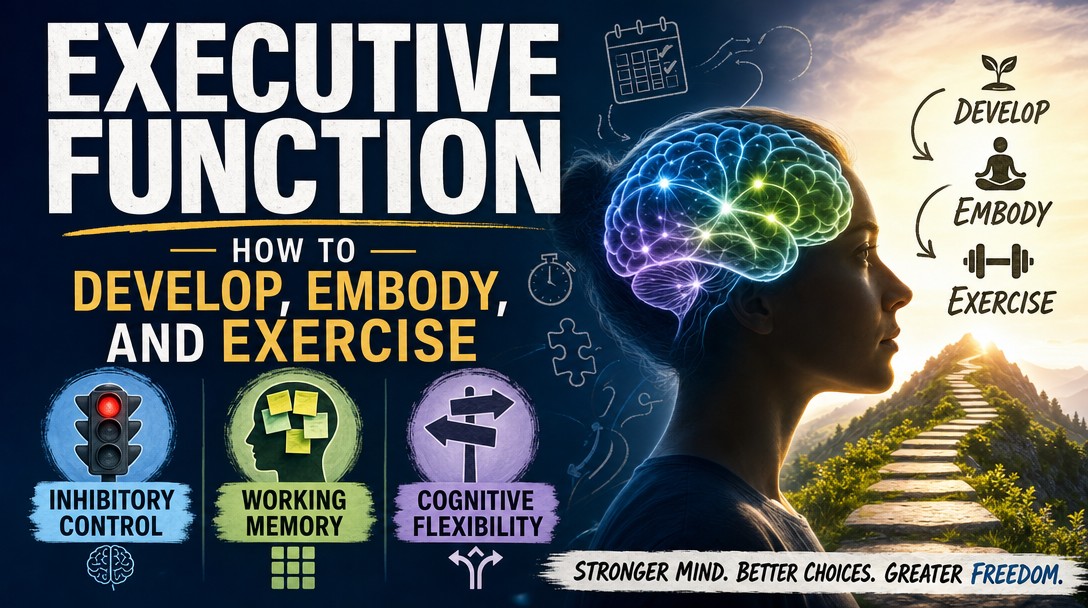
Executive Function: How to Develop, Embody, and Exercise Inhibitory Control, Working Memory, and Cognitive Flexibility
An in-depth look at how inhibitory control, working memory, and cognitive flexibility work together, with research, hypothetical scenarios, and reflection exercises.
| Cognition | 16 min read
You're in a conversation that's starting to go sideways. Someone says something that lands wrong, and for a fraction of a second you feel the retort forming, fully worded, before you've decided whether to say it. A minute later you're holding three things at once: the point you meant to make five minutes ago, the errand waiting for you after this, and the words the other person is saying right now. One of them slips. Then the conversation turns in a direction you didn't expect, and you hear yourself still arguing for a plan the conversation left behind a while ago.
Each of these moments is ordinary, brief, and easy to miss. Together they form the visible surface of executive function, the set of mental processes that let you guide your own thinking and behavior toward what you're actually trying to do. You've felt all three of its core capacities at work today, probably dozens of times, most of them below the level of notice. Inhibitory control is what caught (or didn't catch) that retort. Working memory is what held (or dropped) those three threads. Cognitive flexibility is what let you turn (or kept you from turning) when the conversation changed direction.
Researchers have spent decades studying each capacity on its own, and the findings are rich. What they reveal most clearly, though, is how thoroughly the three depend on one another, and how much the conditions of your life shape what any of them can do on a given day. Developing them asks for more than drills. It asks for a clearer view of how they move in you.
What Executive Function Describes
The term comes from neuropsychology, and it often turns up in diagnostic settings, attached to assessments and evaluations. Here it serves a plainer, descriptive purpose. Dr. Adele Diamond, a developmental cognitive neuroscientist at the University of British Columbia whose work has shaped much of the current understanding of this territory, describes executive functions as the effortful processes you draw on when running on autopilot or instinct would be unwise, insufficient, or impossible. Her synthesis of decades of research converges on three core capacities: inhibitory control, working memory, and cognitive flexibility. From those three, higher-order abilities like reasoning, problem-solving, and planning are built.
Diamond's reference to autopilot points toward how much of daily life runs without conscious direction. A great deal of what you do each day unfolds in Darkness, in the plain sense that it proceeds outside the reach of conscious awareness: the route you drive to work, the reach for your phone during a lull in conversation, the tone your voice takes when you feel criticized. Much of this is useful. Habit is efficient, and a mind that had to consciously decide every movement would never get anything done. Executive function comes into play at the specific points where automatic responses stop serving you, and what it does there is bring Light into a process that was running unseen. You notice the reach for the phone. You hear the defensive tone before it becomes a sentence. The response that was about to happen on its own becomes something you can see, and what you can see, you can choose about.
Each of the three capacities brings Light to a different part of that process. Inhibitory control illuminates the impulse. Working memory keeps your goal lit while other demands compete for attention. Cognitive flexibility reveals the other paths available when the one you're on stops leading anywhere useful. They can be studied separately, and each has its own texture, but in practice they rarely work alone. Strong inhibitory control paired with a strained working memory leaves you able to stop yourself and unable to remember what you were stopping for. Ample working memory without flexibility leaves you holding a plan with great precision long after the situation has changed around it.
Inhibitory Control: The Space Between Impulse and Action
Inhibitory control is your capacity to hold back an automatic or dominant response so a more fitting one has room to form. It's commonly mistaken for willpower, a fixed reserve of moral strength that some people simply have more of, and that misreading does real harm, because it turns an ordinary cognitive process into a verdict on character. Diamond's research describes inhibitory control as working on at least two levels. Interference control governs attention, letting you stay with what you've chosen to focus on when something else pulls at you. Response inhibition governs behavior, letting you stop yourself from acting on an impulse once it's already underway.
Picture yourself at your desk, reading a document that matters, when your phone lights up. Interference control is what keeps your eyes on the page. Say you glance anyway, and the notification is an email from someone whose tone consistently strikes you as condescending. You feel the reply assembling itself, sharp and satisfying. Response inhibition is what lets you close the email and return to your reading, leaving the reply unwritten until you can decide what you'd want it to accomplish. Your frustration stays with you the whole time. What inhibitory control gives you is distance: a gap between stimulus and action wide enough for a considered response to take shape inside it.
That gap usually announces itself in the body first, which is where embodying this capacity begins. Before an impulse becomes an action, it tends to register physically: a tightening in the jaw, a lean forward in your chair, a quickening of breath, a thumb already moving toward the screen. These sensations may be your earliest and most reliable signal that a dominant response is about to take over, and learning your own versions of them turns inhibitory control from an abstract ability into something you can feel yourself doing. I've noticed that my own urge to interrupt someone shows up as a slight intake of breath, a fraction of a second before any words exist. Catching the breath is far easier than catching the sentence.
Walter Mischel's delay-of-gratification studies at Stanford, begun in the late 1960s with preschoolers choosing between one marshmallow now and two later, are frequently cited as evidence that early inhibitory control predicts favorable outcomes across a lifetime. The story has grown more complicated since. Celeste Kidd and her colleagues at the University of Rochester found that children who had just watched an adult break a small promise waited far less time than children whose adult had kept one. Then, in 2018, Tyler Watts, Greg Duncan, and Haonan Quan revisited Mischel's question with a larger, more diverse sample and found the long-term relationship considerably weaker once family background and early cognitive ability were accounted for. A child raised where promised rewards reliably arrive has good reason to wait for the second marshmallow. A child whose experience has taught that promises often go unkept has equally good reason to take the first. The capacity to delay is shaped by whether patience has historically paid off, which makes it as much a response to lived conditions as an individual trait.
Inhibitory control also keeps maturing well past childhood, since the prefrontal regions that support it continue developing into early adulthood. And it fluctuates within a single day. You likely have more of it on a rested morning than at the end of a draining afternoon, and more when you feel safe than when you feel threatened. Recognizing that variation lets you read your lapses as information about conditions instead of evidence of failure.
Working Memory: Holding the Pieces While You Think
Working memory is your capacity to hold information in an active, accessible state while you use it: comparing it, rearranging it, relating it to something else. Long-term memory functions as a vast storehouse, and short-term memory holds material more passively. Working memory is where information gets worked on. In 1974, Alan Baddeley and Graham Hitch proposed a model with several components: a phonological loop that holds verbal and auditory material, a visuospatial sketchpad for images and spatial arrangements, and a central executive coordinating between them. Baddeley later added an episodic buffer, a space where information from these sources, and from long-term memory, can be bound together into a coherent scene.
The system's capacity is strikingly small. Nelson Cowan's research at the University of Missouri suggests that most adults can hold only around four meaningful chunks of information in focus at once. Imagine cooking a meal with rice that needs stirring at intervals, a sauce that can scorch if left alone, vegetables roasting on a timer, and a conversation with someone leaning against the counter. That's four threads, right at the edge of capacity, and when something drops, it's usually whatever has been quietest. The sauce scorches because it asked for nothing, right up until the moment it asked for everything.
Holding information in working memory behaves much like holding heat. A pan pulled off the burner begins losing warmth to the room immediately, and it stays hot only as long as something keeps supplying energy. Information in working memory fades the same way once attention moves elsewhere, persisting only through continual renewal: the silent repetition of a phone number, the returning glance at the sauce. Attention is the heat source. Spread it across too many pans and none of them stays warm enough, which is precisely what overload feels like from the inside.
Your available capacity also shifts with your state. John Sweller's cognitive load theory, developed at the University of New South Wales, describes how the demands of a task compete for this limited space, and Michael Eysenck's attentional control theory adds that anxiety draws on the same resources, leaving less room for whatever you're trying to do. Worry takes up residence in working memory, circling and rehearsing, and every loop spends attention that could have gone elsewhere. When you forget something during a stressful week, or lose the thread of a conversation while something heavy sits on your mind, you're experiencing a finite system under strain. Seen that way, those moments call for less self-criticism and more practical support.
One of the most effective forms of that support is also one of the simplest. Evan Risko of the University of Waterloo and Sam Gilbert of University College London describe cognitive offloading, the practice of moving information out of your head and into the world: a written list, a note on the counter, a timer set for the sauce. Their review of the research suggests offloading frees working memory for the thinking itself, the comparing, deciding, and connecting, instead of spending its scarce capacity on retention. A few words on a page can hold a thread steady while your attention does something more useful. Offloading carries trade-offs, since information you never hold internally is less likely to be remembered later, but for the ordinary juggling of a full day, externalizing the load is a sensible use of the tools around you.
Cognitive Flexibility: Changing Course When Conditions Change
Cognitive flexibility is your capacity to shift your thinking, attention, or approach in response to new information or changing demands. Researchers sometimes call it set-shifting: moving from one way of seeing a situation to another without getting stuck in the first frame. One of the oldest measures of it, the Wisconsin Card Sorting Test, asks people to sort cards by a rule they have to infer, then quietly changes the rule partway through. People who struggle with flexibility keep sorting by the old rule even as the feedback tells them, card after card, that it no longer works.
The same pattern shows up well outside the laboratory. Picture arriving at a meeting thoroughly prepared, with a clear plan for how the conversation should go. The other person opens with information that reframes everything: an unexpected constraint, a shift in priorities, a piece of context you had no way of knowing. Flexibility is what lets you set down your prepared plan and build a new approach in real time. Its absence looks like pressing on as though nothing has changed, sometimes because letting go of the plan feels like admitting it was wrong. The plan was sound. It was built for conditions that stopped existing ten minutes ago.
Habit carves its own terrain, much the way water carves a riverbed. Each time water flows through a channel, it deepens that channel a little, and the deeper channel draws more of the next flow toward it. Thought and behavior follow the same pattern: every repetition of a familiar response makes the next repetition more likely, which is efficient right up until the landscape changes. Cognitive flexibility is the capacity to let water find a new course when something blocks the old one, and it takes effort because the old channel is still there, still deep, still pulling. Rigidity, seen this way, is the ordinary consequence of well-worn paths, and your mind follows the terrain it has carved.
Diamond's research indicates that cognitive flexibility develops later than the other two capacities and draws on both of them. Setting aside the original plan requires some inhibitory control. Holding the old framework and the new information side by side long enough to compare them requires working memory. Flexibility is partly constructed from the other two, which makes it the clearest illustration of how interdependent the whole system is.
It also carries a relational dimension. When you disagree with someone, flexibility shows up as the ability to step inside their reasoning long enough to understand why their position makes sense from where they stand. You can do this without agreeing with them at all; what it asks is that you temporarily hold a frame other than your own, the same shift the card sorter makes, applied to a person instead of a rule. You may find that practicing this kind of perspective-taking in low-stakes disagreements makes the high-stakes ones easier to move through.
How Executive Function Skills Work Together
Consider a moment that calls on all three at once. You're in a difficult conversation with a family member about a disagreement that's been running for years. Partway through, they say something that triggers a familiar defensive reaction, the same one that has derailed this conversation before. Inhibitory control lets you notice the reaction forming and hold off on acting from it. Working memory keeps your actual goal in view, perhaps repair, perhaps simply understanding, while the emotional charge of the moment pulls your attention toward winning the point. Cognitive flexibility lets you recognize that your usual approach hasn't worked and try something new, like asking a real question where you'd normally restate your position.
Inhibitory control creates the space. Working memory holds the thread. Cognitive flexibility redirects the path. Weaken any one, and the whole exchange tends to suffer. Akira Miyake and Naomi Friedman at the University of Colorado Boulder describe this pattern as the unity and diversity of executive functions. Their research finds the capacities correlated, sharing a common underlying component, while each retains something distinct. They draw from shared ground and do different jobs on it.
Because of that shared ground, strengthening one capacity can ripple into the others, though rarely in a tidy or predictable way. As a reflexive reaction claims less of your attention, more remains available for holding goals and adjusting course. The movement is recursive: forward, then circling back, then slipping under stress, then consolidating again at a slightly different level. If you've ever felt you'd finally learned to stay calm in a certain kind of argument, only to lose that calm entirely during an exhausting month, you've seen this recursion firsthand. The earlier progress was still there, waiting for conditions that would let it show up again.
The Conditions That Shape Executive Function
Any account of executive function that treats it purely as individual achievement leaves out something essential. Amy Arnsten's research at Yale has shown how stress alters the prefrontal cortex's chemistry, weakening the networks that support working memory and flexible thinking while strengthening older, more reflexive circuits that favor habitual and emotional responses. Under sustained stress, the capacities described here become hardest to reach, and stress tends to arrive when they're most needed: during financial strain, unstable housing, caregiving, illness, or loss.
Sendhil Mullainathan and Eldar Shafir documented a related effect they describe as the bandwidth cost of scarcity. In one study, sugarcane farmers in India performed noticeably worse on cognitive tests before their harvest, when money was tight, than after it, when it wasn't, even though they were the same people with the same abilities. Scarcity of money, time, or security occupies mental space the way worry does, and a mind constantly calculating how to make rent has less left over for everything else.
Sleep deprivation produces similar effects, as does chronic pain, as does prolonged uncertainty. So does isolation: John Cacioppo's research at the University of Chicago linked chronic loneliness to diminished executive functioning. Someone who seems unable to regulate a reaction, keep a plan in mind, or adapt to change may be carrying conditions that have drained the resources those capacities depend on. Development remains possible under strain. It happens within a context, though, and tending to that context, through rest, support, relief, and connection wherever they're available, belongs to the work as fully as any practice does.
How to Develop Executive Function Through Practice
The research on strengthening these capacities is encouraging within honest limits. In a 2011 review published in Science, Adele Diamond and Kathleen Lee examined interventions ranging from computerized training and aerobic exercise to martial arts, mindfulness practice, and classroom curricula built around self-regulation. Several produced measurable improvements. The gains tended to be modest, specific to the capacities being exercised, and dependent on practice that kept increasing in challenge. No single activity developed all three equally, and none came with a timeline.
Diamond also observed that the most effective programs went beyond training cognition. They tended to reduce stress, build joy and confidence, offer a sense of belonging, and involve the body. Traditional martial arts, dance, and music combine sustained attention, memory, and adaptation with physical engagement and social connection, and they seem to work partly because they nourish the whole person. In her framing, executive function suffers when you're sad, stressed, lonely, or physically unwell, and it flourishes when those needs are met. Exercising these capacities and caring for the life they operate within turn out to be one project.
If you'd like a way to bring all three into conscious practice together, you might experiment with a simple sequence the next time tension builds, whether in a conversation, a task, or your own mind. It draws loosely on principles shared by acceptance and commitment therapy and cognitive behavioral approaches to self-regulation, and it's meant to be adapted to your circumstances. Begin by noticing the physical signal, the tightening jaw or quickened breath, and naming what's happening internally, something as plain as "there's the urge to push back." Give it three full seconds before deciding anything. That pause is inhibitory control at work, and all it has to do is let you see the impulse clearly; overriding it is optional. Then ask yourself what you're trying to accomplish in this moment, and hold that goal deliberately, jotting it down if the situation allows, so it stays lit beneath the pull of the reaction. Next, consider whether your usual approach serves that goal here, or whether the moment calls for something different: a question in place of an argument, a pause in place of a decision, another person's frame held alongside your own. Then choose a response and act on it.
Afterward, without scoring yourself, notice what happened. Did the pause hold, and did your goal stay in view once the charge of the moment arrived? Were you able to adjust, or did the familiar pattern reassert itself even as you recognized it? Each answer tells you something about how these capacities work in you specifically, under your particular pressures. Practiced now and then, the sequence tends to ask less of you over time, because the capacities it draws on strengthen with repeated, deliberate use.
Living With an Imperfect System
No one exercises these three capacities consistently well. There will be conversations where inhibitory control fails and you say the thing you wish you hadn't. There will be days when working memory buckles under real overload and something important slips away. There will be moments when flexibility arrives too late and you realize you've followed a plan well past the point where it served anyone. All of this is the ordinary behavior of a finite system operating under real constraints, subject to fatigue, stress, and the unpredictability of being a person in a complicated world.
What seems to matter more than any single lapse is the ability to look back at it clearly, to see what happened and why without collapsing that recognition into self-judgment. That kind of review is executive function turned toward your own experience: pausing before the verdict, holding the details of what happened, and considering explanations other than the harshest one. Each honest look at a lapse makes the next one a little easier to see coming.
Where This Leaves You
Somewhere in the space between the reaction you almost had and the one you chose, between the plan you made and the moment it stopped fitting, these three capacities are doing quiet, continuous work. Most of the time you won't notice them. They become visible when something goes wrong, and, less often remarked on, when something goes unexpectedly well: when the sharp reply stays unsent, when all four threads make it to the table, when you hear yourself ask a question that changes the direction of a conversation you'd been losing for years.
What you can carry from all of this is a way of paying attention. Your impulses announce themselves in your body before they become actions. Your working memory holds only so much, and offloading what you can leaves more room for thought. Your habits carve channels, and new courses take effort because the old ones run deep. Around all of it sit the conditions of your life, the rest, safety, and connection that give these capacities something to draw on.
Living intentionally depends on this quiet work: bringing Light to what would otherwise run on its own, holding what matters while everything else competes for attention, and turning when the terrain turns. None of it is ever finished. You'll keep changing, your circumstances will keep shifting, and the way these capacities move in you will shift along with them. Every time you catch yourself mid-reaction and choose, even slightly, what happens next, you widen the space where your own life gets decided.
Keep reading
- Understanding Attention Fragmentation: A Beginner's Guide
- Consciousness and Cognition: Identity, Mind, & The Space Between Them
- How to Break Free from the Mental Birdcage: Release From Learned Helplessness & Limiting Beliefs
- Cognitive Flexibility and Its Powerful Impact on Mental Health
- Contemplation, Metacognition, & Cognitive Differentiation
- The Sacred Gift of Conscious Choice: Intentional Living Through Deliberate Decisive Action
- The Zeus in You: Why the Old Gods Still Describe the Mind
- Why I Am Guilty of Having No Shame